
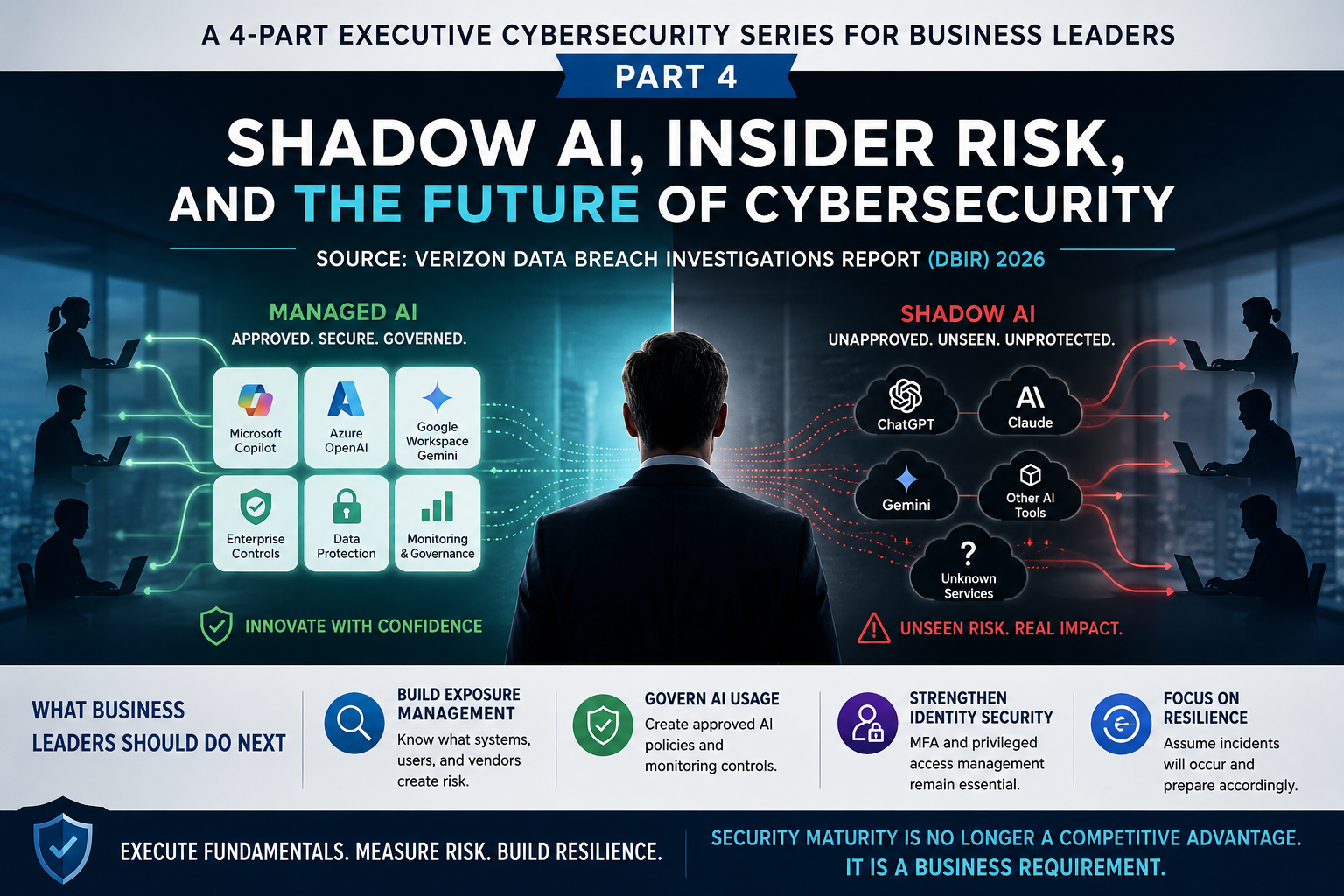
Source: Verizon Data Breach Investigations Report (DBIR) 2026
Shadow AI, Insider Risk, and the Future of Cybersecurity
Cybersecurity leaders often focus on external threats.
But one of the fastest-growing risks now originates inside the organization.
The Verizon 2026 DBIR highlights a new challenge:
Shadow AI.
Employees Are Using AI at Scale
The adoption of AI tools has accelerated dramatically.
According to the report:
45% of employees are now regular AI users on corporate devices
Up from just 15% the previous year
67% access AI services using non-corporate accounts on company devices
This creates a visibility and governance challenge.
Shadow AI Is Becoming a Data Leakage Problem
Shadow AI refers to employees using unauthorized AI tools without organizational approval.
The DBIR found:
Shadow AI is now the third most common non-malicious insider action detected in DLP programs
The frequency increased fourfold year-over-year
Employees often upload:
Source code
Images
Structured business data
Technical documentation
Research materials
In many cases, users don't realize they may be exposing intellectual property.
Insider Risk Is Evolving
Not all insider threats are malicious.
Many involve:
Convenience
Productivity shortcuts
Misconfiguration
Lack of awareness
As AI adoption grows, organizations must balance innovation with governance.
The goal is not to ban AI.
The goal is to enable safe AI usage.
The Cybersecurity Fundamentals Still Win
Perhaps the most important conclusion from the 2026 DBIR is surprisingly simple.
Despite ransomware, AI, third-party risk, and advanced threats, the report repeatedly emphasizes that strong fundamentals remain the most effective defense.
Those fundamentals include:
Asset visibility
Vulnerability management
MFA deployment
Least privilege
Security awareness
Incident response planning
Third-party risk management
What Business Leaders Should Do Next
Build an Exposure Management Program
Know what systems, users, and vendors create risk.
Govern AI Usage
Create approved AI policies and monitoring controls.
Strengthen Identity Security
MFA and privileged access management remain essential.
Focus on Resilience
Assume incidents will occur and prepare accordingly.
Final Thoughts
The Verizon 2026 DBIR reinforces a powerful lesson:
Cybersecurity is not failing because organizations lack tools.
It is failing because attackers are moving faster than many organizations can adapt.
The winners in 2026 and beyond will not be those chasing every new technology trend.
They will be the organizations that execute cybersecurity fundamentals consistently, measure risk continuously, and build resilience into every business process.
Security maturity is no longer a competitive advantage. It is a business requirement.
Ready to see where your company defenses stand?
👉 Request your customized cyber vulnerability report today and stay ahead of threats.
👉 Gain insights into your unique cybersecurity vulnerabilities with a custom report.
👉 Train your team to be your first line of defense
📞 Schedule a call today or 📧 contact us for a consultation.