
Source: Verizon Data Breach Investigations Report (DBIR) 2026
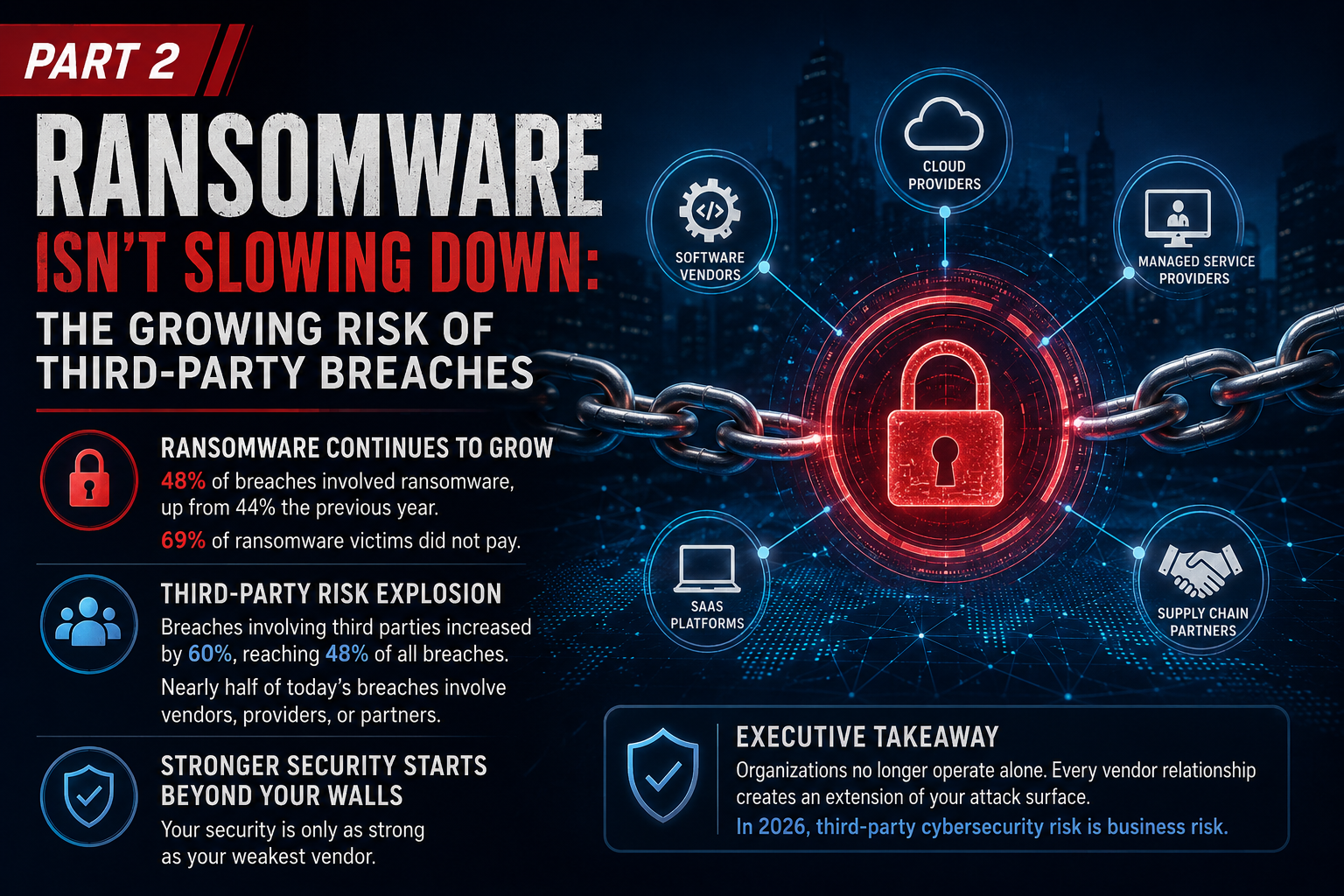
Ransomware Isn't Slowing Down
The Growing Risk of Third-Party Breaches
Many cybersecurity headlines focus on sophisticated nation-state attacks.
The reality is much simpler.
Most organizations today are far more likely to be impacted by ransomware or a compromised vendor than by a Hollywood-style hacking operation.
The Verizon 2026 DBIR confirms that trend.
Ransomware Continues to Grow
Despite years of defensive investments, ransomware remains one of the most successful cybercrime business models ever created.
The report found:
48% of all breaches involved ransomware, up from 44% the previous year.
Almost one out of every two breaches now includes ransomware.
However, there is a positive development.
The percentage of victims paying ransoms continues to decline.
According to Verizon:
69% of ransomware victims did not pay
Median ransom payments decreased to $139,875
Organizations are becoming better prepared for recovery.
The Third-Party Risk Explosion
Perhaps the most important finding in the report is not ransomware.
It's third-party exposure.
Breaches involving third parties increased by 60% year-over-year, reaching 48% of all breaches.
Nearly half of today's breaches involve:
Software vendors
Cloud providers
Managed service providers
SaaS platforms
Supply chain partners
In other words:
Your security is increasingly dependent on organizations you don't control.
Why Vendors Become Attack Paths
The DBIR describes three common scenarios:
Vendor Software Is Exploited
Attackers leverage vulnerabilities within trusted software.
Vendor Systems Are Breached
Your data resides in a provider's environment and becomes exposed.
Vendor Access Is Misused
Attackers compromise vendor credentials and pivot into customer environments.
All three continue to increase.
The MFA Problem
One recurring theme appears throughout the report:
Poor authentication controls.
Verizon found that many third-party breaches involve:
Missing MFA
Weak passwords
Excessive permissions
Poor credential management
Even among third parties:
Only 23% fully remediated MFA-related issues
Password and permission issues often remained unresolved for months
Executive Takeaways
Evaluate Vendors Like Attackers Do
Assess authentication, privilege management, and incident response capabilities.
Require MFA Everywhere
Especially for privileged accounts and service accounts.
Review Vendor Access
Regularly validate who has access to sensitive systems and data.
Build Third-Party Risk Management Programs
Vendor security reviews should become a routine business process.
Final Thought
Organizations no longer operate alone.
Every vendor relationship creates an extension of your attack surface.
In 2026, third-party cybersecurity risk is business risk.
In Part 3, we'll examine how AI is changing cybercrime and why mobile-based social engineering is becoming more successful than traditional phishing.
Ready to see where your company defenses stand?
👉 Request your customized cyber vulnerability report today and stay ahead of threats.
👉 Gain insights into your unique cybersecurity vulnerabilities with a custom report.
👉 Train your team to be your first line of defense
📞 Schedule a call today or 📧 contact us for a consultation.