
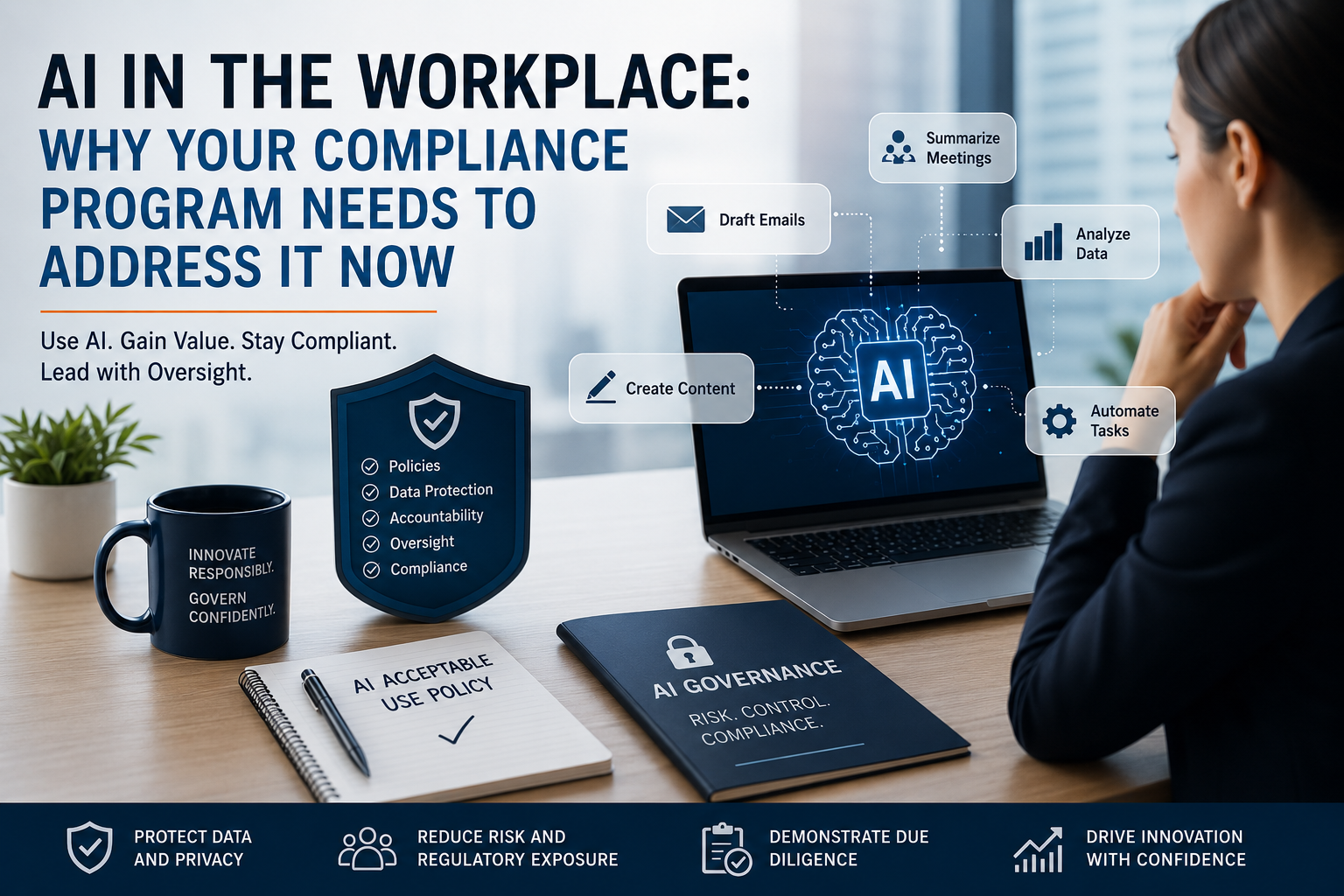
Artificial intelligence is quickly becoming part of everyday business operations. Employees are using AI tools to draft emails, summarize meetings, create marketing content, analyze data, and automate routine tasks.
In many cases, business owners don't even realize how often AI is being used.
While AI can improve efficiency and productivity, it also introduces new compliance, privacy, and governance challenges that many organizations are unprepared for.
The question is no longer whether your employees are using AI.
The question is whether your business has the policies, controls, and oversight needed to use it responsibly.
AI Adoption Is Creating New Compliance Risks
Most compliance frameworks are designed to help organizations manage risk, protect sensitive information, and maintain accountability.
AI changes how information is processed, shared, and generated, which means it directly impacts many of the controls organizations already have in place.
Consider a few common scenarios:
An employee uploads customer information into a public AI tool to create a report.
A manager uses AI-generated content without verifying its accuracy.
A marketing team relies on AI to create customer communications that contain incorrect information.
Employees use multiple AI platforms without approval or oversight.
None of these actions may be malicious, but each can create compliance concerns involving data protection, privacy, record management, intellectual property, and regulatory requirements.
For many organizations, AI has become the newest form of "shadow IT" — technology being used without management visibility or approval.
Compliance Is About More Than Security
When people think about AI risks, they often focus on cybersecurity.
Security is certainly important, but compliance professionals must look beyond cyber threats.
A well-managed compliance program should address questions such as:
What information can employees enter into AI systems?
Who is responsible for reviewing AI-generated content?
How is AI use documented and monitored?
Are vendors providing adequate protection for business data?
Does AI use align with regulatory requirements and contractual obligations?
Without clear answers, organizations may unknowingly create gaps in their compliance posture.
Why Policies Matter Before Technology
Many businesses begin by selecting AI tools.
From a compliance perspective, that is often the wrong starting point.
Before deploying any AI platform, organizations should establish expectations for how AI can be used within the business.
An AI Acceptable Use Policy should clearly define:
Approved AI applications and platforms
Prohibited uses of AI
Data types that may not be entered into AI systems
Requirements for human review and validation
Employee responsibilities when using AI-generated content
Reporting procedures for AI-related concerns
Policies create consistency, accountability, and documentation—all critical components of a mature compliance program.
Data Governance Becomes Even More Important
One of the biggest compliance concerns surrounding AI involves data handling.
Employees often treat AI tools like search engines or digital assistants, entering information without considering where that data goes or how it may be stored.
Before allowing AI use, organizations should identify:
Sensitive customer information
Financial records
Employee data
Intellectual property
Proprietary business information
Contractually protected information
If employees are unclear about what information can be shared with AI systems, compliance risks increase significantly.
Strong data governance helps prevent accidental disclosures and supports regulatory requirements related to privacy and confidentiality.
AI Governance Is Becoming a Compliance Expectation
Regulators, auditors, customers, and business partners are beginning to ask questions about AI governance.
Organizations that can demonstrate oversight will be better positioned than those that cannot explain how AI is being used within their environment.
An effective AI governance program should include:
Risk Assessments
Evaluate how AI tools may impact privacy, security, operations, and regulatory obligations.
Vendor Reviews
Understand how AI providers collect, process, retain, and protect business information.
Employee Training
Help employees understand both the benefits and risks associated with AI use.
Ongoing Monitoring
Regularly review how AI tools are being used and whether established policies are being followed.
Documentation
Maintain records of policies, assessments, approvals, and training activities.
These practices align with the same governance principles already found in frameworks such as NIST, ISO 27001, SOC 2, HIPAA, and CMMC.
AI Is Not a Compliance Problem—Unmanaged AI Is
Organizations do not need to avoid AI.
In fact, businesses that responsibly adopt AI will likely gain operational advantages over competitors that do not.
The real risk comes from allowing AI adoption to happen without structure, oversight, or accountability.
When compliance teams take an active role in AI governance, organizations can:
Improve productivity while maintaining control
Protect sensitive information
Demonstrate due diligence to customers and auditors
Reduce legal and regulatory exposure
Support responsible innovation across the organization
Final Thoughts
AI is rapidly becoming another business tool, much like email, cloud storage, and collaboration platforms before it.
The organizations that benefit most from AI will not necessarily be the ones using the most advanced technology. They will be the ones that implement it with clear policies, strong governance, and effective oversight.
From a compliance perspective, AI should be treated like any other business process that handles information and influences decisions: it requires accountability, documentation, and risk management.
If your organization is already using AI—or suspects employees may be using it informally—now is the time to evaluate whether your compliance program is prepared for the challenges and opportunities that come with it.
Because in 2026, the question is no longer whether AI belongs in your business.
The question is whether your compliance program is ready for it.
Ready to see where your company defenses stand?
👉 Request your customized cyber vulnerability report today and stay ahead of threats.
👉 Gain insights into your unique cybersecurity vulnerabilities with a custom report.
👉 Train your team to be your first line of defense
📞 Schedule a call today or 📧 contact us for a consultation.