Artificial intelligence

When the Bots Start Doing Billy’s Job (Part 4)

Written by:  William White, CISSP

Chief Technology Officer, Ultimate Risk Services

(Part 4 in our AI vs AI series)

Don’t Let AI Create Your CMMC Policies 

Why Letting AI Write Your CMMC Cybersecurity Policies Is a Risky Shortcut

There’s a growing temptation in cybersecurity circles: “Why not just have AI write our policies?”

After all, AI is fast, fluent, and can generate documents that look like they were written by a committee of very serious people who use phrases like “robust control framework” without irony.

For many use cases, that’s fine.

But if you’re aiming for CMMC compliance, letting AI take the wheel on your cybersecurity policies is less “efficiency hack” and more “creative way to fail an assessment.”

Let’s talk about why you should leave your CMMC policies to the professionals. 

1. CMMC Is Not a Template Exercise

CMMC (Cybersecurity Maturity Model Certification) isn’t just a checklist you casually breeze through with a well-formatted document. It’s a structured framework with very specific practices and processes that must be implemented and demonstrable.

AI tends to approach policy writing like this:

“Here is a very professional, generally applicable policy that sounds correct.”

CMMC assessors approach it like this:

“Show me exactly how your organization satisfies this specific requirement.”

That gap between generic correctness and specific applicability is where AI-generated policies tend to fall apart. 

2. “Mostly Covered” Is the Same as “Not Covered”

AI is very good at getting things mostly right.

Unfortunately, CMMC is very good at penalizing “mostly.”

Each control has nuances:

  • Specific documentation expectations

  • Defined roles and responsibilities

  • Evidence of implementation

  • Alignment with your actual environment

AI might:

  • Combine multiple requirements into one vague statement

  • Miss subtle distinctions between similar controls

  • Omit edge-case requirements that still count

And in an assessment, missing even part of a requirement isn’t partial credit—it’s a finding. 

3. Your Environment Is Weird (And AI Doesn’t Fully Know How)

Every organization believes they aren’t unique with their general IT needs. Most aren’t wrong… arguably.

However, when it comes to cybersecurity environments, everyone is weird in their own very specific, very compliance-relevant ways.

You might have:

  • A hybrid cloud/on-prem setup with legacy systems

  • Contract-specific data handling requirements

  • Third-party dependencies that complicate control ownership

  • Operational workarounds that never made it into official diagrams

AI doesn’t see any of that unless you explicitly and exhaustively tell it; and, even then, it may not interpret those nuances correctly.

So it writes policies for an idealized version of your organization.
CMMC evaluates the real one. 

4. CMMC Requires Traceability, Not Just Readability

A good CMMC policy isn’t just readable… it’s traceable.

You need to be able to map:

  • Each policy statement → to a specific CMMC control

  • Each control → to implementation evidence

  • Each implementation → to actual system behavior

AI-generated policies often lack this precision. They sound comprehensive, but they aren’t structured for:

  • Control-by-control validation

  • Audit defensibility

  • Clear evidence mapping

In other words, they look good right up until someone asks, “Where exactly do you address AC.L2-3.1.1?” and the answer is… “somewhere in paragraph four, probably.” 

5. AI Doesn’t Understand the Auditor’s Mindset

CMMC compliance isn’t just about meeting requirements; it’s about proving you meet them.

That means thinking like an assessor:

  • What questions will they ask?

  • Where will they look for gaps?

  • What counts as sufficient evidence vs. hand-waving?

AI doesn’t have audit anxiety. It doesn’t anticipate scrutiny. It doesn’t write with the quiet paranoia that comes from knowing someone will try to poke holes in every sentence.

Humans who’ve been through audits do.

And that experience shows up in how policies are written… Tight, explicit, and defensible. 

6. The Hidden Risk: False Confidence

This might be the most dangerous part.

AI-generated policies often look so polished that they create a false sense of security:

  • “This seems comprehensive.”

  • “We’ve covered everything.”

  • “We should be good for the assessment.”

But compliance failures rarely come from obviously bad policies.
They come from subtle gaps that weren’t caught early.

AI doesn’t raise its hand and say:

“I might have missed a requirement that will cost you certification.”

It just keeps writing confidently. 

7. Where AI Can Help (Without Getting You in Trouble)

To be fair, AI isn’t the villain here, it’s just being over-trusted.

Used correctly, it’s actually quite helpful:

  • Drafting initial policy language

  • Translating technical controls into plain English

  • Suggesting structure aligned to frameworks

  • Highlighting potential gaps (as a second opinion, not the final one)

But the key word is assist.

Final policy ownership, especially for CMMC, needs to stay with someone who:

  • Understands the framework deeply

  • Knows your environment intimately

  • Can defend every line in front of an assessor 

Final Thought

If you let AI write your CMMC cybersecurity policies, you’ll likely end up with something that looks impressive, reads smoothly, and passes a quick glance test.

What you may not get is something that actually passes a CMMC assessment. And in the world of compliance, that distinction is everything. Because when the assessor walks in, they’re not grading your writing style.

They’re verifying your reality.

And that’s one test you don’t want AI taking on your behalf. Let the pros handle that for you.


When the Bots Start Doing Billy’s Job (Part 3)

Written by:  William White, CISSP

Chief Technology Officer, Ultimate Risk Services

(Part 3 in our AI vs AI series)

In a previous post (about getting your CISSP to keep your job), I stated:

“Try asking an AI to convince a senior executive to invest in a security initiative that won’t show ROI until after something bad happens. Exactly.”

But then I got to thinking again…hmmm…

Who would be more effective at convincing, a CISSP or a machine? This is within the per view of a CISO , after all.

Cybersecurity Tip!

Ready to see where your company defenses stand?

👉 Request your customized cyber vulnerability report today and stay ahead of threats.
👉 Gain insights into your unique cybersecurity vulnerabilities with a custom report.
👉 Train your team to be your first line of defense

📞 Schedule a call today or 📧 contact us for a consultation.

Cybersecurity Tip!

Ready to see where your company defenses stand?

👉 Request your customized cyber vulnerability report today and stay ahead of threats.
👉 Gain insights into your unique cybersecurity vulnerabilities with a custom report.
👉 Train your team to be your first line of defense

📞 Schedule a call today or 📧 contact us for a consultation.

AI in Cybersecurity: When the Bots Start Doing Billy’s Job- Part 1

Written by:  William White, CISSP

Chief Technology Officer, Ultimate Risk Services

(This is Part 1 in our AI vs AI series)

According to Challenger,  Gray and Christmas:

“In March, Artificial Intelligence (AI) led all reasons for job cuts, with 15,341 announced during the month, 25% of total cuts. Closings followed with 13,931, Restructuring was cited for 8,726, and Market and Economic Conditions accounted for 6,597 planned layoffs.” 

That got me thinking….. hmm…. 

ASK EZ2USEAII am a cybersecurity professional.  Read the attached article.  Then let me know what you ithink about my profession’s future. Will it be lost to an AI agent one day?  Is AIvAI Warfare going to make me obsolete? Should I be shitting tokens?

Cybersecurity Tip!

Ready to see where your company defenses stand?

👉 Request your customized cyber vulnerability report today and stay ahead of threats.
👉 Gain insights into your unique cybersecurity vulnerabilities with a custom report.
👉 Train your team to be your first line of defense

📞 Schedule a call today or 📧 contact us for a consultation.

Cybersecurity Tip!

Ready to see where your company defenses stand?

👉 Request your customized cyber vulnerability report today and stay ahead of threats.
👉 Gain insights into your unique cybersecurity vulnerabilities with a custom report.
👉 Train your team to be your first line of defense

📞 Schedule a call today or 📧 contact us for a consultation.

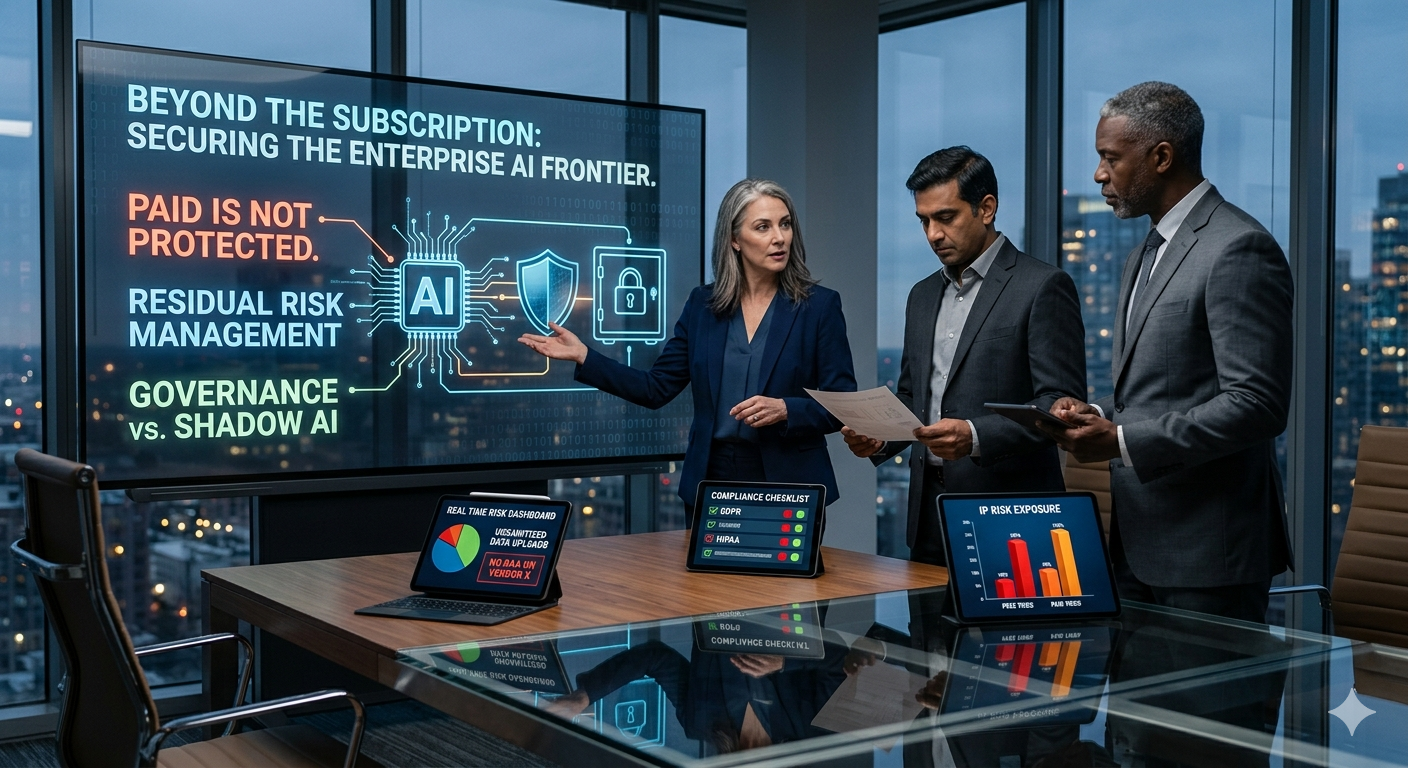
Beyond the Subscription: Why "Paid" AI is Not a Cybersecurity Strategy

Beyond the Subscription: Why "Paid" AI is Not a Cybersecurity Strategy

By 2026, 80% of enterprises have woven GenAI into the fabric of their operations. The efficiency gains are transformative, but for many organizations, these gains are built on a foundation of illusory security.

There is a pervasive C-Suite misconception: If we pay for Enterprise seats, our proprietary data is shielded. In reality, a paid subscription is merely a licensing agreement—not a comprehensive security posture. To protect shareholder value and intellectual property (IP), leadership must look past the "Enterprise" label.

The AI Security Shift: Protecting Your Business in 2026

The AI Security Shift: Protecting Your Business in 2026

In 2026, the cybersecurity landscape has undergone a tectonic shift. According to the World Economic Forum’s 2026 Global Cybersecurity Outlook, over 94% of security leaders now identify AI as the primary driver of cyber risk. Hackers are no longer just using scripts; they are deploying "Agentic AI"—autonomous bots that can scout, adapt, and attack with superhuman speed.

To help you navigate this, we’ve synthesized the latest 2026 guidance from the CISA (Cybersecurity and Infrastructure Security Agency), FBI, and NIST into an actionable defense plan.

Eight Lessons That Stood Out at The Official Cybersecurity Summit March 2026 in Dallas

Eight Lessons That Stood Out at  The Official Cybersecurity Summit March 2026 in Dallas

Spending a day at the Cybersecurity Summit in Dallas was like getting a tour through the most urgent realities of modern cyber defense. The venue was the Sheraton Dallas Hotel, but the conversations spanned everywhere from the cloud and APIs to AI threats and identity governance. Here’s what I took away from the sessions that mattered most.

Is Your Business AI-Proof? 5 Critical Cyber Threats Every Small Business Must Face in 2026

Is Your Business AI-Proof? 5 Critical Cyber Threats Every Small Business Must Face in 2026

The "honeymoon phase" of Artificial Intelligence is officially over. In 2026, AI is no longer just a productivity tool for your marketing team; it has become the primary weapon for global cybercrime syndicates.

For the modern small business, the question isn't whether you should use AI—it’s whether you can survive the version of AI being pointed at you.

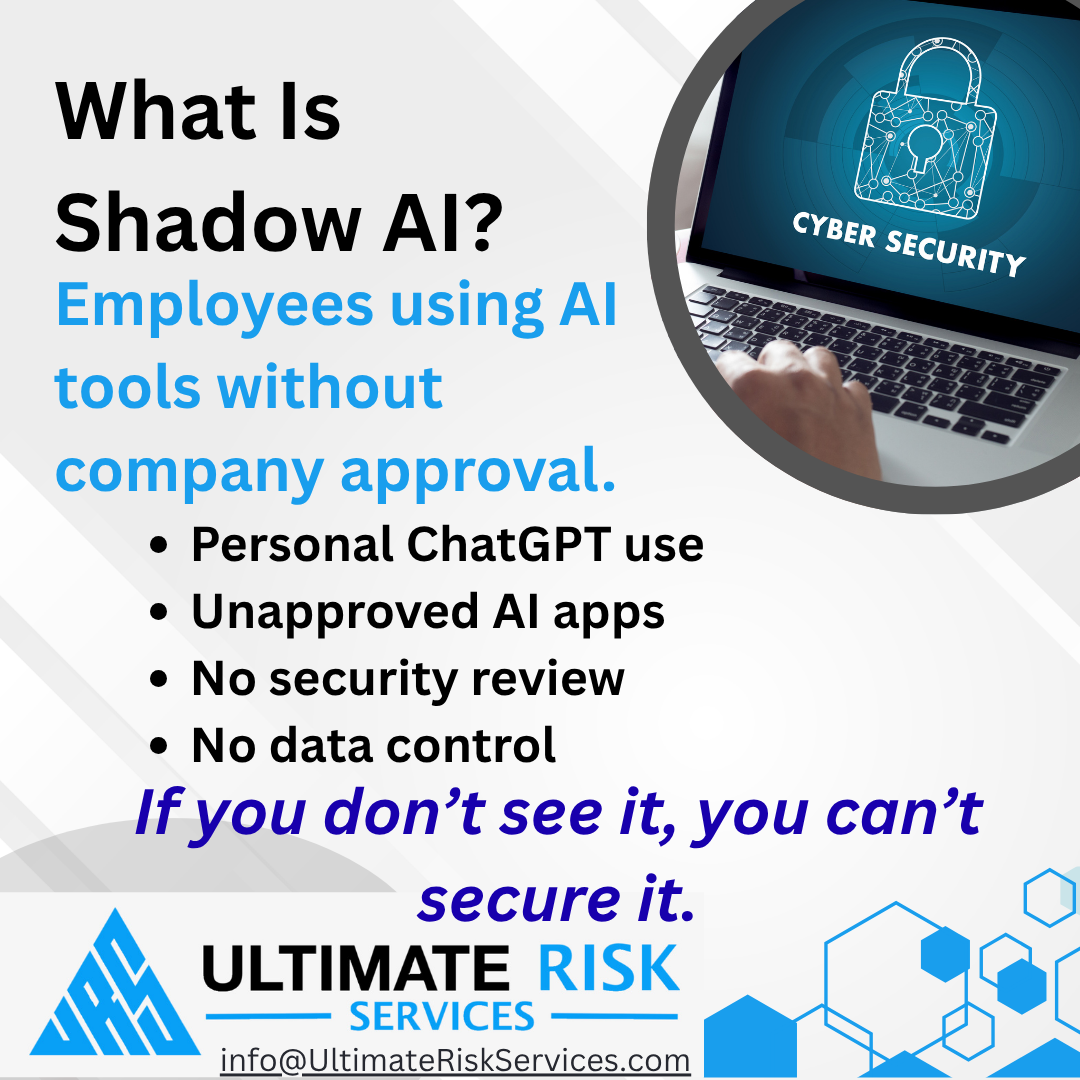
The AI Underground: Why "Shadow AI" is Your Next Big Security Headache

The AI Underground: Why "Shadow AI" is Your Next Big Security Headache

We’ve all been there: You have a deadline looming, a mountain of data to summarize, or a stubborn bug in your code. Then you remember that ChatGPT or Claude can solve it in thirty seconds.

You copy, you paste, and—poof—problem solved.

But for security teams, that "poof" is the sound of proprietary data vanishing into a black box. This is the world of Shadow AI, and it’s moving much faster than your traditional IT policies.

Cybersecurity Tip!

👉 Request your customized cyber vulnerability report today and stay ahead of threats.
👉 Gain insights into your unique cybersecurity vulnerabilities with a custom report.
👉 Train your team to be your first line of defense

📞 Schedule a call today or 📧 contact us for a consultation.

How NIST Is Redefining Cybersecurity and Compliance for the AI Era

How NIST Is Redefining Cybersecurity and Compliance for the AI Era

AI Is Changing Cybersecurity — Here’s What NIST Wants Organizations to Do About It

Why AI Changes the Compliance Conversation

Artificial Intelligence is no longer a “future technology.”
It’s already writing emails, analyzing data, approving transactions, and helping teams make decisions.

But here’s the problem most organizations haven’t addressed yet:

If AI becomes part of your business, it also becomes part of your cybersecurity risk—and your compliance responsibility.

That’s why NIST has released new draft guidance focused specifically on AI and cybersecurity, helping organizations understand how to use AI safely without breaking trust, rules, or regulations.

Top AI Data Security Risks and How to Mitigate Them in 2025

Top AI Data Security Risks and How to Mitigate Them in 2025

In an era where artificial intelligence (AI) systems are being increasingly integrated into critical infrastructure, enterprise operations, and even national security frameworks, AI data security has emerged as a vital concern. As highlighted by a coalition of cybersecurity authorities—including the NSA, CISA, FBI, ASD’s ACSC, NCSC-UK, and others—protecting the data that powers AI is no longer optional—it’s foundational.

Compliance Isn’t Enough—You Must Prove Your Cybersecurity Measures Work

Prove It or Lose It: Why Cybersecurity Compliance is More Than Just a Checkbox

Cybersecurity: More Than Just a Checked Box

Your organization has everything in place: a talented team, a strong mission, and a cybersecurity strategy that appears solid. But before you confidently check that cybersecurity box, ask yourself—can you prove it?

The cyber landscape is evolving at an alarming pace, and compliance is no longer a passive requirement. It’s an active necessity. Having security controls isn’t enough; you must document, validate, and be prepared to defend your security measures with tangible proof.

Boost Your Team’s Efficiency with Microsoft Copilot

Boost Your Team’s Efficiency with Microsoft Copilot

In today’s competitive business world, maximizing efficiency is crucial. Repetitive tasks and manual processes can slow down workflows and drain valuable time. Microsoft Copilot, an AI-powered assistant, offers a smart solution to help businesses streamline tasks and unlock greater productivity. By automating everyday responsibilities and enhancing data-driven decision-making, Copilot is designed to supercharge your team’s output.

Decoding the NYDFS Cybersecurity Regulation: Essential Compliance Insights

Decoding the NYDFS Cybersecurity Regulation: Essential Compliance Insights

The NYDFS Cybersecurity Regulation (23 NYCRR 500) represents a comprehensive framework established by the New York Department of Financial Services (NYDFS) to impose cybersecurity standards on all covered financial entities. Introduced on February 16th, 2017, following extensive feedback from industry stakeholders and the public, these regulations encompass 23 sections delineating the obligations for developing and executing an effective cybersecurity program. Covered institutions are mandated to assess their cybersecurity risks and devise proactive strategies to mitigate them. The regulation follows a phased implementation approach, allowing organizations ample time to fortify their policies and controls.

Adversarial AI: A New Threat To Your Business

Adversarial AI: A New Threat To Your Business

The rise of artificial intelligence (AI) has revolutionized various aspects of our lives, including cybersecurity. AI-powered solutions have become invaluable tools for threat detection, incident response, and proactive defense. However, as with any tool, AI itself introduces a new and concerning threat: adversarial AI.

Building Trust: Ensuring Ethical AI Development for Robust Security Solutions

Building Trust: Ensuring Ethical AI Development for Robust Security Solutions

n today's digital landscape, cybersecurity threats lurk around every corner. From phishing scams and malware attacks to data breaches and ransomware, businesses of all sizes are vulnerable. But amidst this rising tide of cybercrime, a powerful ally emerges: Artificial Intelligence.

AI-powered security solutions hold immense potential to revolutionize threat detection and prevention. From analyzing vast amounts of data to identifying intricate attack patterns, AI can bring unparalleled speed and accuracy to your cybersecurity defenses. However, as with any powerful tool, trust in AI is paramount for its successful implementation.