
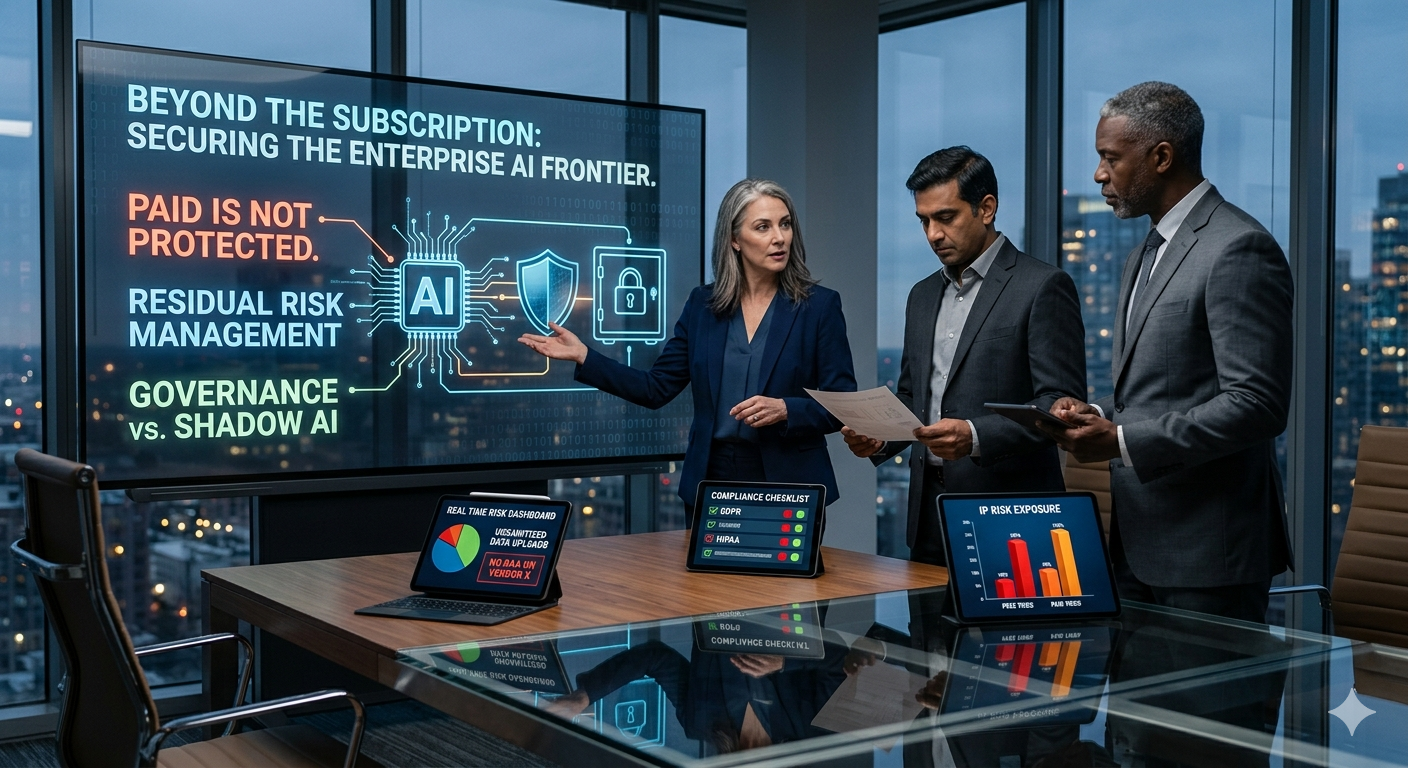
Source: Gartner, "AI Adoption in Enterprises 2026," March 2026.
By 2026, 80% of enterprises have woven GenAI into the fabric of their operations. The efficiency gains are transformative, but for many organizations, these gains are built on a foundation of illusory security.
There is a pervasive C-Suite misconception: If we pay for Enterprise seats, our proprietary data is shielded. In reality, a paid subscription is merely a licensing agreement—not a comprehensive security posture. To protect shareholder value and intellectual property (IP), leadership must look past the "Enterprise" label.
1. The Transparency Gap:Privacy is Not a Proxy for Security
While premium tiers from providers like OpenAI, Anthropic, and Microsoft offer "opt-outs" for model training, privacy is only one side of the coin.
Residual Risk: Most Enterprise agreements still allow for "Abuse Monitoring." This means your sensitive inputs may be stored in plain text for 30 days or reviewed by third-party human moderators.
The "Black Box" Problem: If an AI provider suffers a lateral breach, your "private" chat history becomes a roadmap for bad actors to navigate your internal strategy.
2. The Liability of Managed vs. "Shadow" AI
The greatest threat to your perimeter isn't the tools you’ve vetted; it’s Shadow AI. When corporate policies are too restrictive or procurement is too slow, high-performing teams use personal, "free-tier" accounts to hit their KPIs.
Data Bleed: Every time an employee "summarizes" a confidential M&A deck or "refines" proprietary code on a personal account, that IP is permanently ingested into the public model's training set.
Fiduciary Failure: As an officer of the company, ignoring Shadow AI is a failure of oversight that can lead to significant regulatory fines.
3. Compliance is Not "Out of the Box"
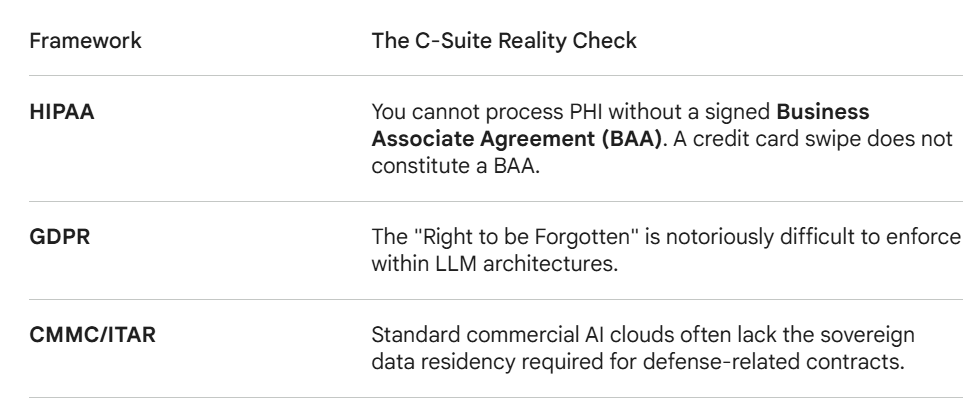
A "Paid" status does not automatically satisfy the rigorous demands of global regulators. Each framework requires active, documented management:
4. Moving from Adoption to Governance
To capture the ROI of AI without compromising the enterprise, leadership must champion a Layered Governance Framework:
Hard Guardrails (DLP): Implement Data Loss Prevention tools that automatically scrub PII, PCI, and API keys before they reach the AI prompt.
Zero Data Retention (ZDR): Negotiate contracts that ensure data is never cached or logged, moving beyond standard "Enterprise" terms.
The Human Firewall: Move beyond static training. Cultivate a culture where AI is viewed as an external contractor—never to be trusted with the "keys to the kingdom."
The Strategic Mandate
AI is a powerful tailwind, but it creates a new category of unforced errors. Success in 2026 requires more than a budget line item for AI subscriptions; it requires a governance-first mindset that treats data as your most volatile asset.
Does your current AI vendor agreement include a signed BAA and a zero-retention clause? If you don't know the answer, your data is at risk.
Ready to see where your company defenses stand?
👉 Request your customized cyber vulnerability report today and stay ahead of threats.
👉 Gain insights into your unique cybersecurity vulnerabilities with a custom report.
👉 Train your team to be your first line of defense
📞 Schedule a call today or 📧 contact us for a consultation.