Security

Cybersecurity Tip!

Ready to see where your company defenses stand?

👉 Request your customized cyber vulnerability report today and stay ahead of threats.
👉 Gain insights into your unique cybersecurity vulnerabilities with a custom report.
👉 Train your team to be your first line of defense

📞 Schedule a call today or 📧 contact us for a consultation.

When the Bots Start Doing Billy’s Job (Part 4)

Written by:  William White, CISSP

Chief Technology Officer, Ultimate Risk Services

(Part 4 in our AI vs AI series)

Don’t Let AI Create Your CMMC Policies 

Why Letting AI Write Your CMMC Cybersecurity Policies Is a Risky Shortcut

There’s a growing temptation in cybersecurity circles: “Why not just have AI write our policies?”

After all, AI is fast, fluent, and can generate documents that look like they were written by a committee of very serious people who use phrases like “robust control framework” without irony.

For many use cases, that’s fine.

But if you’re aiming for CMMC compliance, letting AI take the wheel on your cybersecurity policies is less “efficiency hack” and more “creative way to fail an assessment.”

Let’s talk about why you should leave your CMMC policies to the professionals. 

1. CMMC Is Not a Template Exercise

CMMC (Cybersecurity Maturity Model Certification) isn’t just a checklist you casually breeze through with a well-formatted document. It’s a structured framework with very specific practices and processes that must be implemented and demonstrable.

AI tends to approach policy writing like this:

“Here is a very professional, generally applicable policy that sounds correct.”

CMMC assessors approach it like this:

“Show me exactly how your organization satisfies this specific requirement.”

That gap between generic correctness and specific applicability is where AI-generated policies tend to fall apart. 

2. “Mostly Covered” Is the Same as “Not Covered”

AI is very good at getting things mostly right.

Unfortunately, CMMC is very good at penalizing “mostly.”

Each control has nuances:

  • Specific documentation expectations

  • Defined roles and responsibilities

  • Evidence of implementation

  • Alignment with your actual environment

AI might:

  • Combine multiple requirements into one vague statement

  • Miss subtle distinctions between similar controls

  • Omit edge-case requirements that still count

And in an assessment, missing even part of a requirement isn’t partial credit—it’s a finding. 

3. Your Environment Is Weird (And AI Doesn’t Fully Know How)

Every organization believes they aren’t unique with their general IT needs. Most aren’t wrong… arguably.

However, when it comes to cybersecurity environments, everyone is weird in their own very specific, very compliance-relevant ways.

You might have:

  • A hybrid cloud/on-prem setup with legacy systems

  • Contract-specific data handling requirements

  • Third-party dependencies that complicate control ownership

  • Operational workarounds that never made it into official diagrams

AI doesn’t see any of that unless you explicitly and exhaustively tell it; and, even then, it may not interpret those nuances correctly.

So it writes policies for an idealized version of your organization.
CMMC evaluates the real one. 

4. CMMC Requires Traceability, Not Just Readability

A good CMMC policy isn’t just readable… it’s traceable.

You need to be able to map:

  • Each policy statement → to a specific CMMC control

  • Each control → to implementation evidence

  • Each implementation → to actual system behavior

AI-generated policies often lack this precision. They sound comprehensive, but they aren’t structured for:

  • Control-by-control validation

  • Audit defensibility

  • Clear evidence mapping

In other words, they look good right up until someone asks, “Where exactly do you address AC.L2-3.1.1?” and the answer is… “somewhere in paragraph four, probably.” 

5. AI Doesn’t Understand the Auditor’s Mindset

CMMC compliance isn’t just about meeting requirements; it’s about proving you meet them.

That means thinking like an assessor:

  • What questions will they ask?

  • Where will they look for gaps?

  • What counts as sufficient evidence vs. hand-waving?

AI doesn’t have audit anxiety. It doesn’t anticipate scrutiny. It doesn’t write with the quiet paranoia that comes from knowing someone will try to poke holes in every sentence.

Humans who’ve been through audits do.

And that experience shows up in how policies are written… Tight, explicit, and defensible. 

6. The Hidden Risk: False Confidence

This might be the most dangerous part.

AI-generated policies often look so polished that they create a false sense of security:

  • “This seems comprehensive.”

  • “We’ve covered everything.”

  • “We should be good for the assessment.”

But compliance failures rarely come from obviously bad policies.
They come from subtle gaps that weren’t caught early.

AI doesn’t raise its hand and say:

“I might have missed a requirement that will cost you certification.”

It just keeps writing confidently. 

7. Where AI Can Help (Without Getting You in Trouble)

To be fair, AI isn’t the villain here, it’s just being over-trusted.

Used correctly, it’s actually quite helpful:

  • Drafting initial policy language

  • Translating technical controls into plain English

  • Suggesting structure aligned to frameworks

  • Highlighting potential gaps (as a second opinion, not the final one)

But the key word is assist.

Final policy ownership, especially for CMMC, needs to stay with someone who:

  • Understands the framework deeply

  • Knows your environment intimately

  • Can defend every line in front of an assessor 

Final Thought

If you let AI write your CMMC cybersecurity policies, you’ll likely end up with something that looks impressive, reads smoothly, and passes a quick glance test.

What you may not get is something that actually passes a CMMC assessment. And in the world of compliance, that distinction is everything. Because when the assessor walks in, they’re not grading your writing style.

They’re verifying your reality.

And that’s one test you don’t want AI taking on your behalf. Let the pros handle that for you.


When the Bots Start Doing Billy’s Job (Part 3)

Written by:  William White, CISSP

Chief Technology Officer, Ultimate Risk Services

(Part 3 in our AI vs AI series)

In a previous post (about getting your CISSP to keep your job), I stated:

“Try asking an AI to convince a senior executive to invest in a security initiative that won’t show ROI until after something bad happens. Exactly.”

But then I got to thinking again…hmmm…

Who would be more effective at convincing, a CISSP or a machine? This is within the per view of a CISO , after all.

AI in Cybersecurity: When the Bots Start Doing Billy’s Job- Part 1

Written by:  William White, CISSP

Chief Technology Officer, Ultimate Risk Services

(This is Part 1 in our AI vs AI series)

According to Challenger,  Gray and Christmas:

“In March, Artificial Intelligence (AI) led all reasons for job cuts, with 15,341 announced during the month, 25% of total cuts. Closings followed with 13,931, Restructuring was cited for 8,726, and Market and Economic Conditions accounted for 6,597 planned layoffs.” 

That got me thinking….. hmm…. 

ASK EZ2USEAII am a cybersecurity professional.  Read the attached article.  Then let me know what you ithink about my profession’s future. Will it be lost to an AI agent one day?  Is AIvAI Warfare going to make me obsolete? Should I be shitting tokens?

Ransomware Surge Triggers Federal Crackdown: What Businesses Must Do to Stay Compliant

Ransomware Surge Triggers Federal Crackdown: What Businesses Must Do to Stay Compliant

Cybersecurity is no longer just an IT issue—it’s a national security and regulatory priority.

Ransomware attacks are rising at an alarming pace, and federal agencies like Cybersecurity and Infrastructure Security Agency (CISA), Department of Justice (DOJ), and Federal Bureau of Investigation are responding with stronger guidance, increased enforcement, and coordinated action across industries.

The message is clear: Organizations are now expected to prevent, detect, and report ransomware—not just recover from it.

Cybersecurity Fraud & The False Claims Act: Why "Faking It" is Now a Multi-Million Dollar Legal Risk

Cybersecurity Fraud & The False Claims Act: Why "Faking It" is Now a Multi-Million Dollar Legal Risk

When Your Cybersecurity Claims Become Legal Risks: The New Era of Federal Enforcement

For years, cybersecurity in the world of federal contracting was a bit like a "check-the-box" compliance exercise. You had your requirements, you did your audits, and if there were gaps, you fixed them over time. Falling short was a headache, but it wasn't exactly an existential threat.

That era is officially over.

The Department of Justice (DOJ) is now using one of its most formidable legal hammers—the False Claims Act (FSA)—to police cybersecurity. This shift, formalized through the DOJ’s Civil Cyber-Fraud Initiative, means the government is no longer just looking at whether your firewalls are up; they are looking at whether you lied about them being up.

Beyond the Subscription: Why "Paid" AI is Not a Cybersecurity Strategy

Beyond the Subscription: Why "Paid" AI is Not a Cybersecurity Strategy

By 2026, 80% of enterprises have woven GenAI into the fabric of their operations. The efficiency gains are transformative, but for many organizations, these gains are built on a foundation of illusory security.

There is a pervasive C-Suite misconception: If we pay for Enterprise seats, our proprietary data is shielded. In reality, a paid subscription is merely a licensing agreement—not a comprehensive security posture. To protect shareholder value and intellectual property (IP), leadership must look past the "Enterprise" label.

Cybersecurity Tip!

👉 Request your customized cyber vulnerability report today and stay ahead of threats.
👉 Gain insights into your unique cybersecurity vulnerabilities with a custom report.
👉 Train your team to be your first line of defense

📞 Schedule a call today or 📧 contact us for a consultation.

The "Invisible" Trap: Why Your Camera is the New Front Door for Hackers

The "Invisible" Trap: Why Your Camera is the New Front Door for Hackers

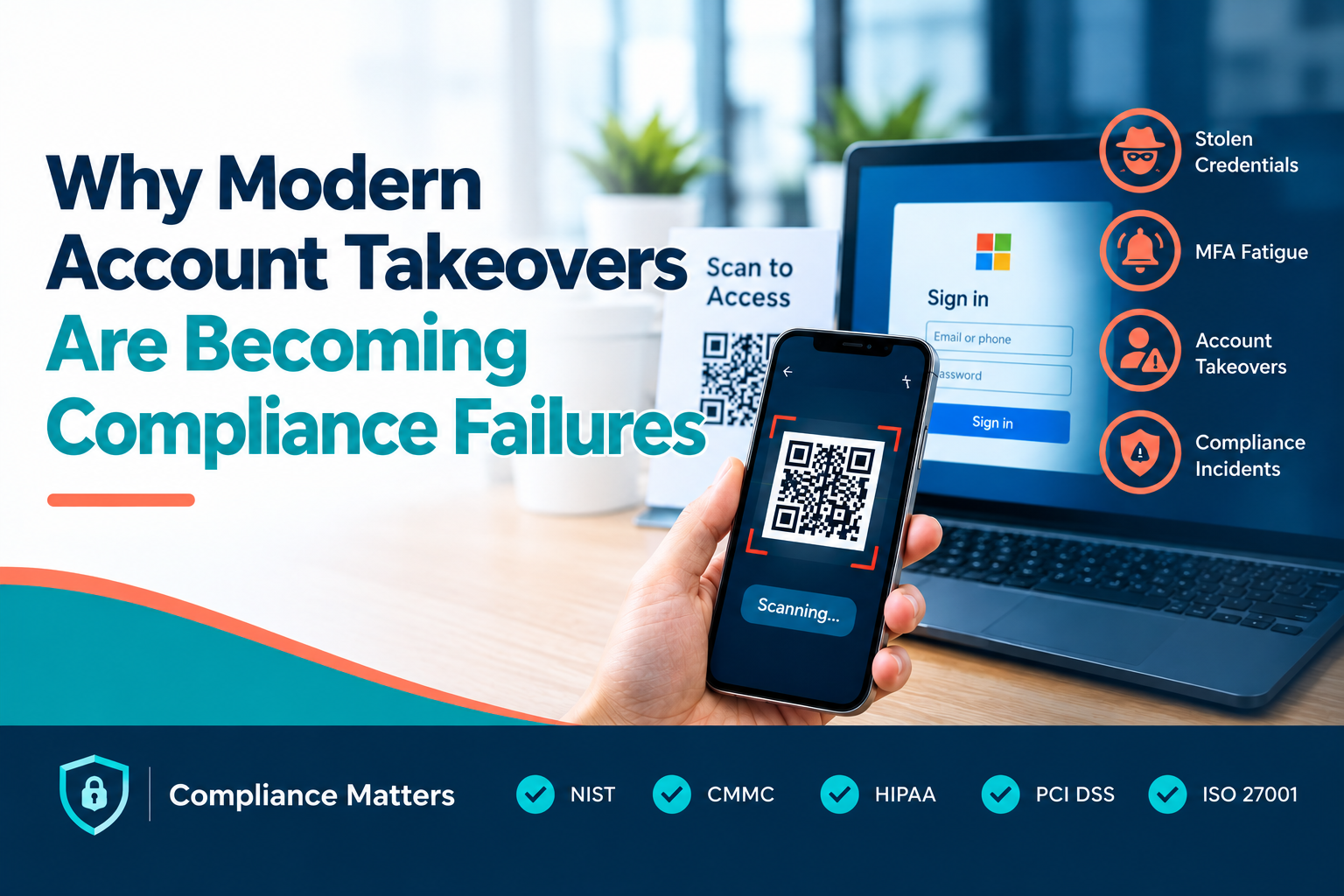
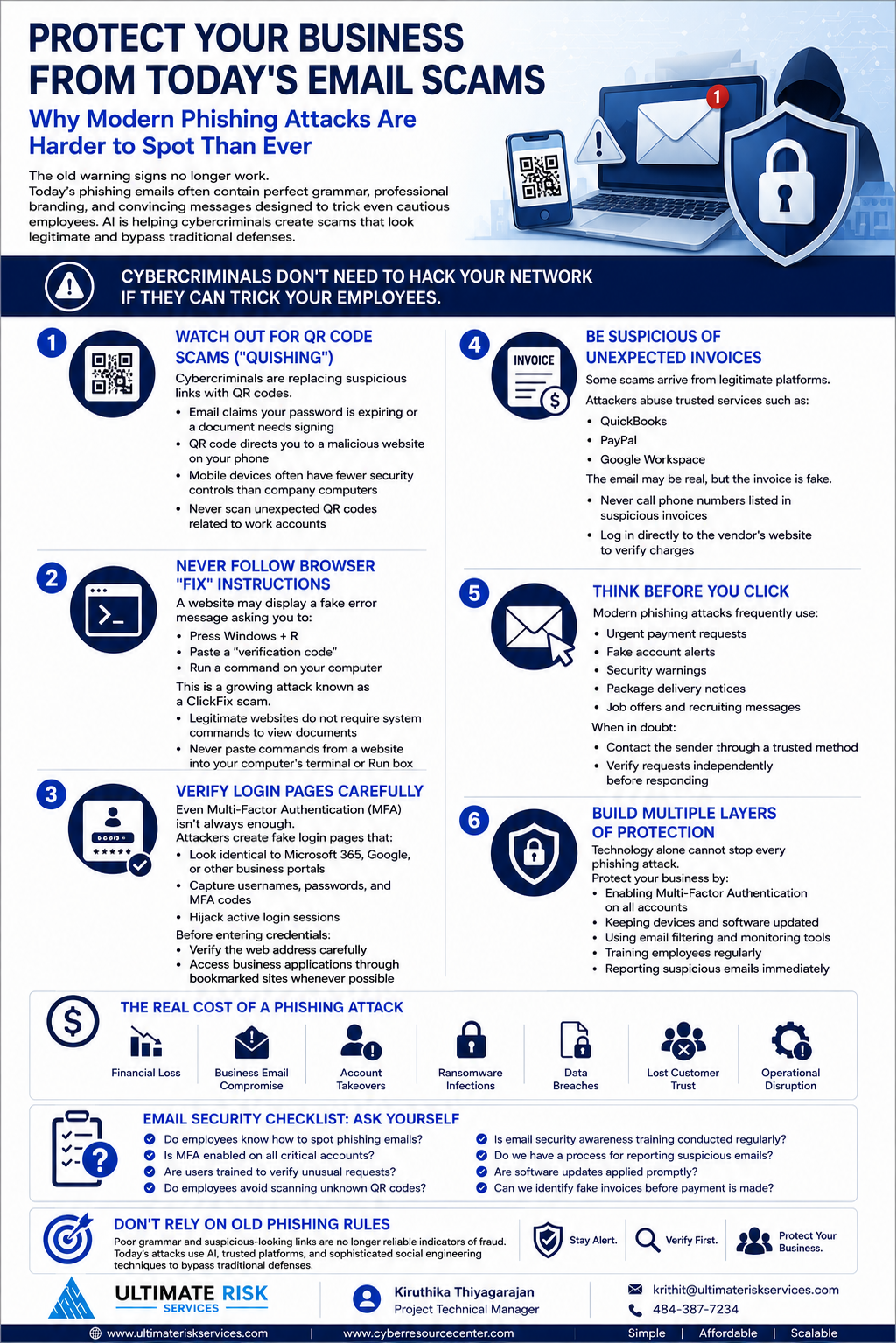
We see them everywhere—on restaurant tables, parking meters, and even in our work emails. Those little black-and-white checkered squares, known as QR codes, have become a part of our daily rhythm. They feel convenient, modern, and safe... until they aren’t.

Lately, there’s been a massive spike in a scam called "Quishing" (short for QR-code phishing). It’s clever, it’s quiet, and it’s designed to bypass all the high-tech security systems your computer has by targeting something much simpler: your blind trust.

The AI Security Shift: Protecting Your Business in 2026

The AI Security Shift: Protecting Your Business in 2026

In 2026, the cybersecurity landscape has undergone a tectonic shift. According to the World Economic Forum’s 2026 Global Cybersecurity Outlook, over 94% of security leaders now identify AI as the primary driver of cyber risk. Hackers are no longer just using scripts; they are deploying "Agentic AI"—autonomous bots that can scout, adapt, and attack with superhuman speed.

To help you navigate this, we’ve synthesized the latest 2026 guidance from the CISA (Cybersecurity and Infrastructure Security Agency), FBI, and NIST into an actionable defense plan.

Eight Lessons That Stood Out at The Official Cybersecurity Summit March 2026 in Dallas

Eight Lessons That Stood Out at  The Official Cybersecurity Summit March 2026 in Dallas

Spending a day at the Cybersecurity Summit in Dallas was like getting a tour through the most urgent realities of modern cyber defense. The venue was the Sheraton Dallas Hotel, but the conversations spanned everywhere from the cloud and APIs to AI threats and identity governance. Here’s what I took away from the sessions that mattered most.

Beyond Passwords: How to Strengthen Your Business Security Today

Beyond Passwords: How to Strengthen Your Business Security Today

From "Checking Boxes" to Building Armor: The 4 Pillars of Modern Business Resilience

In the world of government contracting and infrastructure, "security" used to mean high fences and badges. Today, the perimeter has shifted. Whether you are a small sub-contractor or a mid-sized engineering firm, your most vulnerable asset isn’t your job site—it’s your data.

At URS (Ultimate Risk Services), we see compliance not just as a regulatory hurdle, but as a competitive advantage. When you "level your defenses," you aren’t just satisfying an auditor; you’re telling your partners and the Department of Defense that you are a reliable link in the chain.

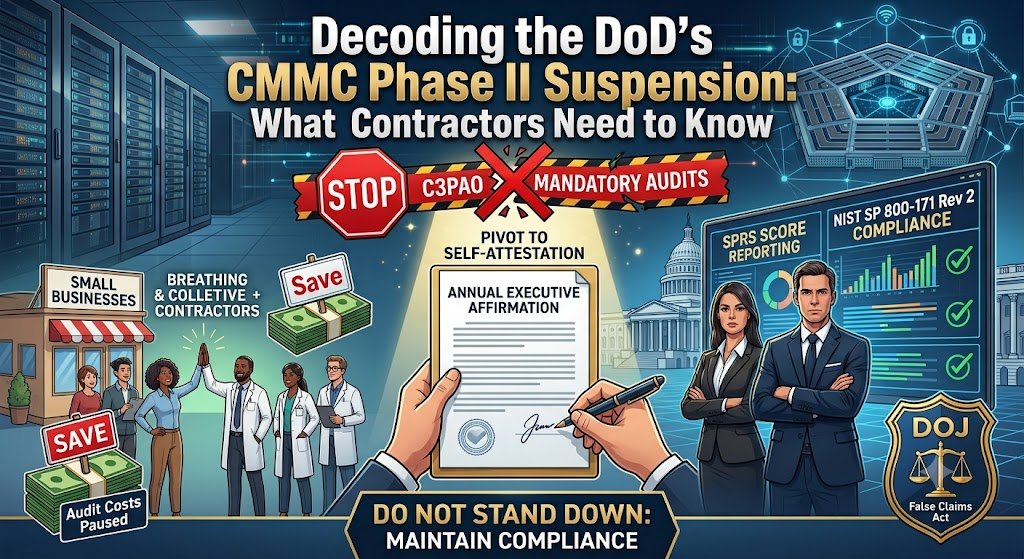
The CMMC 2.0 Annual Affirmation: What Defense Executives Need to Know

The CMMC 2.0 Annual Affirmation: What Defense Executives Need to Know

CMMC 2.0: The Path to Compliance and the Critical Role of Executive Affirmations

The Department of Defense (DoD) has officially entered a new era of cybersecurity. With the finalization of the Cybersecurity Maturity Model Certification (CMMC) program, the "honor system" for defense contractors is effectively over. For the 220,000+ companies in the Defense Industrial Base (DIB), the focus has shifted from planning for CMMC to executing it.

As we move through the phased implementation that began on November 10, 2025, contractors must understand not just the technical controls, but the legal accountability that now sits at the heart of the program: the Annual Affirmation.

Is Your Business AI-Proof? 5 Critical Cyber Threats Every Small Business Must Face in 2026

Is Your Business AI-Proof? 5 Critical Cyber Threats Every Small Business Must Face in 2026

The "honeymoon phase" of Artificial Intelligence is officially over. In 2026, AI is no longer just a productivity tool for your marketing team; it has become the primary weapon for global cybercrime syndicates.

For the modern small business, the question isn't whether you should use AI—it’s whether you can survive the version of AI being pointed at you.

Cybersecurity Tip!

👉 Request your customized cyber vulnerability report today and stay ahead of threats.
👉 Gain insights into your unique cybersecurity vulnerabilities with a custom report.
👉 Train your team to be your first line of defense

📞 Schedule a call today or 📧 contact us for a consultation.
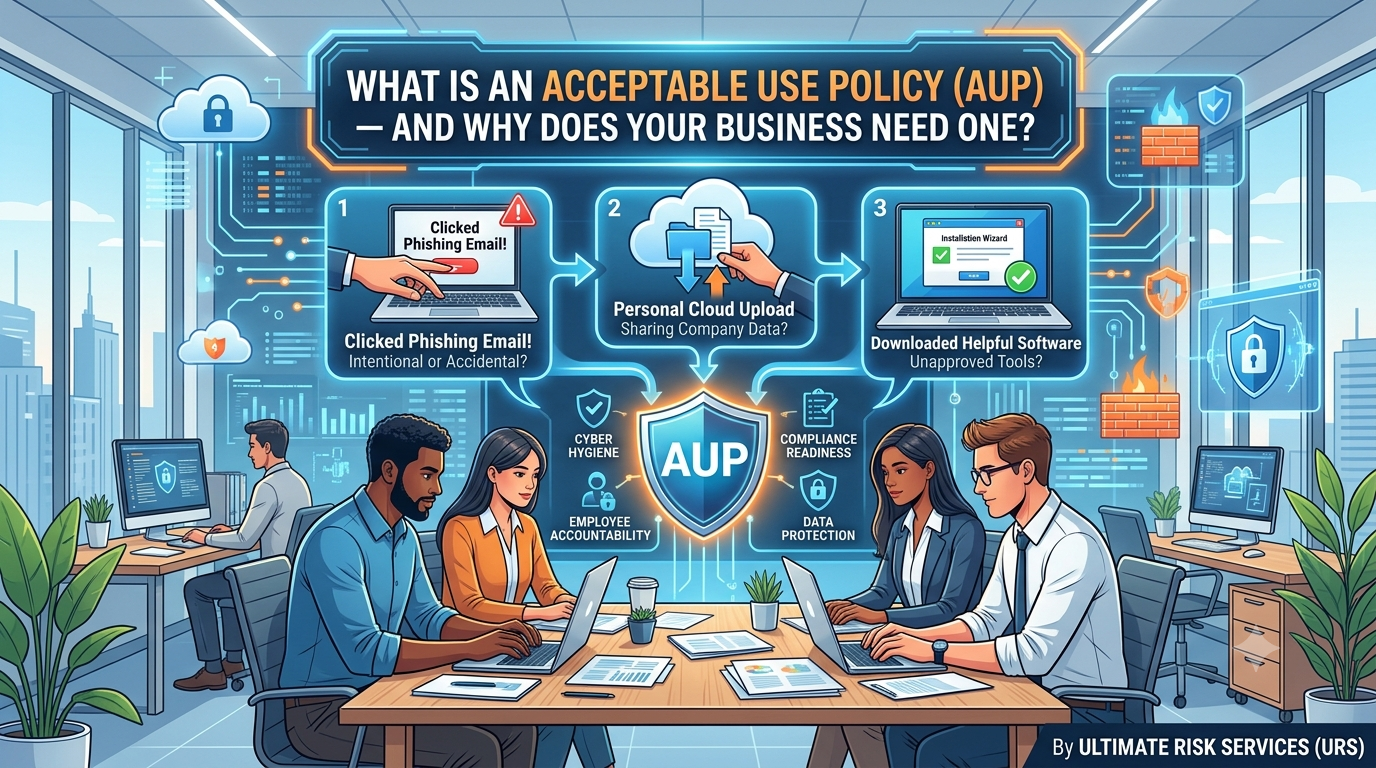
The AI Underground: Why "Shadow AI" is Your Next Big Security Headache

The AI Underground: Why "Shadow AI" is Your Next Big Security Headache

We’ve all been there: You have a deadline looming, a mountain of data to summarize, or a stubborn bug in your code. Then you remember that ChatGPT or Claude can solve it in thirty seconds.

You copy, you paste, and—poof—problem solved.

But for security teams, that "poof" is the sound of proprietary data vanishing into a black box. This is the world of Shadow AI, and it’s moving much faster than your traditional IT policies.

Hidden Cybersecurity Risks That Put Your Business at Risk (And How to Fix Them)

Hidden Cybersecurity Risks That Put Your Business at Risk (And How to Fix Them)

Why Most Cybersecurity Breaches Start With Overlooked Blind Spots

Most business leaders know cybersecurity matters. You’ve invested in antivirus software, firewalls, and backups. You may even have policies in place.

So why do breaches still happen?

Because the most dangerous cyber risks aren’t always dramatic or obvious. They’re quiet. Routine. Easy to overlook. And that’s exactly why hackers love them.

Cybercriminals rarely “break in” the way movies portray. Instead, they walk through doors that were accidentally left open—doors created by small gaps in everyday operations. These hidden weaknesses are called cybersecurity blind spots, and nearly every organization has them.

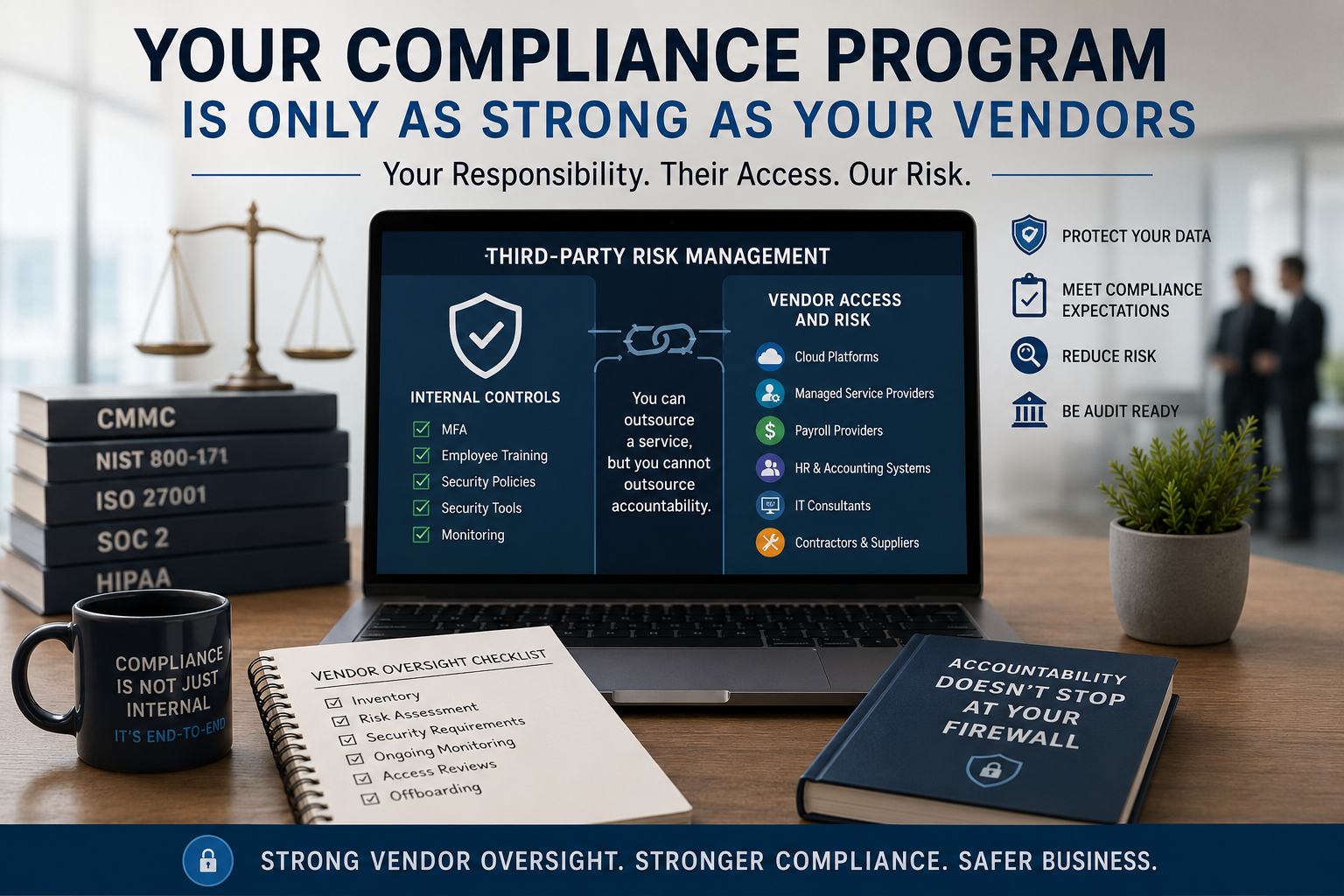
Assessing Your Partners: How to Prioritize Supplier Criticality in C-SCRM

Assessing Your Partners: How to Prioritize Supplier Criticality in C-SCRM

A Guide to Identifying High-Risk Vendors Using NIST CSF 2.0 Activity 2

Now that you have established a strategy for Cybersecurity Supply Chain Risk Management (C-SCRM), the next logical step is to identify exactly who is in your "supply chain ecosystem". As the recent NIST SP 1305 guide points with, you cannot treat every vendor the same way. A cloud provider holding your company’s intellectual property requires much stricter oversight than a vendor providing office furniture.

This process is known as Activity 2: Identifying and Prioritizing Suppliers.

How to Secure Your Tech Supply Chain: A Beginner’s Guide to C-SCRM

How to Secure Your Tech Supply Chain: A Beginner’s Guide to C-SCRM

Why NIST CSF 2.0 is the New Standard for Managing Vendor Cybersecurity Risks

In today’s world, no piece of technology is an island. Whether you are using a laptop, a smartphone, or a cloud service, that product was built using an extensive, global network of parts, software, and people. This network is known as the Supply Chain Ecosystem.

Cybersecurity Tip!

👉 Request your customized cyber vulnerability report today and stay ahead of threats.
👉 Gain insights into your unique cybersecurity vulnerabilities with a custom report.
👉 Train your team to be your first line of defense

📞 Schedule a call today or 📧 contact us for a consultation.