
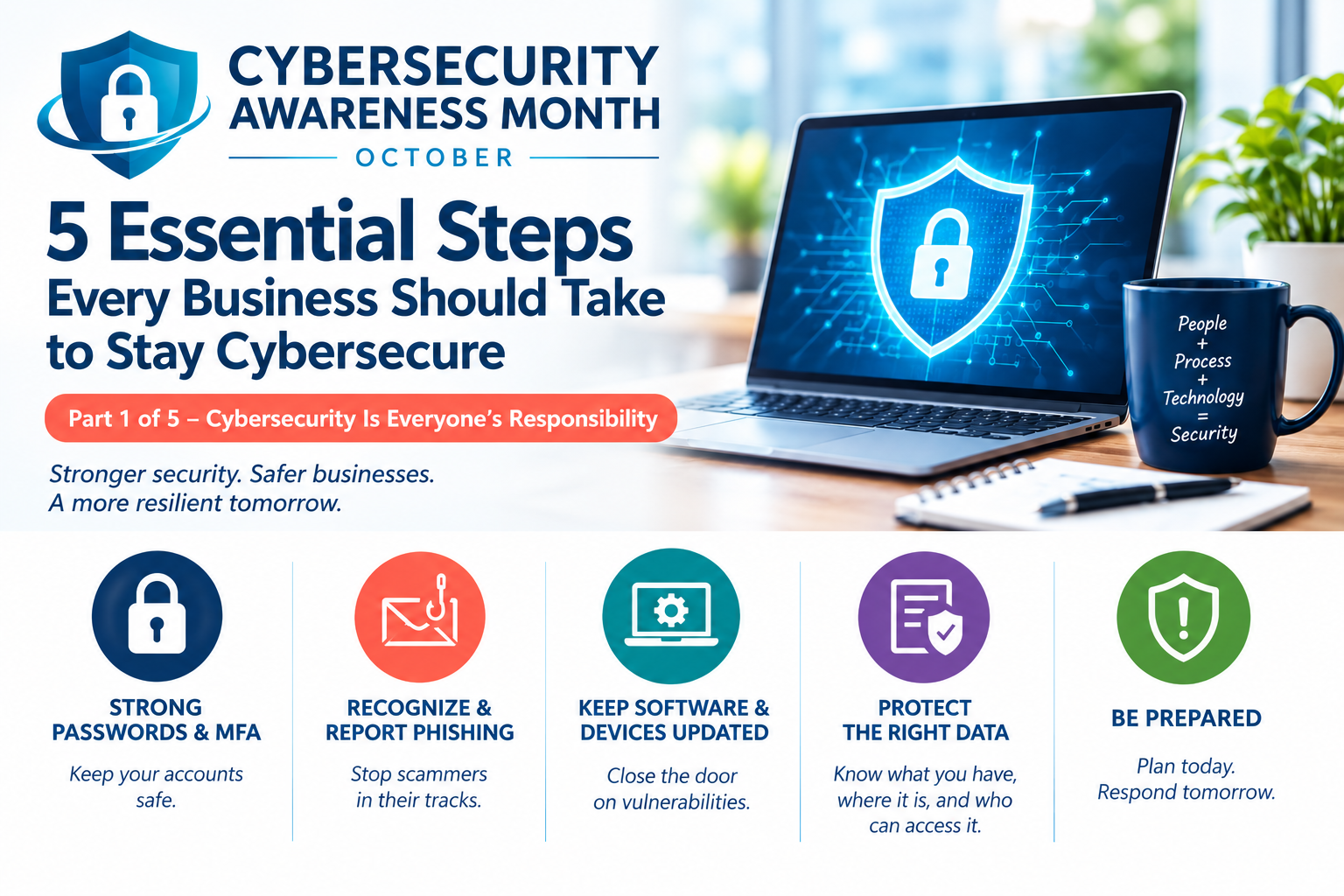
URS Cybersecurity Awareness Month: Part 1
Cybersecurity Is Everyone's Responsibility
October is Cybersecurity Awareness Month—a reminder that protecting digital information is a shared responsibility.
In 2026, CISA's Cybersecurity Awareness Month campaign, "Securing the Next 250," emphasizes the importance of strengthening cybersecurity and protecting the systems and services that businesses and communities depend on.
But cybersecurity is not just a concern for large corporations or government agencies.
Small businesses, healthcare providers, manufacturers, financial organizations, and individuals all rely on technology to manage sensitive information, communicate with customers, process payments, and operate their businesses.
A single compromised email account, an outdated system, or an employee clicking a malicious link can expose sensitive information, interrupt business operations, and create significant financial and regulatory consequences.
The good news? Improving cybersecurity does not always require a large IT department or an expensive security infrastructure.
It begins with understanding your risks, establishing good security practices, and making cybersecurity an ongoing part of your daily operations.
Let's start with five essential cybersecurity practices everyone should understand.
1. Protect Your Accounts With Strong Passwords and MFA
Passwords remain an important part of protecting business and personal accounts.
Weak or reused passwords can make it easier for attackers to gain unauthorized access.
Individuals and businesses should:
Use strong, unique passwords for important accounts.
Consider a password manager to securely store credentials.
Avoid sharing passwords through email or messaging applications.
Enable multifactor authentication (MFA) wherever available.
MFA adds another layer of protection beyond a password. Even if a password is compromised, an attacker may have difficulty accessing the account.
For businesses, MFA should be prioritized for email, remote access, cloud applications, administrative accounts, and financial systems.
2. Recognize and Report Phishing
Phishing is a common method used by cybercriminals to steal credentials, distribute malware, and manipulate employees into providing access to business systems.
A suspicious message may appear to come from a trusted customer, vendor, executive, bank, or technology provider.
Be cautious of messages that:
Create urgency or threaten immediate consequences.
Request passwords or sensitive information.
Ask for unexpected payments or changes to banking details.
Contain suspicious links or unexpected attachments.
Before acting on a financial request or sensitive business instruction, verify it through a separate, trusted communication channel.
If you suspect a phishing attempt, report it according to your organization's procedures.
3. Keep Software and Devices Updated
Software updates frequently address security vulnerabilities that attackers may exploit.
Outdated computers, applications, operating systems, and network devices can expose businesses to unnecessary risk.
Organizations should establish a process for identifying and installing security updates, reviewing unsupported software, and ensuring that critical systems receive appropriate protection.
Updating software is not simply an IT maintenance task.
It is an important part of managing cybersecurity risk.
4. Understand What Information You Need to Protect
Businesses cannot adequately protect information they do not know they possess.
Organizations should identify:
What sensitive information they collect.
Where that information is stored.
Who has access to it.
How it is shared with customers, employees, and vendors.
How long it needs to be retained.
For healthcare organizations, this may include electronic protected health information (ePHI).
For businesses accepting payment cards, it may include payment account data.
For federal contractors, it may include Controlled Unclassified Information (CUI).
Understanding where sensitive information exists helps organizations determine which safeguards and compliance requirements may apply.
5. Prepare for a Cybersecurity Incident
Even organizations with strong security controls may experience a cybersecurity incident.
Preparation can make a significant difference in how effectively a business responds.
Every organization should consider establishing an incident response plan that identifies:
Who employees should contact when something suspicious occurs.
Who is responsible for coordinating the response.
How the IT team or MSP should be engaged.
How evidence will be preserved.
How business operations will be restored.
When legal, regulatory, or other reporting obligations may apply.
Businesses should also maintain appropriate backups and periodically test their ability to recover critical information.
How URS Helps Businesses Strengthen Cybersecurity
At Ultimate Risk Services (URS), we understand that small and medium-sized businesses often face cybersecurity challenges without having a dedicated internal compliance team.
URS helps businesses identify cybersecurity risks, understand their compliance obligations, and develop a structured approach to improving security.
Our services can include:
External and internal vulnerability assessments.
Mini penetration testing.
Risk identification and prioritization.
Customized cybersecurity policies and procedures.
Employee security awareness training.
Compliance documentation and reporting.
Optional ongoing exposure monitoring.
URS helps organizations understand the risks identified through assessments and recommends appropriate remediation actions.
The organization's internal IT team or MSP performs the technical remediation.
Our goal is to make cybersecurity compliance more understandable, practical, and manageable for businesses.
Final Thoughts
Cybersecurity Awareness Month is an opportunity to review your security practices and take meaningful steps toward protecting your business.
You do not need to implement every security improvement overnight.
Start with the basics: protect your accounts, recognize phishing, update your systems, understand your data, and prepare for incidents.
Small cybersecurity actions, when practiced consistently, can make a meaningful difference in reducing risk.
Stay tuned for Part 2 of our Cybersecurity Awareness Month series, where we will explore how businesses and individuals can protect their digital identities against phishing, account takeovers, and cyber scams.
Ready to see where your company defenses stand?
👉 Request your customized cyber vulnerability report today and stay ahead of threats.
👉 Gain insights into your unique cybersecurity vulnerabilities with a custom report.
👉 Train your team to be your first line of defense
📞 Schedule a call today or 📧 contact us for a consultation.