
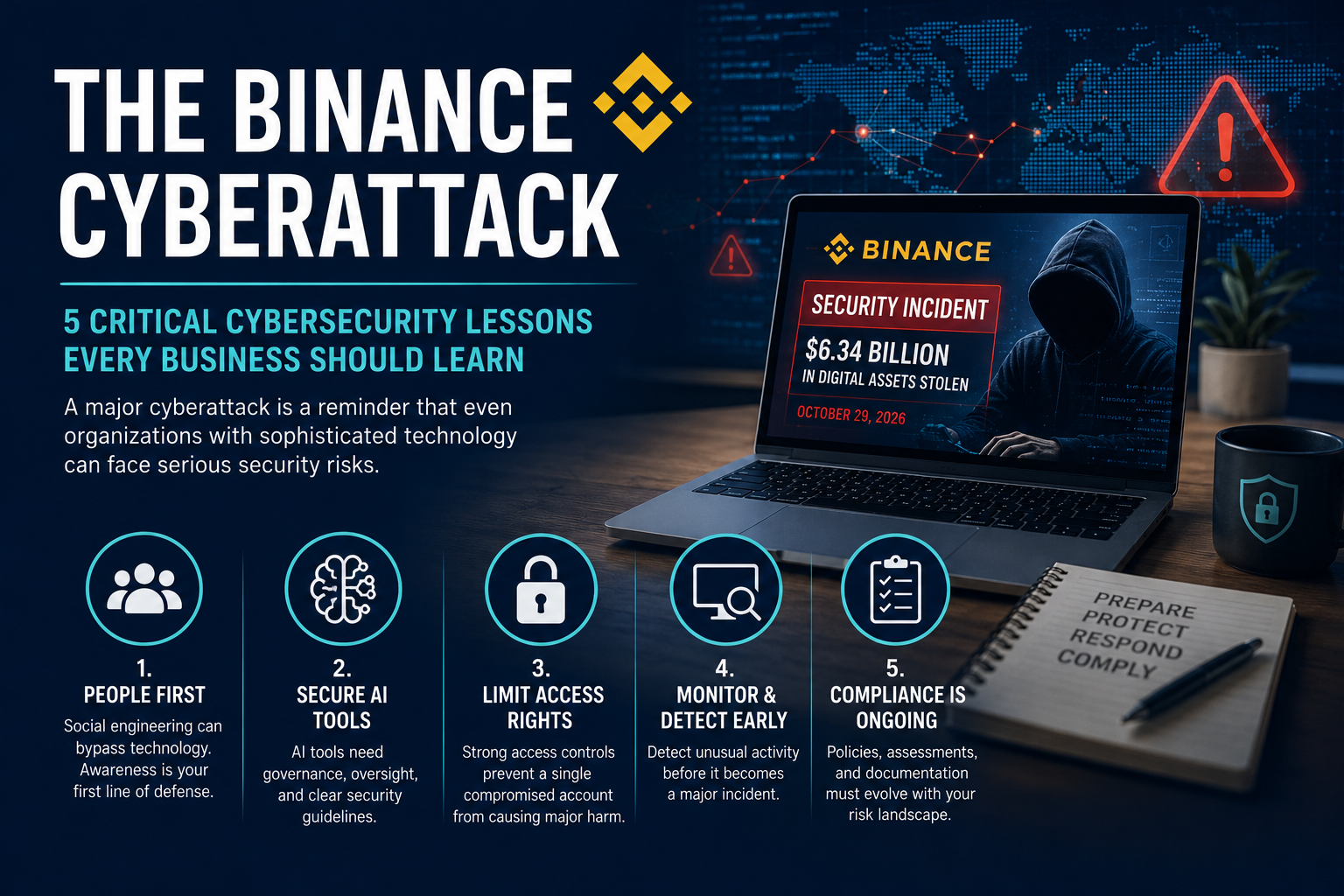
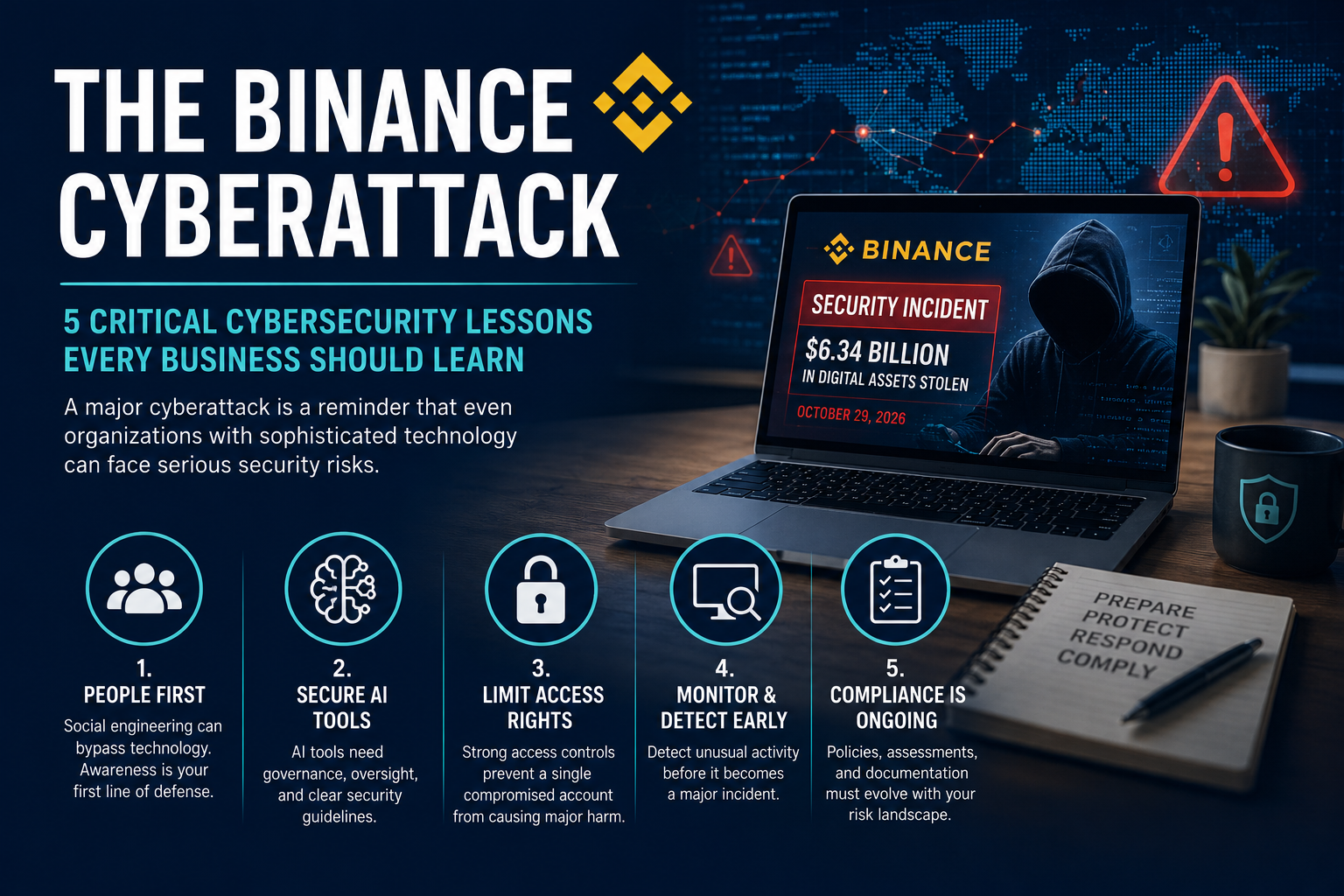
A major cyberattack is a reminder that even organizations with sophisticated technology can face serious security risks.
On October 29, 2026, cryptocurrency exchange Binance experienced a significant security incident involving approximately $6.34 billion in digital assets across multiple blockchain networks. The FBI attributed the theft to North Korea and identified the activity as TraderTraitor. Binance's initial investigation revealed a sophisticated, multi-stage attack involving compromised employee devices, social engineering, malicious software, internal AI tooling, and unauthorized access to wallet-signing operations.
While the incident involved cryptocurrency infrastructure, its lessons extend far beyond the financial and digital asset industries.
For businesses managing sensitive information, customer data, government contracts, or regulated operations, the Binance incident raises an important question:
Are your cybersecurity controls designed to prevent a single compromised employee, device, or application from putting your entire organization at risk?
At Ultimate Risk Services (URS), we believe cybersecurity is not just about having security tools. It is about identifying risks, implementing appropriate controls, maintaining compliance, and ensuring organizations can demonstrate that their security practices are working.
Here are five critical lessons businesses can take away from the Binance attack.
1. Cybersecurity Starts With People, Not Just Technology
According to Binance's initial incident report, the attack involved social engineering through fake recruitment interviews, malicious software downloads, and compromised employee endpoints.
This illustrates how attackers may exploit people before attempting to compromise critical systems.
Employees may receive convincing interview invitations, software downloads, vendor communications, or requests that appear legitimate. A single unsafe action can create an entry point into the organization's environment.
For businesses, cybersecurity awareness must go beyond annual policy acknowledgment.
Employees should understand how to:
Recognize suspicious recruitment invitations, attachments, and downloads.
Verify unexpected requests involving credentials or system access.
Report suspicious activity promptly.
Avoid installing unauthorized software.
Follow established security policies when using company devices.
Organizations should also maintain documented security awareness training and track employee participation.
URS Compliance Perspective: Employee awareness is an important part of demonstrating that cybersecurity responsibilities are understood and consistently communicated. Training should be supported by documented policies, participation records, and periodic reinforcement.
2. AI Tools Need Security Controls and Governance
One of the more concerning aspects of the Binance incident was the reported compromise of internal AI tooling.
Binance's initial investigation described a multi-stage campaign in which attackers leveraged a compromised computer and internal AI tooling to gain access to additional engineering systems.
This highlights a growing challenge for businesses: AI tools are becoming part of everyday operations, but they may also introduce new security risks.
Employees may use AI applications to analyze data, generate code, summarize documents, or automate business processes. Without appropriate oversight, these tools can create risks involving sensitive information, unauthorized access, and insecure workflows.
Businesses should establish clear AI security guidelines covering:
Which AI applications employees are authorized to use.
What confidential or regulated information can be entered into AI tools.
How AI applications are approved and monitored.
Who is responsible for reviewing AI-related risks.
How AI-generated code and outputs are validated before use.
Organizations developing or deploying AI systems should also evaluate risks such as prompt injection, excessive permissions, insecure integrations, and unintended data exposure.
URS Compliance Perspective: AI security should be incorporated into an organization's broader cybersecurity risk management program. Documented AI usage policies, risk assessments, and employee training can help organizations establish accountability as AI adoption grows.
3. Access Controls Must Limit What a Compromised Account Can Do
The Binance incident involved unauthorized access to wallet-signing operations and the use of compromised credentials and permissions. The attack ultimately enabled unauthorized digital asset transfers.
The lesson for businesses is straightforward:
A compromised account should not automatically become a pathway to critical systems.
Organizations should implement access controls that limit what employees, applications, and service accounts can access.
Important practices include:
Enforcing multifactor authentication (MFA).
Applying the principle of least privilege.
Reviewing administrative and privileged access regularly.
Removing access when employees change roles or leave.
Separating critical functions so one account cannot perform every action.
Monitoring the use of privileged credentials and access tokens.
For organizations handling sensitive information or supporting government contracts, access control documentation is particularly important.
It is not enough to state that access is restricted. Businesses should be able to demonstrate who has access, why that access is necessary, and how it is reviewed.
URS Compliance Perspective: Access control is a core component of frameworks such as NIST SP 800-171, CMMC, and ISO 27001. Regular reviews and documented procedures help organizations demonstrate that access is managed appropriately.
4. Cybersecurity Monitoring Must Detect Unusual Activity
The Binance attack involved unauthorized transfers across multiple blockchain networks. The exchange's incident report described alerts, investigation, and containment actions following the suspicious activity.
For businesses, this reinforces the importance of identifying unusual activity before it develops into a larger incident.
Traditional security controls may prevent many threats, but organizations must also be prepared to detect activity that bypasses preventive measures.
Examples of suspicious activity include:
Unusual login locations or times.
Unexpected large data transfers.
Unapproved software installations.
Abnormal use of privileged accounts.
Changes to critical security settings.
Unexpected activity involving cloud services or AI applications.
Monitoring should be supported by a clear process for investigating alerts and escalating potential incidents.
Organizations should also understand which monitoring responsibilities belong to their internal IT team, managed service provider (MSP), or security provider.
URS Compliance Perspective: Continuous monitoring, vulnerability assessments, and documented incident response procedures support an organization's ability to identify and manage cybersecurity risks. Compliance programs should clearly establish responsibilities and maintain evidence that controls are being monitored.
5. Compliance Is Not a One-Time Exercise
The Binance incident demonstrates how cybersecurity risks can emerge through multiple interconnected systems, employees, applications, and permissions.
A business may have policies in place and still face risks if those policies are outdated, controls are inconsistently applied, or new technologies are introduced without appropriate oversight.
Cybersecurity compliance should be treated as an ongoing process that includes:
Identifying and assessing security risks.
Reviewing policies and procedures.
Evaluating technical security controls.
Conducting vulnerability assessments.
Providing employee security awareness training.
Maintaining audit-ready documentation.
Reviewing and updating the cybersecurity program as risks change.
For organizations subject to CMMC, NIST, HIPAA, PCI DSS, or other regulatory and contractual requirements, maintaining compliance requires more than preparing for an audit.
It requires an ongoing understanding of the organization's security posture and the ability to demonstrate that required controls are addressed.
URS Compliance Perspective: A structured compliance program helps organizations move from uncertainty to a clear, documented cybersecurity roadmap. URS helps businesses identify gaps, understand their compliance obligations, and maintain the documentation needed to support their cybersecurity program.
What Businesses Should Do Now
The Binance incident is a timely reminder for organizations to review their cybersecurity posture.
Here are five practical steps businesses can take:
Review employee security awareness
Confirm that employees understand phishing, suspicious downloads, credential protection, and incident reporting.
Assess AI usage and security risks
Identify AI tools in use and establish policies for data protection, access, and approved applications.
Evaluate access controls
Review privileged accounts, MFA, permissions, and access to critical business systems.
Identify security gaps
Conduct external and internal vulnerability assessments to understand potential exposures.
Review compliance readiness
Confirm that cybersecurity policies, procedures, assessments, and supporting evidence are current and aligned with applicable requirements.
Cybersecurity Compliance: A Business Responsibility
The Binance cyberattack reinforces an important principle: cybersecurity risks are not limited to IT departments.
Employees, leadership, technology providers, and compliance teams all play a role in protecting an organization.
Businesses need to understand their risks, establish appropriate controls, and maintain the documentation required to demonstrate their security posture.
At Ultimate Risk Services (URS), we help organizations navigate cybersecurity compliance through risk assessments, vulnerability assessments, policy and procedure development, security awareness training, and ongoing compliance support.
Our approach is designed to help organizations understand where they stand, what needs attention, and how to move toward a more secure and audit-ready environment.
URS does not replace your IT or MSP team. We help identify cybersecurity risks and compliance gaps, provide a clear roadmap, and support your organization in maintaining compliance while your IT team or MSP handles remediation.
Is Your Business Prepared for Today's Cybersecurity Risks?
Whether your organization is working toward CMMC certification, aligning with NIST requirements, or strengthening its overall cybersecurity compliance program, URS can help you take the next step.
Understand your risks. Strengthen your compliance.Don't wait for a vulnerability to become a business disruption.
Learn how URS can help your organization identify risks, strengthen compliance, and maintain an audit-ready cybersecurity program.
Ready to see where your company defenses stand?
👉 Request your customized cyber vulnerability report today and stay ahead of threats.
👉 Gain insights into your unique cybersecurity vulnerabilities with a custom report.
👉 Train your team to be your first line of defense
📞 Schedule a call today or 📧 contact us for a consultation.