
Protecting your website is more than keeping your software running. It is about protecting your business, customer information, and compliance responsibilities.
PHP is one of the most widely used programming languages for websites and web applications. It powers platforms, business portals, e-commerce websites, and content management systems that organizations rely on every day.
However, vulnerabilities in PHP can create significant cybersecurity risks—especially for SMBs that depend on third-party website developers, hosting providers, or managed IT service providers (MSPs).
In October 2026, two critical PHP vulnerabilities, identified as CVE-2026-109618 and CVE-2026-109619, brought renewed attention to the importance of timely security updates. These vulnerabilities could allow attackers to execute malicious code on affected servers without authentication.
For SMBs, the message is clear: keeping your website, applications, and underlying technology updated is a business security responsibility—not just an IT task.
Understanding the Latest PHP Vulnerabilities
The PHP security team disclosed two critical vulnerabilities on October 21, 2026. Together, they are commonly referred to as "PHP2Shell."
Both vulnerabilities have a CVSS v4.0 severity score of 9.2 out of 10 and could allow remote code execution (RCE).
Remote code execution means an attacker may be able to run malicious commands on a vulnerable server from a remote location.
What are the vulnerabilities?What it means?
CVE-2026-109618 : A memory-handling flaw that may allow attackers to trigger memory corruption and execute malicious code.
CVE-2026-109619: A memory-management flaw that may allow a PHP worker to reuse improperly retained internal data, potentially enabling malicious code execution.
These vulnerabilities are particularly concerning because affected PHP installations may process malicious requests before the application's normal security controls are executed.
The risk extends beyond a website's visible content. A compromised server could potentially expose sensitive business data, customer information, application credentials, or other connected systems.
The PHP team and CISA have urged organizations to apply the security updates immediately.
Why SMBs Should Be Concerned
Many small businesses assume their website is secure because they use a reputable hosting provider or regularly update WordPress.
Unfortunately, these assumptions can create security gaps.
PHP is often part of a larger technology environment, including:
WordPress and other content management systems.
E-commerce platforms.
Customer portals and business applications.
Third-party web applications.
Internal business tools.
Websites hosted by external service providers.
A vulnerability in the underlying PHP environment may remain even when the website's content management system, themes, and plugins are updated.
What could happen if a PHP vulnerability is exploited?
Potential consequences include:
1. Website compromise
Attackers could modify website content, inject malicious scripts, or use the website to distribute malware.
2. Data exposure
Customer information, business records, or sensitive information stored within connected applications could be exposed.
3. Business disruption
A compromised website or application may need to be taken offline, resulting in operational interruptions and lost business opportunities.
4. Financial and reputational damage
A security incident may lead to investigation expenses, recovery costs, customer concerns, and potential legal or regulatory consequences.
5. Compliance challenges
Organizations may be unable to demonstrate that they maintained appropriate security controls, monitored vulnerabilities, and addressed identified risks.
For SMBs, a single vulnerable system can create risks that extend across the entire organization.
What Should SMBs Do Immediately?
The most important action is to identify whether PHP is running within your organization's technology environment and confirm that the appropriate security updates have been applied.
1. Identify All Systems Running PHP
Businesses should maintain an accurate inventory of their technology assets.
This includes identifying:
Public-facing websites.
Web applications and customer portals.
PHP-based business applications.
Hosting environments and cloud platforms.
Systems managed by external IT providers.
If your business uses WordPress, ask your website developer or hosting provider whether PHP is used and which version is running.
Do not assume that PHP is absent simply because your business does not directly manage its website server.
2. Apply the Latest Security Updates
The PHP security team released the following patched versions for the October 2026 PHP2Shell vulnerabilities:
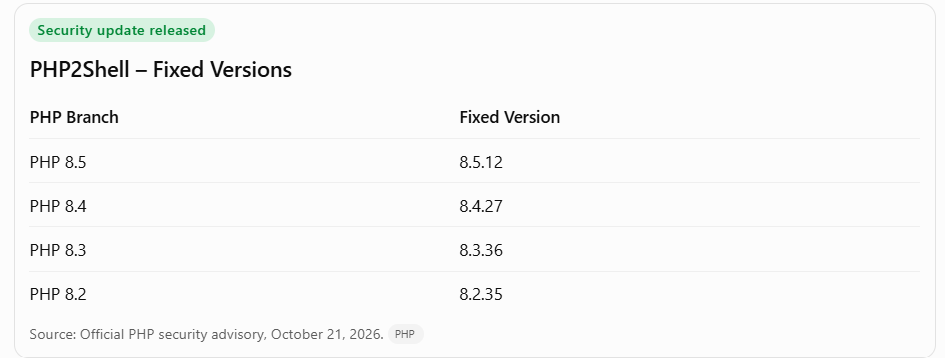
Organizations should work with their IT teams, MSPs, developers, or hosting providers to apply the appropriate updates.
Important: PHP 8.2 is approaching the end of its security support period on December 31, 2026. Businesses using PHP 8.2 should plan to transition to a newer supported branch.
If immediate patching is not possible, CISA recommends taking affected PHP-based systems offline until they can be patched or updated. A web application firewall may provide temporary protection, but it does not replace a security update.
3. Review Website and Application Security
Updating PHP is an important step, but businesses should also review the overall security of their web applications.
Recommended security practices include:
Update website platforms, themes, plugins, and application dependencies.
Remove unused plugins, applications, and outdated software.
Restrict administrative access to authorized users.
Enforce multi-factor authentication (MFA).
Review user permissions and access privileges.
Secure file uploads and application configurations.
Ensure sensitive information is not unnecessarily exposed.
These measures help reduce the likelihood of attackers exploiting additional weaknesses in the environment.
4. Monitor for Suspicious Activity
Businesses should ensure their IT teams or MSPs monitor systems for unusual activity.
Potential warning signs include:
Unexpected changes to website files.
Unusual server processes.
PHP worker processes launching command shells.
Unexpected downloads or outbound network connections.
Unusual authentication activity.
Unexpected server errors or resource consumption.
CISA specifically recommends monitoring for suspicious activity, including PHP worker processes launching shells or downloading tools.
If suspicious activity is identified, organizations should activate their incident response procedures and investigate whether the vulnerability was exploited.
PHP Vulnerabilities and Cybersecurity Compliance
For SMBs, cybersecurity is not only about preventing attacks. It is also about demonstrating that appropriate security measures are in place.
Organizations subject to regulatory, contractual, or industry cybersecurity requirements should evaluate how PHP vulnerabilities affect their existing security controls.
How PHP security relates to major frameworks
NIST Cybersecurity Framework 2.0
Vulnerability management, risk assessment, asset identification, and continuous monitoring help organizations identify and manage cybersecurity risks.
NIST SP 800-171
Organizations handling Controlled Unclassified Information (CUI) should assess whether vulnerable PHP systems affect applicable security requirements, including flaw remediation and system monitoring.
CMMC
Defense contractors should evaluate vulnerabilities within their applicable CMMC assessment scope and maintain evidence that relevant security requirements are implemented.
PCI DSS
Businesses that store, process, or transmit payment card information should assess PHP-related risks within their cardholder data environment and applicable vulnerability management requirements.
HIPAA
Healthcare organizations and applicable business associates should evaluate whether vulnerable systems could affect the confidentiality, integrity, or availability of electronic protected health information (ePHI).
The specific compliance requirements depend on the organization's industry, systems, contractual obligations, and assessment scope.
A vulnerability does not automatically mean an organization is noncompliant. However, failure to identify, assess, and address known security risks may create compliance gaps.
Compliance is not a one-time achievement. It requires ongoing risk management, documentation, and monitoring.
How SMBs Can Stay Updated and Audit-Ready
Organizations should establish a structured vulnerability management process rather than responding to security updates only when an emergency occurs.
A practical process includes the following:
Maintain a Vulnerability Management Program
Businesses should establish a consistent process to:
Identify vulnerabilities affecting their systems.
Evaluate severity and business impact.
Prioritize risks based on exposure and criticality.
Coordinate remediation with their IT team or MSP.
Verify that updates have been applied.
Document the results and maintain evidence.
Maintain Compliance Documentation
Organizations should retain records that demonstrate how vulnerabilities are managed.
Useful documentation includes:
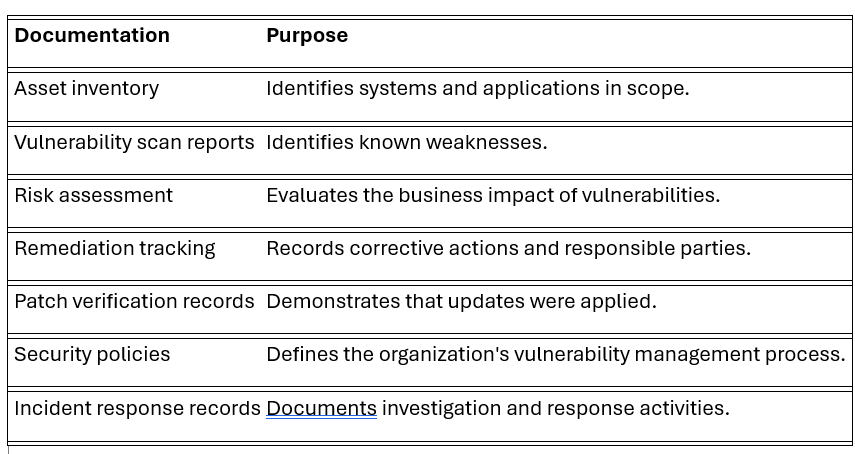
These records can support internal reviews, compliance assessments, customer requirements, and audit preparation.
How URS Helps SMBs Manage Cybersecurity Compliance
At Ultimate Risk Services (URS), we understand that small and medium-sized businesses often face cybersecurity challenges without having a dedicated internal compliance department.
Organizations need more than a list of vulnerabilities. They need to understand what those vulnerabilities mean, which risks require attention, and how to demonstrate that appropriate security controls are in place.
URS provides cybersecurity compliance guidance and risk assessment services designed to help businesses navigate their security and regulatory requirements.
Our approach includes:
Vulnerability Assessments
External and internal vulnerability scans help identify security weaknesses within an organization's technology environment.
Risk Assessment and Reporting
URS helps organizations understand identified risks through clear, actionable reporting designed for business leaders and compliance teams.
Policies and Compliance Guidance
We help businesses align cybersecurity policies, procedures, and documentation with applicable regulatory and industry requirements.
Security Awareness Training
We help employees understand cybersecurity threats and their role in protecting business systems and information.
URS identifies risks and provides recommendations. Remediation is performed by the organization's internal IT team or MSP.
Our goal is to help SMBs move from uncertainty to a clear, documented, and manageable cybersecurity compliance roadmap.
Final Thoughts: Don't Wait for a Security Incident
PHP vulnerabilities are a reminder that cybersecurity risks can emerge from the underlying technology that businesses depend on every day.
For SMBs, the most effective approach is to stay informed, maintain an accurate asset inventory, apply security updates promptly, monitor for suspicious activity, and document how risks are managed.
A secure website is not simply one that works. It is one that is maintained, monitored, and supported by a structured cybersecurity program.
Stay informed. Stay updated. Stay compliant.
At URS, we help businesses simplify cybersecurity compliance, understand their risks, and build confidence in their security posture.
Is Your Business Cybersecurity-Ready?
Don't wait for a vulnerability to become a business disruption.
Learn how URS can help your organization identify risks, strengthen compliance, and maintain an audit-ready cybersecurity program.
Ready to see where your company defenses stand?
👉 Request your customized cyber vulnerability report today and stay ahead of threats.
👉 Gain insights into your unique cybersecurity vulnerabilities with a custom report.
👉 Train your team to be your first line of defense
📞 Schedule a call today or 📧 contact us for a consultation.