
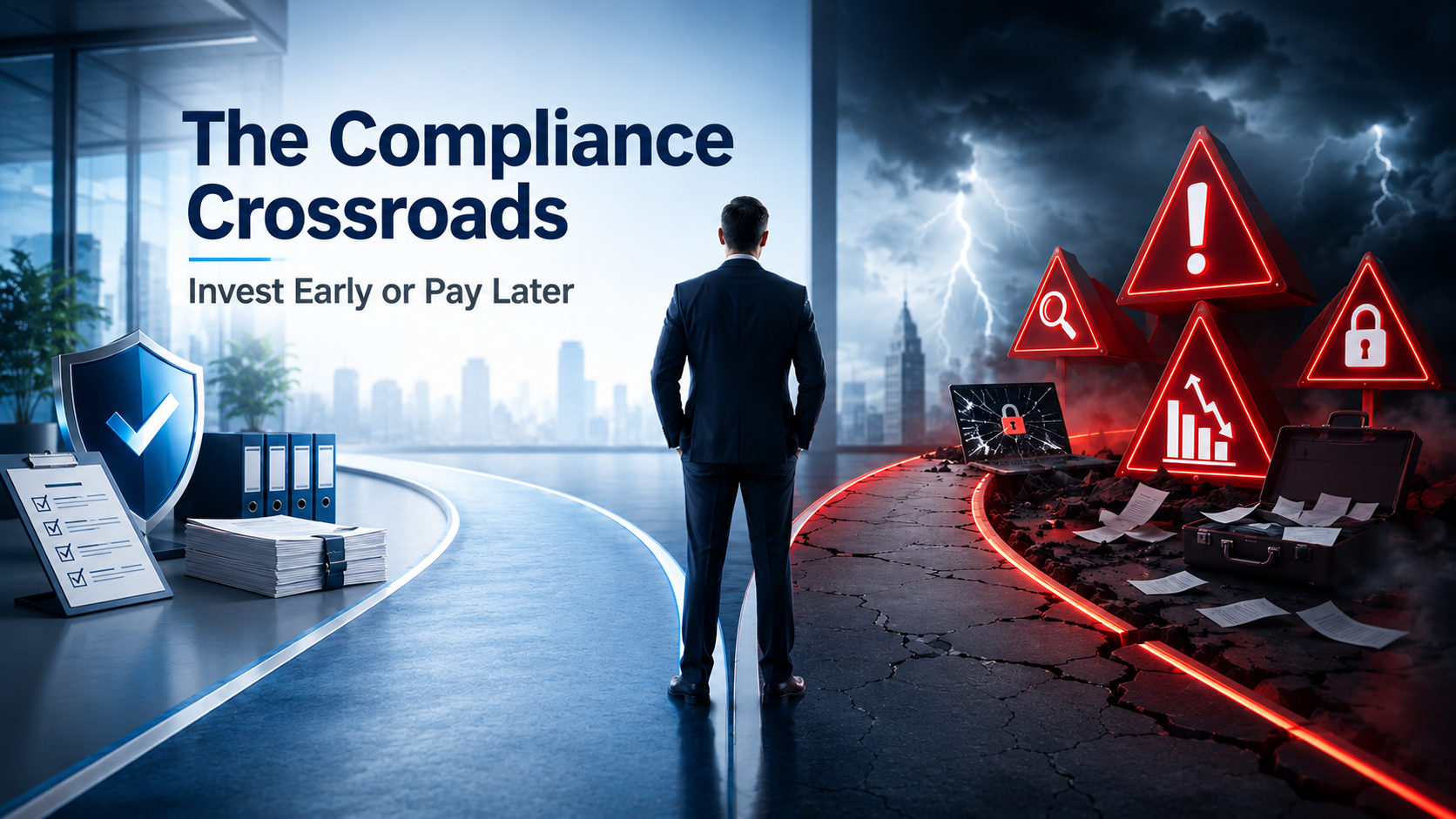
Business owners rarely wake up thinking about compliance.
They're focused on serving customers, growing revenue, managing employees, and keeping operations running smoothly. Compliance often feels like something that can wait until later.
Unfortunately, "later" is usually when a problem appears.
A customer requests security documentation before signing a contract.
An insurance carrier asks difficult questions during renewal.
An auditor uncovers gaps nobody knew existed.
Or worse, a cyber incident exposes weaknesses that have been building quietly for years.
Over the years, I've noticed that organizations rarely struggle because they don't care about security or compliance. They struggle because they assume everything is fine until someone asks them to prove it.
And that's where the surprises begin.
The Compliance Problem Nobody Talks About
Most businesses don't intentionally ignore compliance.
What actually happens is much simpler.
The organization grows.
New employees join.
Software gets added.
Processes evolve.
Vendors change.
Artificial intelligence tools get adopted.
Cloud applications multiply.
But the security and compliance program never evolves at the same pace.
As a result, leadership believes the organization is operating safely while the reality slowly drifts in another direction.
This gap between perception and reality is where risk lives.
The Questions Business Leaders Often Can't Answer
When organizations start preparing for an audit, contract review, or security assessment, several important questions suddenly become difficult to answer:
Where is our sensitive information stored?
Who has access to it?
Which vendors can view customer data?
Are employees following security policies?
How quickly could we respond to a cyber incident?
Can we prove our controls are working?
These aren't technical questions.
They're business questions.
And when leadership cannot answer them confidently, it becomes clear that compliance is more than a regulatory requirement—it's an operational challenge.
Compliance Isn't About Passing Audits
One of the biggest misconceptions I encounter is the belief that compliance exists solely for audits.
In reality, the strongest compliance programs are rarely built for auditors.
They're built to help organizations:
Make better decisions
Reduce operational risk
Protect customer trust
Strengthen vendor oversight
Improve incident response
Support business growth
An audit simply measures whether those practices exist.
The real value comes from having them in place long before anyone asks.
The "We're Fine" Trap
Many organizations believe they're in good shape because they haven't experienced a major problem.
But absence of evidence is not evidence of security.
I've seen companies confidently state that everything is under control because:
They passed an audit last year
Their IT provider manages updates
They have cybersecurity software installed
Nothing bad has happened yet
Then a customer questionnaire arrives.
Or a cyber insurance application.
Or a regulatory review.
And suddenly leadership realizes they cannot demonstrate the controls they thought they had.
The challenge isn't that the organization failed.
The challenge is that nobody was continuously validating the program.
How Modern Business Creates New Risk
A decade ago, compliance was largely about internal systems.
Today, every business depends on an ecosystem of vendors, cloud platforms, service providers, and AI-powered tools.
Every new technology introduces new questions:
What data is being shared?
Where is it being stored?
Who can access it?
How is it protected?
What happens if the vendor experiences a breach?
Many organizations discover these questions only after a tool has already been deployed.
That's why vendor governance and technology oversight have become some of the fastest-growing areas of compliance risk.
What Usually Triggers Action
Interestingly, organizations rarely seek compliance support because they suddenly become passionate about compliance.
Most often, there is a catalyst.
Common examples include:
A Major Customer Opportunity
A prospect requests security documentation before signing a contract.
Suddenly compliance becomes a revenue issue.
Cyber Insurance Renewal
The renewal questionnaire is far more detailed than expected.
Leadership realizes they may not be able to demonstrate required controls.
New Regulatory Requirements
Industry regulations evolve, and the organization is unsure whether existing practices meet expectations.
A Security Incident
An event exposes weaknesses in processes, documentation, response planning, or vendor oversight.
At this point, compliance becomes urgent.
The Organizations That Handle Compliance Best
The most successful organizations don't wait for a trigger event.
They treat compliance the same way they treat accounting, legal support, or financial planning.
Not because regulators demand it.
Because it helps the business operate more effectively.
These organizations understand that compliance is not a project.
It's not a checklist.
It's not an annual audit exercise.
It's an ongoing business discipline that provides visibility, accountability, and confidence.
Is Your Organization Ready?
Ask yourself a few simple questions:
Could you confidently explain your security program to a major customer?
Are your policies aligned with what employees actually do every day?
Do you know where sensitive data is stored?
Have your vendors been evaluated for risk?
Is someone clearly responsible for compliance oversight?
Could you demonstrate that your controls are working?
If any of these questions create uncertainty, it's worth taking a closer look at your current posture.
Not because an audit is coming.
Not because a regulator is watching.
But because waiting until a problem appears is usually the most expensive way to discover one.
Final Thought
The businesses that struggle most with compliance are often the ones that believed they had more time.
The businesses that succeed are the ones that view compliance as a business enabler rather than a regulatory burden.
By the time a customer, auditor, insurer, or attacker exposes a gap, the opportunity to prepare has already passed.
The smartest organizations don't wait for a reason to take compliance seriously.
They build resilience before they need it.
Ready to see where your company defenses stand?
👉 Request your customized cyber vulnerability report today and stay ahead of threats.
👉 Gain insights into your unique cybersecurity vulnerabilities with a custom report.
👉 Train your team to be your first line of defense
📞 Schedule a call today or 📧 contact us for a consultation.