
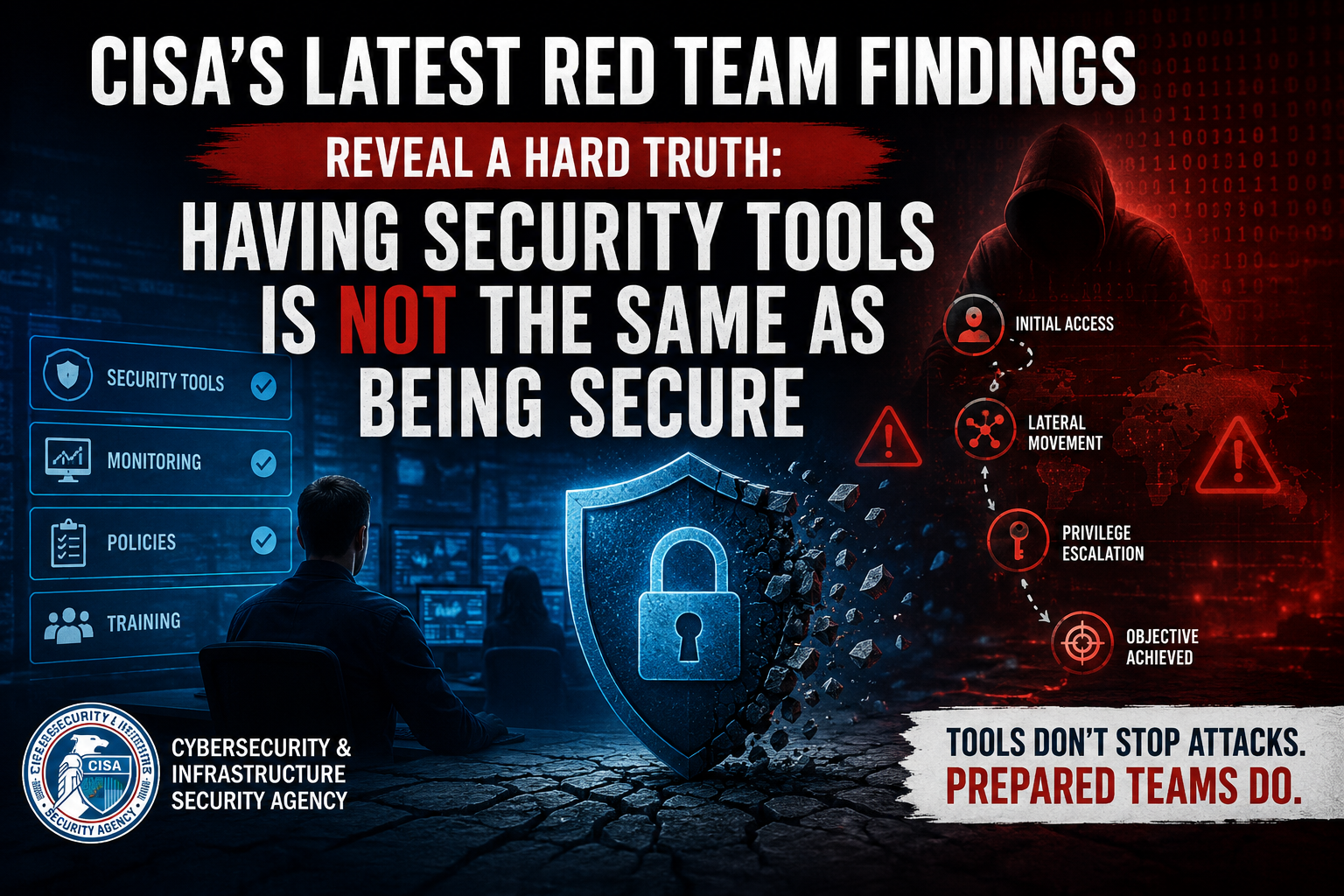
Many organizations invest heavily in cybersecurity tools. They deploy endpoint protection, collect logs, purchase security monitoring services, and implement security policies.
Yet when a real attacker gets in, many organizations still struggle to detect suspicious activity, investigate incidents, and respond before damage occurs.
A recent advisory from the U.S. Cybersecurity and Infrastructure Security Agency (CISA) highlights exactly why. Through authorized red team assessments conducted at two critical infrastructure organizations, CISA simulated real-world cyberattacks to evaluate how effectively organizations could detect, investigate, and respond to malicious activity. The results revealed significant gaps between having security controls in place and actually being prepared to stop an attack.
What Is a Red Team Assessment?
A red team assessment is a controlled cybersecurity exercise where security professionals simulate the tactics, techniques, and procedures used by real threat actors.
Unlike a traditional vulnerability scan or penetration test that focuses primarily on technical weaknesses, red team exercises evaluate people, processes, and technology together. The goal is to determine whether an organization can detect and respond to an attack before significant damage occurs.
Think of it as a fire drill for cybersecurity.
The purpose is not simply to find vulnerabilities. It is to determine whether the organization's security program actually works when faced with a realistic threat.
What CISA Discovered
CISA's red team assessments showed a stark contrast between the two organizations.
In one environment, attackers were able to move through systems and achieve objectives without being detected by the security operations team. In the other, defenders successfully identified and responded to suspicious activity, significantly limiting the red team's ability to operate.
The findings reinforce an important lesson:
Security tools alone do not provide protection.
Organizations may have monitoring solutions, endpoint detection platforms, and logging systems installed, but if alerts are not reviewed, processes are not practiced, and teams are not prepared, those investments may provide little value during an actual incident.
Common Weaknesses Identified
While every organization is different, CISA's findings highlighted several recurring issues that many businesses face:
1. Insufficient Monitoring and Detection
Many organizations collect large amounts of security data but lack the processes needed to identify meaningful threats within that data.
When alerts go unreviewed or detection rules are poorly configured, attackers can operate for extended periods without being noticed.
2. Weak Identity and Access Controls
Compromised credentials remain one of the most common paths attackers use to gain access.
Once attackers obtain legitimate credentials, they can often blend in with normal user activity, making detection much more difficult. Effective identity management, privileged access controls, and multi-factor authentication remain critical defenses.
3. Limited Incident Response Readiness
Many organizations have incident response plans on paper but have never tested them.
Without regular exercises and simulations, teams may not know how to react when an actual security event occurs. This can lead to confusion, delayed responses, and greater business impact.
4. Lack of Visibility Across Environments
Modern organizations operate across on-premises systems, cloud services, remote work environments, and third-party platforms.
Attackers often exploit visibility gaps between these environments to move laterally and maintain access. CISA's assessments included enterprise systems, cloud identities, applications, and even pathways toward operational technology environments.
Why This Matters for Small and Mid-Sized Businesses
Many business leaders assume red team exercises are only for large enterprises or government agencies.
That assumption can be dangerous.
Cybercriminals increasingly target small and mid-sized organizations because they often have fewer resources, less mature security programs, and weaker monitoring capabilities.
Attackers do not care about the size of your company. They care whether your defenses can be bypassed.
If your organization cannot detect suspicious activity, a ransomware operator, insider threat, or compromised vendor could remain undetected for days, weeks, or even months.
The Compliance Perspective
From a compliance standpoint, these findings reinforce a growing trend across major frameworks:
Organizations are expected to demonstrate not only that security controls exist, but that they are effective.
Frameworks such as NIST Cybersecurity Framework (CSF), NIST 800-171, CMMC, ISO 27001, SOC 2, and CIS Controls all emphasize continuous monitoring, incident response testing, access management, and security validation activities.
Auditors increasingly ask questions such as:
How do you know your controls are working?
When was the last time you tested your incident response plan?
Can you detect unauthorized activity?
How quickly can your team respond to a security incident?
Are your monitoring and alerting systems regularly reviewed?
Red team assessments and similar validation exercises help organizations answer these questions with evidence rather than assumptions.
Key Lessons for Business Leaders
CISA's advisory offers several important takeaways:
Assume Prevention Will Eventually Fail
No security control is perfect. Organizations should invest as much effort into detection and response as they do into prevention.
Test Your Security Program Regularly
Tabletop exercises, penetration tests, phishing simulations, vulnerability assessments, and red team engagements help identify weaknesses before attackers do.
Improve Security Visibility
Ensure logs, alerts, cloud activity, endpoint events, and user behavior are being monitored and reviewed.
Strengthen Identity Security
Implement multi-factor authentication, review privileged accounts, enforce strong password policies, and monitor for suspicious login activity.
Practice Incident Response
A well-documented incident response plan is valuable only if employees know how to execute it under pressure.
Final Thoughts
The most important lesson from CISA's latest advisory is simple:
Cybersecurity is not measured by the number of tools you own. It is measured by your ability to detect, respond to, and recover from real attacks.
Organizations that regularly test their defenses gain a clearer understanding of their risks, improve operational readiness, and reduce the likelihood that a minor security event becomes a major business disruption.
The question every organization should ask is not, "Do we have security tools?"
The better question is:
"If an attacker gained access today, would we know?"
Ready to see where your company defenses stand?
👉 Request your customized cyber vulnerability report today and stay ahead of threats.
👉 Gain insights into your unique cybersecurity vulnerabilities with a custom report.
👉 Train your team to be your first line of defense
📞 Schedule a call today or 📧 contact us for a consultation.