
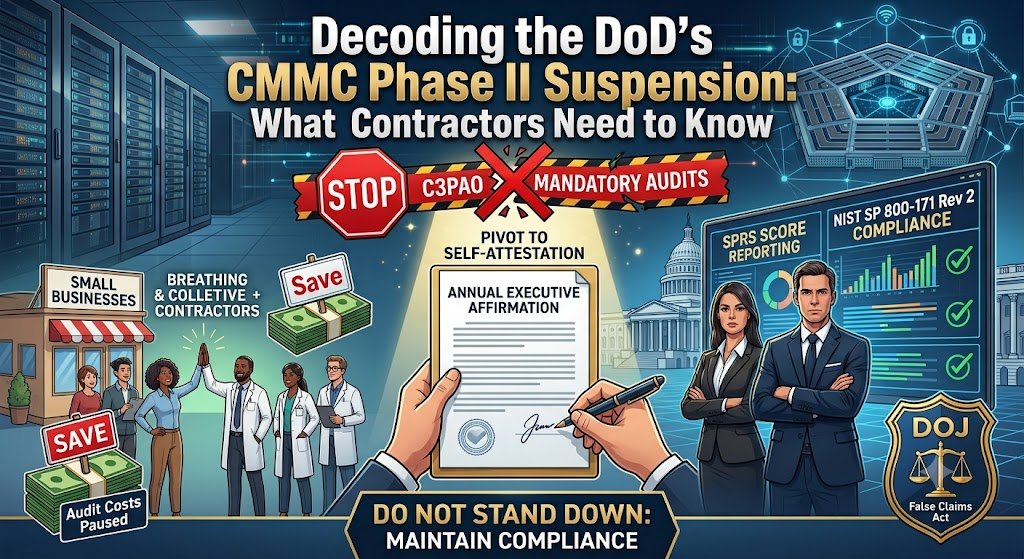
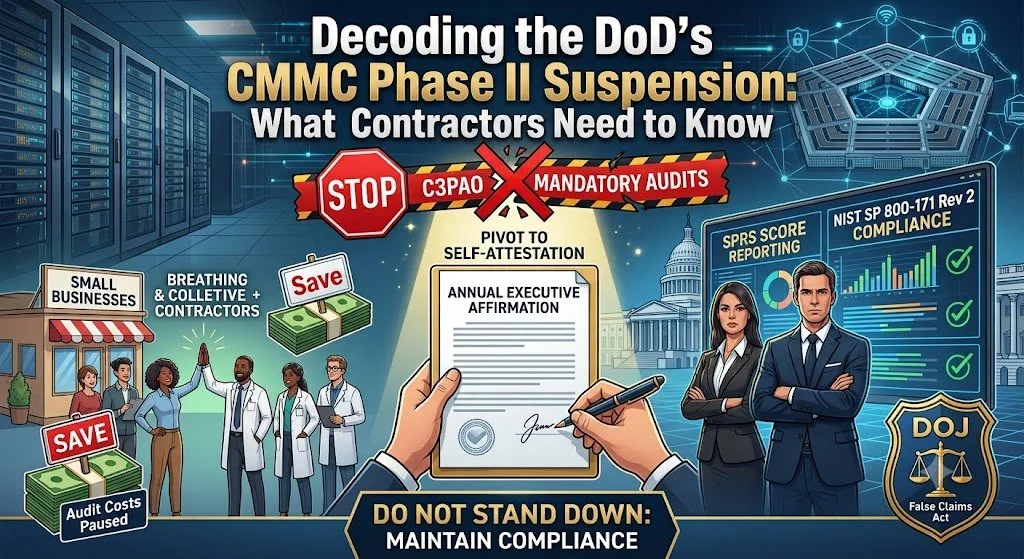
If you operate in the Defense Industrial Base (DIB), you’ve likely spent months preparing for mandatory third-party cybersecurity audits. However, in a major policy pivot, the Department of Defense (DoD) announced an immediate suspension of CMMC Phase II requirements—halting the mandatory rollout of third-party assessor (C3PAO) audits originally set for November 10, 2026.
While this creates needed breathing room, it is not a free pass to stand down. In fact, by pausing C3PAO audits, the DoD is relying heavily on annual executive affirmations. Here is what changed, why the Phase II pause happened, and the concrete steps your organization must take right now to maintain compliance.
1. What Triggered the Phase II Suspension?
The suspension stems from directives aimed at reducing administrative red tape and lowering financial barriers for small, medium, and non-traditional defense contractors.
Key drivers behind the decision include:
High Financial Burden: Industry feedback and Small Business Administration (SBA) data showed C3PAO audit costs were running upward of $500k+ for smaller sub-tier suppliers, driving innovative vendors out of the defense market.
60-Day Reform Review: The Department established a CMMC Reform Task Force to conduct a top-to-bottom review, replacing rigid paperwork exercises with scalable, operational cyber resilience.
Solicitation Amendments: Contracting officers have been instructed to remove C3PAO requirements from active and future solicitations, substituting Level 1 (Self) or Level 2 (Self) assessments.
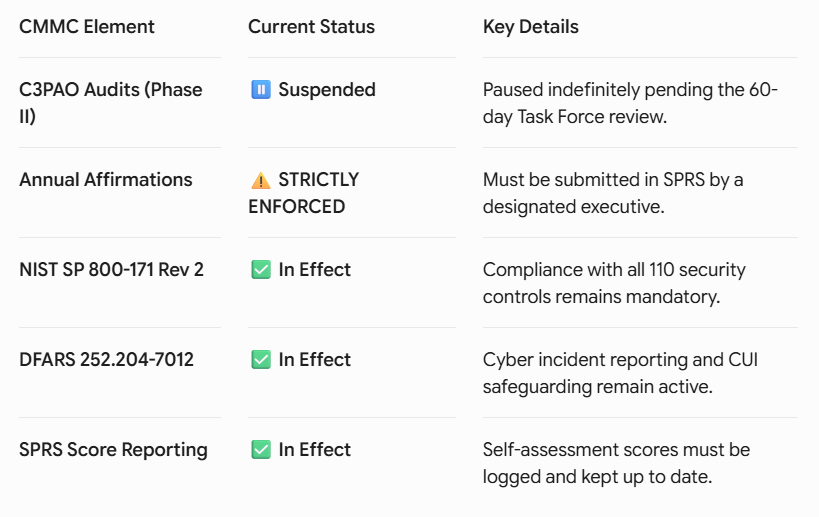
Key Takeaway: The pause halts mandatory third-party C3PAO audits. It does not suspend your legal and contractual obligation to safeguard Controlled Unclassified Information (CUI) under DFARS 252.204-7012.
2. Paused vs. Required: The Compliance Breakdown
To keep your contracts safe, it helps to distinguish between what was paused and what remains enforced:
3. The Catch: Why Annual Affirmations Carry Massive Legal Weight
With third-party auditors out of the picture for now, federal oversight isn't disappearing—it's shifting to self-attestation backed by law enforcement.
Under 32 CFR § 170.22 and DFARS 252.204-7021, contractors handling CUI or FCI must navigate a strict four-step compliance process:
NIST SP 800-171 Self-Assessment: Conduct an internal technical evaluation against all 110 security controls.
SPRS Score Entry: Log your calculated assessment score in the Supplier Performance Risk System.
Annual Executive Affirmation: An official corporate officer formally attests to continuing compliance in SPRS.
Legal Enforcement: Submitting false or unverified affirmations triggers civil and criminal liability under the Department of Justice's Civil Cyber-Fraud Initiative (False Claims Act).
Key Affirmation Rules You Cannot Ignore:
The "Affirming Official" Rule: The sign-off must come from a corporate officer (e.g., CEO, CISO, COO) with the legal authority to bind the company.
No Outsourcing: You cannot delegate this attestation to a third-party Managed Service Provider (MSP), virtual CISO, or IT vendor. Leadership must personally take ownership.
Trigger Milestones: Affirmations are required upon initial score submission, annually thereafter for the life of the contract, and upon closing out any 180-day Plan of Action and Milestones (POA&M).
⚠️ The False Claims Act (FCA) Connection:
The Department of Justice (DOJ) uses its Civil Cyber-Fraud Initiative to prosecute contractors that submit inaccurate SPRS scores or false affirmations. Signing an affirmation when security controls aren't actually running in real-time opens both the company and the individual executive to severe legal risk.
4. Next Steps: Action Plan for Defense Contractors
The CMMC Phase II suspension delivers welcome relief from immediate third-party audit fees, but removing C3PAOs turns annual executive affirmations into the primary enforcement tool. Here is how leadership should navigate this transition period:
Immediate Regulatory Actions (By August 14, 2026)
Participate in the DoD Public RFI: The Pentagon opened a public Request for Information (RFI) seeking DIB feedback on C3PAO costs, assessment availability, and regulatory friction. Submitting feedback directly influences how the CMMC Reform Task Force restructures the program.
Review Active Solicitations: Verify that Contracting Officers have updated current RFPs/RFIs to specify Level 1 (Self) or Level 2 (Self) rather than requiring Level 2 C3PAO third-party certifications.
Operational & Evidence Controls (30–60 Days)
Audit Your SPRS Evidence Trail: Before your Affirming Official signs off in SPRS, compile verifiable technical artifacts (e.g., MFA logs, patch records, system configuration files) for all 110 NIST SP 800-171 Rev 2 controls.
Re-Validate System Boundaries: Ensure all cloud repositories (e.g., AWS GovCloud, Microsoft GCC High), sub-tier contractor connections, and remote worker endpoints handling CUI/FCI are explicitly mapped.
Execute Against Your POA&M: Work through active Plans of Action & Milestones. The pause on C3PAO audits does not pause the clock on 180-day POA&M remediation windows.
Subcontractor & Flow-Down Management
Communicate with Sub-Tiers: Update flow-down templates under DFARS 252.204-7012. Confirm that suppliers maintain active SPRS self-assessment scores without holding them to paused C3PAO audit schedules.
Maintain Defensible Posture: Remind leadership that DOJ Cyber-Fraud Initiative enforcement remains active—self-attestations must accurately reflect operational reality at all times.
The Bottom Line
Treat this suspension not as a signal to slow down, but as an opportunity to solidify your technical posture without audit deadline pressure. Ensuring your NIST SP 800-171 controls are operational day-in and day-out allows your executive team to sign off in SPRS with absolute confidence.
Ready to see where your company defenses stand?
👉 Request your customized cyber vulnerability report today and stay ahead of threats.
👉 Gain insights into your unique cybersecurity vulnerabilities with a custom report.
👉 Train your team to be your first line of defense
📞 Schedule a call today or 📧 contact us for a consultation.