
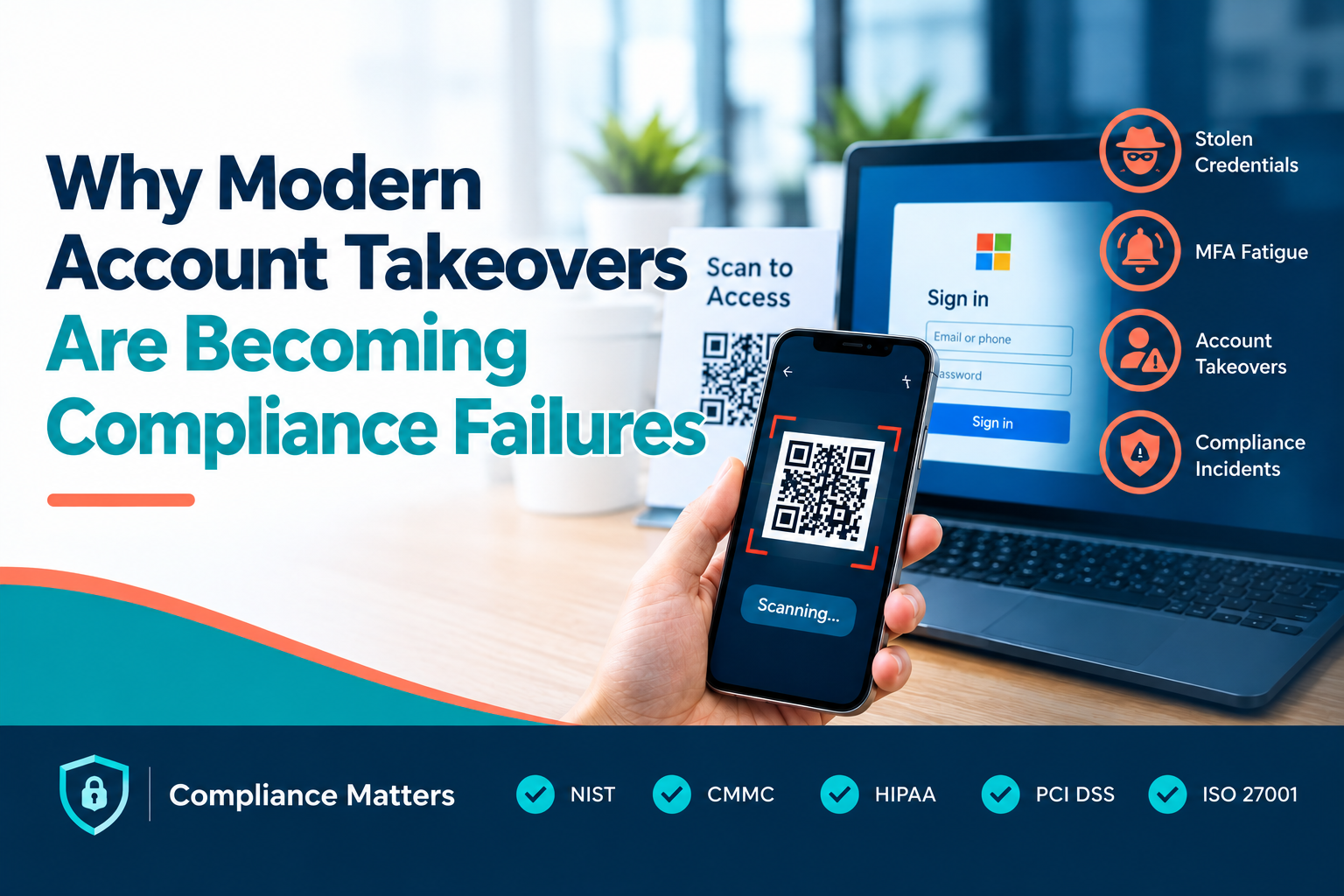
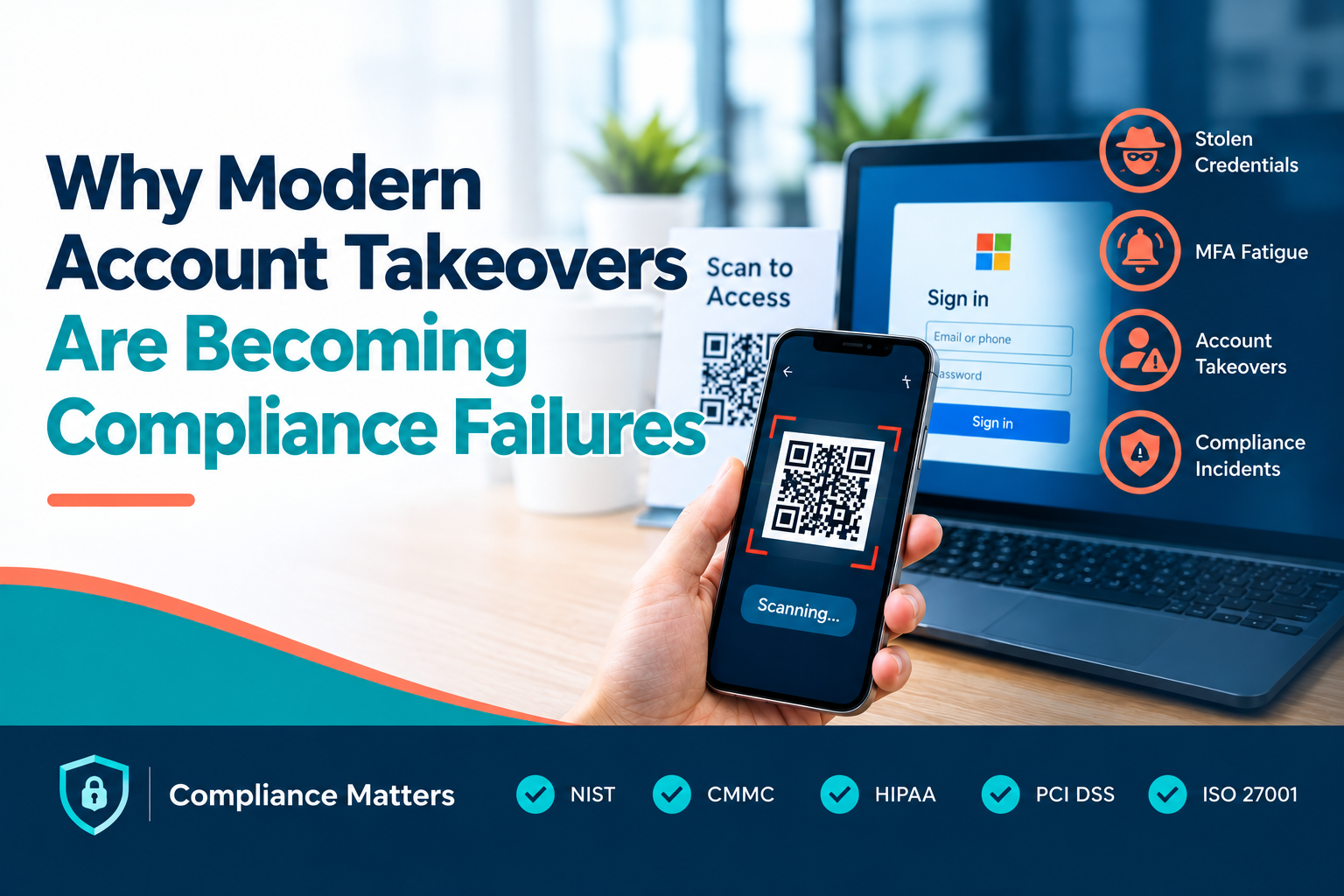
When MFA Isn't Enough: The Compliance Risks Behind QR Code Phishing and Modern Account Takeovers
For years, organizations have been told that enabling multi-factor authentication (MFA) is one of the most effective ways to protect user accounts.
And it is.
But today's attackers are no longer focused on breaking technology. They are focused on exploiting people.
Instead of guessing passwords or launching sophisticated technical attacks, cybercriminals are taking advantage of everyday actions employees perform without a second thought—scanning a QR code, approving a login request, or granting access to a seemingly legitimate application.
As a result, organizations that believe they have strong authentication controls in place are still experiencing account compromises, business email fraud, data exposure incidents, and compliance failures.
This is no longer just a cybersecurity problem.
It is a compliance problem.
Because when an employee account is compromised, auditors, regulators, clients, insurers, and business partners are not interested in whether MFA was enabled. They want to know whether your organization had effective controls in place to prevent, detect, and respond to the threat.
The Compliance Gap Many Organizations Don't Realize Exists
Most compliance frameworks require organizations to implement access controls, user authentication, employee training, and continuous monitoring.
Whether your organization follows NIST, CMMC, HIPAA, PCI DSS, ISO 27001, SOC 2, or another framework, the objective is the same:
Protect sensitive information by ensuring only authorized individuals have access to systems and data.
Unfortunately, many organizations mistake the existence of a control for the effectiveness of a control.
For example, a company may enable MFA for every employee and assume the risk has been addressed.
However, if employees can still be tricked into approving fraudulent login requests or entering credentials into fake websites, the control can be bypassed without exploiting a single technical vulnerability.
From a compliance perspective, that represents a significant risk.
Controls must not only exist—they must be effective, documented, monitored, and supported by training and governance processes.
Why QR Code Phishing Has Become a Growing Business Risk
QR codes have become part of everyday business operations.
Employees use them to access documents, join meetings, review invoices, register for events, download applications, and access company resources.
Because QR codes are convenient and familiar, people tend to trust them.
Attackers are taking advantage of that trust.
Instead of sending suspicious-looking links, criminals embed malicious websites behind QR codes that lead users to convincing login pages designed to steal credentials.
The attack is simple.
An employee scans a code, sees what appears to be a Microsoft 365, Google, or company login screen, enters credentials, and unknowingly hands access to an attacker.
In some cases, attackers place fraudulent QR code stickers over legitimate signs, posters, payment stations, or workplace materials. In others, they distribute QR codes through email, chat platforms, or electronic documents.
Because users cannot easily verify where a QR code leads before scanning it, traditional phishing awareness techniques become less effective.
For organizations that handle customer information, healthcare data, financial records, intellectual property, or controlled government information, a single successful QR code phishing attack can quickly become a reportable compliance incident.
MFA Fatigue: When Security Controls Are Used Against You
Multi-factor authentication remains a critical security safeguard, but attackers have found ways to manipulate human behavior to bypass it.
One increasingly common technique is known as MFA fatigue or push fatigue.
The attack begins when criminals obtain a user's password through phishing, data breaches, password reuse, or credential theft.
Unable to complete the login because MFA is required, the attacker repeatedly triggers authentication requests to the user's device.
The employee receives a continuous stream of notifications asking them to approve a login attempt.
Eventually, frustration, distraction, or confusion leads the employee to approve one of the requests.
Some attackers take the deception even further by calling the employee while the notifications are appearing and pretending to be a member of the IT department.
The employee believes they are helping resolve a technical issue and unknowingly grants access to the attacker.
From a compliance perspective, this highlights an important reality:
A control that relies entirely on user judgment can become a significant risk if employees are not properly trained and monitored.
What Happens After an Account Is Compromised?
Many business leaders assume an attacker will simply read emails and move on.
In reality, compromised accounts often become the starting point for much larger incidents.
Once access is established, attackers frequently:
Register their own MFA methods
Create mailbox forwarding rules
Monitor executive communications
Download sensitive documents
Access cloud storage platforms
Send fraudulent payment requests
Impersonate employees or executives
Approve unauthorized applications
Maintain long-term access to company resources
These activities can continue for days or even weeks before being discovered.
By the time the compromise is identified, organizations may already be dealing with financial losses, contractual obligations, regulatory reporting requirements, cyber insurance notifications, client communications, and forensic investigations.
The longer unauthorized access remains undetected, the greater the operational and compliance impact.
What Auditors, Clients, and Regulators Want to See
When reviewing cybersecurity programs, auditors are increasingly focused on how organizations manage identity-related risks.
They want evidence that controls are operating effectively—not simply that they have been implemented.
Organizations should be prepared to demonstrate the following:
Employee Training That Addresses Modern Threats
Security awareness programs should educate employees on:
QR code phishing attacks
MFA fatigue and push-notification scams
Social engineering techniques
Fraudulent IT support requests
Suspicious application permission requests
Business email compromise tactics
Most importantly, organizations should maintain documentation proving that training has occurred.
If it isn't documented, it becomes difficult to prove during an audit.
Stronger Authentication Practices
Organizations should evaluate whether traditional MFA is sufficient for high-risk users.
Additional safeguards may include:
Phishing-resistant MFA
Passkeys or hardware security keys
Number matching authentication
Risk-based authentication controls
Enhanced protection for privileged accounts
The goal is not simply to require MFA but to reduce opportunities for attackers to abuse it.
Continuous Monitoring of Identity Changes
Identity-related monitoring should include alerts for:
New MFA device registrations
Password resets
Inbox forwarding rules
Unusual login locations
Impossible-travel events
OAuth application approvals
High-volume file downloads
Early detection can significantly reduce the impact of an account compromise.
Governance Over Third-Party Applications
Many modern attacks do not require stolen passwords.
Instead, users are tricked into granting applications permission to access company data.
Organizations should establish controls for:
Application approval processes
Permission reviews
OAuth governance
Documentation of approved integrations
Removal of unnecessary access rights
This area is often overlooked despite representing a significant compliance risk.
Policies That Support Effective Compliance
Technology alone cannot address identity-based threats.
Organizations should ensure policies and procedures clearly address:
QR Code Safety
Employees should be instructed to:
Verify the source of QR codes before scanning
Treat emailed QR codes with caution
Use official company portals whenever possible
Report suspicious codes immediately
Authentication Security
Policies should require employees to:
Deny unexpected MFA requests
Report suspicious login notifications
Use approved authentication methods
Follow enhanced requirements for privileged access
Financial Verification Controls
Organizations should establish documented procedures requiring:
Independent verification of banking changes
Verification through known contact information
Approval workflows for payment modifications
Evidence of verification activities
Help Desk Verification Standards
Support teams should have documented processes for:
Identity verification
Password reset requests
MFA resets
Account recovery procedures
These controls help prevent social engineering attacks against internal support personnel.
Compliance Is About Proving Controls Work
Many organizations invest heavily in cybersecurity tools and believe those investments alone reduce risk.
However, compliance is not measured by the tools you purchase.
It is measured by your ability to demonstrate that controls are operating effectively.
QR code phishing and MFA fatigue attacks are powerful reminders that technology alone cannot protect an organization.
Policies, procedures, employee training, monitoring, governance, and documented evidence all play a critical role in reducing risk.
The organizations that perform best during audits, client assessments, insurance reviews, and regulatory examinations are not necessarily the ones with the largest security budgets.
They are the ones that can clearly demonstrate that their controls are implemented, understood, monitored, documented, and consistently followed.
Final Thoughts
Cybercriminals continue to evolve because they understand a simple truth: people are often easier to exploit than technology.
That is why compliance programs must evolve beyond passwords and basic MFA requirements.
If your organization has not recently reviewed its policies, training programs, authentication controls, monitoring practices, and identity governance processes, now is the time.
Because when a regulator, client, auditor, or cyber insurance provider asks how your organization protects sensitive information, "We have MFA enabled" is no longer enough.
The real question is:
Can you prove your identity controls are effective against the threats organizations face today?
Ready to see where your company defenses stand?
👉 Request your customized cyber vulnerability report today and stay ahead of threats.
👉 Gain insights into your unique cybersecurity vulnerabilities with a custom report.
👉 Train your team to be your first line of defense
📞 Schedule a call today or 📧 contact us for a consultation.