
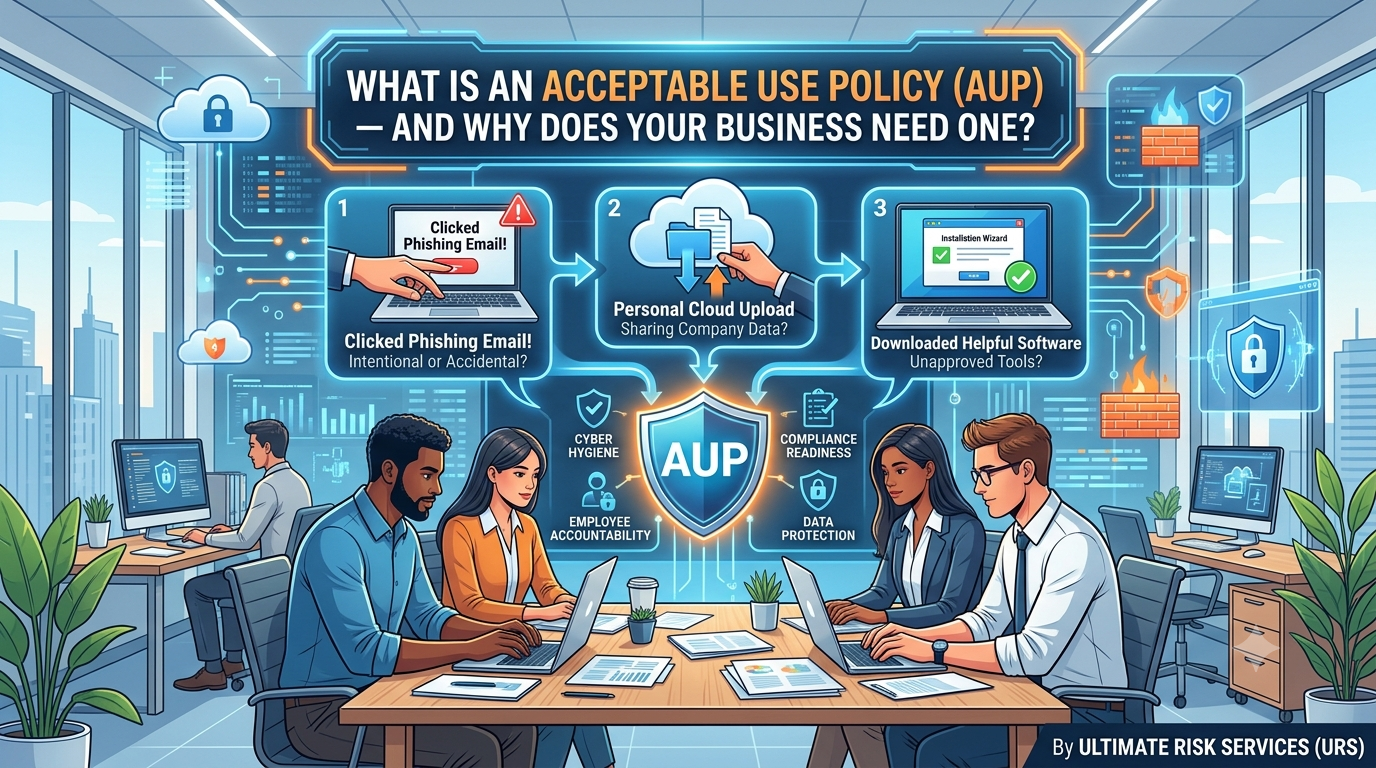
Most cybersecurity incidents don't start with sophisticated hackers. They start with everyday decisions made by well-intentioned employees.
Someone clicks a suspicious email.
Someone uploads company files to a personal cloud account.
Someone installs software they found online because it seemed helpful.
None of these actions are usually malicious. They're often the result of unclear expectations.
That's where an Acceptable Use Policy (AUP) comes in.
An AUP is one of the most overlooked cybersecurity documents in a business, yet it serves as a foundation for good cyber hygiene, compliance readiness, and employee accountability.
So, What Exactly Is an Acceptable Use Policy?
An Acceptable Use Policy is a formal document that explains how employees are expected to use company technology and information systems.
Think of it as the "rules of the road" for your organization's digital environment.
It outlines:
How company computers, laptops, and mobile devices should be used
Expectations for email and internet usage
Password and security requirements
Rules for handling sensitive data
Guidelines for personal device usage
Consequences for violating company technology policies
Without an AUP, employees are left to make their own decisions about what is acceptable—and that creates unnecessary risk for the business.
Why This Matters More Than Ever
Years ago, most employees worked from company offices on company-owned devices.
Today, people work remotely, access cloud applications from anywhere, use personal phones for business communication, and regularly interact with AI tools and third-party platforms.
The technology landscape has changed dramatically.
Unfortunately, many businesses have not updated their policies to keep pace.
As a result, organizations often discover gaps only after an incident occurs, an auditor asks questions, or a cyber insurance application requires documentation.
At that point, the absence of a clear policy becomes much more than an administrative issue.
It becomes a business risk.
The Real Cost of Not Having an AUP
Many business owners assume common sense will guide employee behavior.
The reality is that common sense is not a security control.
Here are a few examples I regularly see across organizations:
Phishing Attacks Become More Successful
An employee receives what appears to be a legitimate email from a vendor, bank, or executive.
Without clear guidance on identifying and reporting suspicious emails, they click a link and unknowingly provide credentials to an attacker.
A documented AUP reinforces employee responsibilities and supports security awareness training that can prevent these situations.
Sensitive Information Leaves the Organization
Employees often send files to personal email accounts, store documents in unauthorized cloud applications, or share information through unapproved communication platforms.
Without clear rules, they may not even realize they are creating risk.
A strong AUP establishes expectations before these situations occur.
Compliance and Audit Issues Surface
Whether your organization is pursuing CMMC, SOC 2, HIPAA, ISO 27001, or cyber insurance coverage, documentation matters.
One of the first things auditors and assessors often request is evidence of security policies, including an Acceptable Use Policy.
If you don't have one, you may face delays, corrective actions, additional costs, or compliance gaps.
HR and Legal Challenges Become Harder to Manage
Imagine terminating an employee for misuse of company systems.
If there is no documented policy and no signed acknowledgment, defending that decision becomes significantly more difficult.
An AUP provides clarity, consistency, and documentation that can help protect the organization.
Productivity Suffers
Unrestricted streaming, unauthorized software downloads, excessive personal use, and risky browsing habits can impact network performance and employee productivity.
An AUP provides leadership and IT teams with a consistent standard for managing these issues.
What Should Be Included in an Effective Acceptable Use Policy?
An effective AUP shouldn't read like a legal document that nobody understands.
It should be practical, clear, and relevant to how your employees actually work.
At a minimum, your policy should address:
Technology Usage Expectations
Define how company devices, applications, networks, and internet access should be used.
Clearly identify prohibited activities such as unauthorized software installations, illegal activities, or accessing inappropriate content.
Data Protection Requirements
Explain how employees should handle confidential information, customer data, financial records, and other sensitive business information.
Include expectations around file sharing, storage, and data transmission.
Password and Security Practices
Set standards for password management, multi-factor authentication, device security, and reporting security incidents.
Email and Communication Guidelines
Employees should understand how to identify phishing attempts, report suspicious messages, and communicate professionally using company systems.
Personal Device Usage
If employees use personal phones, tablets, or computers for work, establish clear rules around security requirements, access controls, and ownership of business data.
Policy Violations and Enforcement
Employees should understand the consequences of violating company policies.
Consistency is critical. Policies only work when they are enforced fairly across the organization.
Employee Acknowledgment
Every employee should review, acknowledge, and sign the policy.
An unsigned policy provides very little protection when issues arise.
How an AUP Strengthens Your Cyber Hygiene
Cyber hygiene is not just about firewalls, antivirus software, and vulnerability scans.
It's about creating habits and behaviors that reduce risk every day.
An Acceptable Use Policy supports cyber hygiene by:
Reducing risky employee behavior
Encouraging accountability
Reinforcing security awareness training
Protecting sensitive information
Supporting incident response efforts
Creating a stronger security culture
When employees understand expectations, they make better security decisions.
And better decisions lead to fewer incidents.
The Business Benefits Go Beyond Cybersecurity
One of the biggest misconceptions about an AUP is that it only benefits the IT department.
In reality, it supports multiple areas of the business.
Leadership Gains Consistency
Managers have a documented standard they can reference when addressing technology misuse or security concerns.
HR Gains Protection
Written policies and employee acknowledgments help support disciplinary actions and reduce legal exposure.
Compliance Teams Gain Readiness
Documented policies help satisfy regulatory, contractual, and insurance requirements.
Employees Gain Clarity
Most employees want to do the right thing.
They simply need clear guidance on what is expected.
An AUP Is Not About Distrust—It's About Protection
One of the most common objections I hear is:
"We trust our employees."
That's great—and you should.
But an Acceptable Use Policy isn't created because you don't trust your team.
It's created because even good employees make mistakes.
A policy provides guidance before mistakes happen, not punishment after they occur.
The goal is not to restrict employees.
The goal is to protect them, the business, and the customers who rely on you.
How Ultimate Risk Services (URS) Can Help
Many organizations download a generic policy template from the internet and assume they are covered.
Unfortunately, auditors, insurers, and regulators often expect policies that align with your specific business operations, technology environment, and compliance requirements.
At URS, we help organizations develop practical, business-focused Acceptable Use Policies that employees can understand and leadership can enforce.
Our approach includes:
Policy development and customization
Compliance alignment
Security governance support
Employee acknowledgment processes
Security awareness integration
Ongoing policy reviews and updates
A policy sitting in a folder does not reduce risk.
A policy that employees understand, acknowledge, and follow does.
Final Thoughts
An Acceptable Use Policy may not be the most exciting cybersecurity investment you'll make, but it is one of the most important.
It establishes expectations, reduces risk, supports compliance, protects the organization legally, and helps build a culture of accountability.
If your business does not currently have an AUP—or if your existing policy hasn't been reviewed in years—now is the time to address it.
Because when it comes to cybersecurity, clear expectations are far less expensive than preventable incidents.
Ready to see where your company defenses stand?
👉 Request your customized cyber vulnerability report today and stay ahead of threats.
👉 Gain insights into your unique cybersecurity vulnerabilities with a custom report.
👉 Train your team to be your first line of defense
📞 Schedule a call today or 📧 contact us for a consultation.