
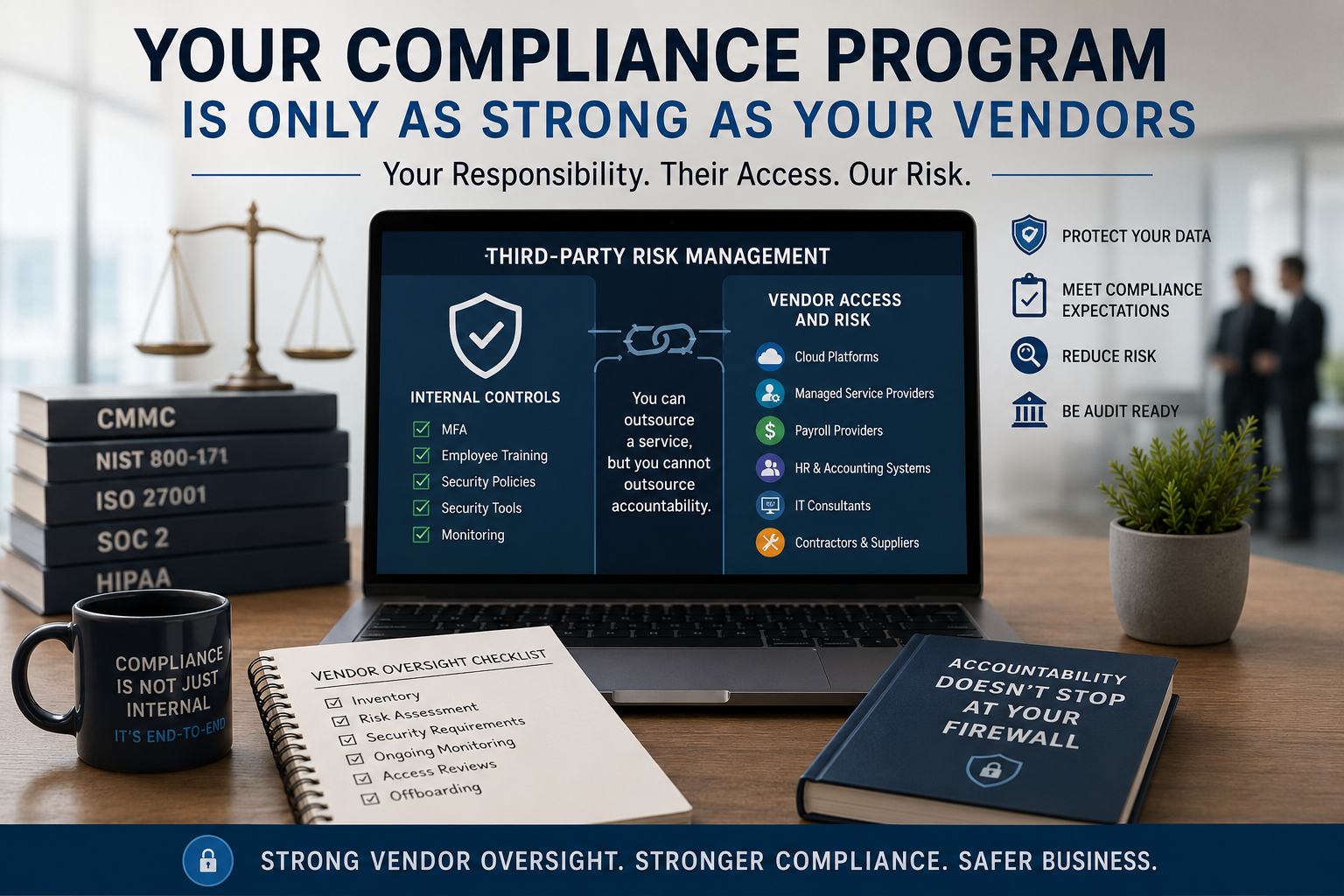
Most organizations spend time and money strengthening their own cybersecurity controls. They implement multi-factor authentication, conduct employee training, maintain policies, and invest in security tools.
But there is one area that often gets overlooked:
The vendors, suppliers, contractors, and service providers that have access to your systems, data, or business processes.
From a compliance perspective, your responsibility doesn't stop at your own network. Regulators, auditors, customers, and cyber insurers increasingly expect organizations to understand and manage the risks introduced by third parties.
The reality is simple: you can outsource a service, but you cannot outsource accountability.
Why Vendor Risk Matters for Compliance
Many businesses rely on third parties for critical operations:
Cloud platforms
Payroll providers
Managed service providers (MSPs)
Accounting systems
HR platforms
Marketing software
IT consultants
Contractors and subcontractors
These vendors often handle sensitive information or have privileged access to systems.
If a vendor experiences a security incident, the impact can quickly become your problem.
A compromised vendor can expose:
Customer information
Employee records
Financial data
Intellectual property
Government-controlled information
Regulated data subject to compliance requirements
This is why modern compliance frameworks place significant emphasis on third-party risk management.
What Auditors Want to See
Whether you're working toward CMMC, NIST 800-171, SOC 2, ISO 27001, HIPAA, or other security frameworks, auditors are increasingly asking similar questions:
Do you maintain an inventory of vendors?
Have you identified vendors that handle sensitive information?
Are vendor security requirements documented?
How do you evaluate vendor security practices?
Who approves vendor access?
How often is vendor access reviewed?
How do you remove access when services end?
Organizations frequently discover that they have strong internal controls but little visibility into their vendor ecosystem.
That gap can create compliance findings, audit concerns, and increased organizational risk.
The Compliance Risks Hidden in Vendor Relationships
Lack of Vendor Inventory
Many organizations cannot quickly answer a basic question:
Which third parties currently have access to our systems or data?
Without a centralized inventory, it becomes difficult to demonstrate oversight during an audit or compliance assessment.
You cannot assess risks that you haven't identified.
Excessive Access Privileges
Vendors often receive more access than necessary because it is convenient during implementation.
Over time, temporary permissions become permanent.
From a compliance standpoint, this violates the principle of least privilege—a requirement found in many security frameworks.
Vendors should receive only the access necessary to perform their responsibilities and nothing more.
No Formal Security Review
Before granting access, organizations should understand whether a vendor maintains reasonable security controls.
Unfortunately, many businesses never ask.
Basic due diligence should include questions such as:
Do they use multi-factor authentication?
How is customer data protected?
Do they conduct security awareness training?
Do they maintain incident response procedures?
Have they experienced recent security incidents?
The goal is not to eliminate all risk but to ensure vendors are managing risk responsibly.
Dormant Accounts and Forgotten Access
One of the most common findings during security assessments is the existence of active accounts tied to former vendors, expired contracts, or completed projects.
These dormant accounts create unnecessary exposure and increase the attack surface available to threat actors.
A mature compliance program includes a process for regularly reviewing and removing unused access.
Lack of Ongoing Monitoring
Vendor risk management is not a one-time exercise.
A vendor that was secure two years ago may have experienced personnel changes, security incidents, acquisitions, or infrastructure changes since then.
Periodic reviews help ensure vendors continue to meet your organization's security expectations.
Building a Vendor Compliance Program
You don't need a large compliance department to improve third-party oversight.
Start with a structured approach.
1. Create a Vendor Inventory
Document every vendor that:
Accesses company systems
Processes sensitive data
Supports critical business functions
Connects to your network
For each vendor, record:
Services provided
Systems accessed
Data handled
Business owner
Contract renewal date
Access level
This inventory becomes the foundation of your vendor management program.
2. Classify Vendor Risk
Not every vendor presents the same level of risk.
A coffee supplier does not require the same scrutiny as a managed IT provider with administrative access to your network.
Consider categorizing vendors as:
Low Risk
Moderate Risk
High Risk
Factors may include:
Access to sensitive data
Network connectivity
Regulatory impact
Operational dependency
This allows you to focus resources where risk is highest.
3. Establish Security Requirements
Define minimum security expectations for vendors that handle sensitive information.
Examples include:
Multi-factor authentication
Encryption of sensitive data
Incident reporting requirements
Access control standards
Background screening where appropriate
Secure data disposal procedures
Documenting expectations helps establish accountability and supports audit readiness.
4. Conduct Periodic Reviews
Vendor relationships evolve over time.
At least annually, review:
Access permissions
Contract status
Security posture
Data-sharing arrangements
Compliance requirements
Regular reviews demonstrate ongoing oversight and strengthen compliance maturity.
5. Remove Access Promptly
When a contract ends, access should end as well.
Develop a formal offboarding process that ensures:
Accounts are disabled
Credentials are revoked
Shared access is removed
Data access is terminated
Documentation is updated
This simple control can significantly reduce risk.
Compliance Is No Longer Just About Internal Controls
Many organizations still view cybersecurity and compliance as internal responsibilities.
Today's threat landscape and regulatory expectations have changed that perspective.
Your security posture now includes the vendors you trust, the partners you connect with, and the third parties that process your data.
Strong vendor risk management demonstrates that your organization understands this reality and is actively addressing it.
More importantly, it helps protect your business from security incidents, audit findings, contract risks, and reputational damage.
Final Thoughts
Vendor management is often treated as a procurement function. In reality, it is a critical component of cybersecurity and compliance.
Organizations that maintain vendor inventories, assess third-party risks, review access regularly, and establish clear security expectations are better positioned for audits, customer requirements, cyber insurance reviews, and regulatory scrutiny.
The question isn't whether your vendors create risk.
The question is whether you can demonstrate that you're managing that risk.
Because when an auditor, customer, or regulator asks about your third-party oversight, "we trust our vendors" is no longer enough.
Ready to see where your company defenses stand?
👉 Request your customized cyber vulnerability report today and stay ahead of threats.
👉 Gain insights into your unique cybersecurity vulnerabilities with a custom report.
👉 Train your team to be your first line of defense
📞 Schedule a call today or 📧 contact us for a consultation.