
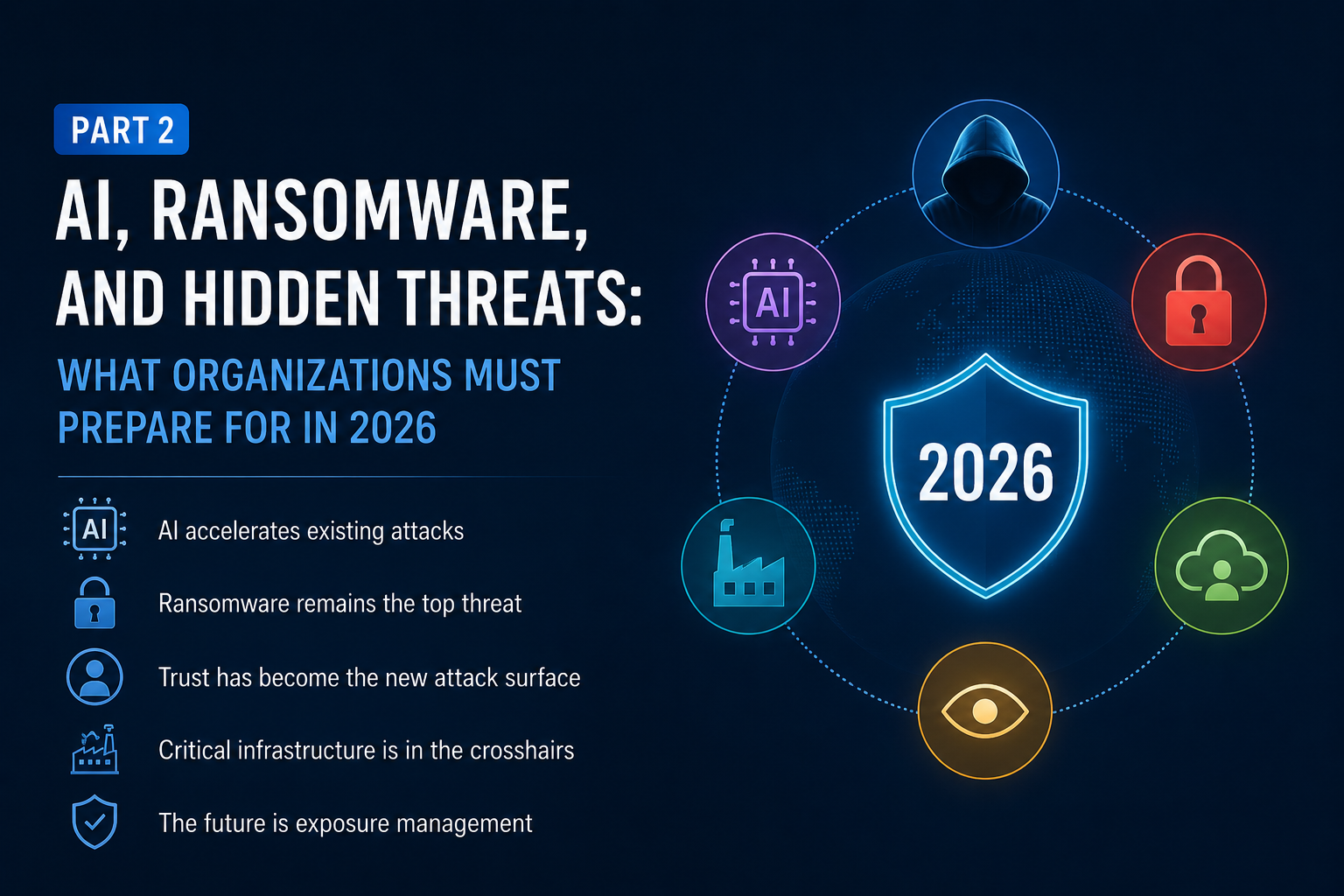
Source: Rapid7 Threat Landscape Report 2026
In Part 1, we explored how cybercriminals have accelerated the attack lifecycle and industrialized access.
In Part 2, we'll examine the emerging trends reshaping cybersecurity risk in 2026.
The most important takeaway?
Attackers are no longer attacking the perimeter.
They're embedding themselves inside the systems organizations trust most.
AI Is Not Replacing Attackers
It's Making Them Faster
One of the biggest misconceptions about AI is that it creates entirely new cyber threats.
Rapid7 found something different.
AI is acting as an acceleration layer for existing attack techniques.
Threat actors are using AI to:
Create phishing emails faster
Improve social engineering campaigns
Automate scripting
Scale reconnaissance
Reduce technical skill requirements
Rather than inventing new attacks, AI is helping cybercriminals execute proven attacks at greater speed and scale.
Ransomware Continues to Dominate
Ransomware remains the most significant operational threat facing organizations today.
According to Rapid7:
42% of incident response investigations involved ransomware
Ransomware leak posts increased by 46.4%
Active ransomware groups increased from 102 to 140
Data theft increasingly occurs before encryption begins
This shift is important.
Modern ransomware attacks are no longer just about locking files.
Attackers steal sensitive data first.
Victims are then threatened with public exposure, regulatory consequences, and reputational damage.
Trust Has Become the New Attack Surface
Traditional security focused on protecting networks.
Today's attackers focus on trusted platforms.
Rapid7 identified growing attacks against:
Cloud identities
SaaS applications
Collaboration tools
APIs
Third-party integrations
In many cases, malicious activity appears identical to legitimate business activity.
That makes detection significantly harder.
Collaboration Platforms Are Being Weaponized
One example highlighted in the report involved threat actors abusing collaboration platforms as covert command-and-control channels.
Instead of deploying traditional malware infrastructure, attackers leveraged legitimate cloud services and APIs to blend into normal business traffic.
Security tools often trust these platforms by default.
That trust creates opportunity.
Nation-State Actors Are Playing the Long Game
Rapid7 warns that strategic cyber threats increasingly involve pre-positioning rather than immediate disruption.
Adversaries are targeting:
Telecommunications networks
Network-edge infrastructure
Cloud authentication systems
SaaS environments
Collaboration platforms
The objective isn't always immediate damage.
Sometimes the goal is persistence.
Access obtained today can be used months or years later during geopolitical conflict or strategic disruption campaigns.
Industrial Systems Are Becoming Targets
One of the most alarming developments in the report involves operational technology (OT) and industrial control systems.
Rapid7 discusses malware specifically designed to manipulate industrial processes rather than exploit traditional software vulnerabilities.
This represents a shift from:
"Living off the land"
to
"Living off the protocol."
Attackers increasingly leverage legitimate industrial commands to create real-world disruption.
For critical infrastructure operators, this changes the security conversation entirely.
The Future Is Exposure Management
The report concludes with a critical strategic shift.
Organizations must move beyond reactive security.
The future belongs to Exposure Management.
Exposure Management means:
Understanding attack surface risk continuously
Prioritizing exploitable vulnerabilities
Monitoring identity exposure
Evaluating business impact
Acting before exploitation occurs
Rapid7 argues that organizations capable of connecting technical risk to business impact will be best positioned to reduce future cyber disruptions.
Final Takeaway
The 2026 threat landscape isn't defined by brand-new attack techniques.
It's defined by speed.
Attackers are exploiting known weaknesses faster.
AI is amplifying proven tactics.
Ransomware groups are operating like businesses.
Nation-state actors are embedding themselves in trusted environments.
The organizations that thrive won't necessarily be those that respond fastest.
They'll be the ones that identify and eliminate exposure before attackers can monetize it.
Next Step
Ask yourself one question:
"If a critical vulnerability affecting our business was disclosed today, how quickly would we know whether we're exposed?"
In 2026, the answer to that question may determine whether you experience a security event—or prevent one.
Ready to see where your company defenses stand?
👉 Request your customized cyber vulnerability report today and stay ahead of threats.
👉 Gain insights into your unique cybersecurity vulnerabilities with a custom report.
👉 Train your team to be your first line of defense
📞 Schedule a call today or 📧 contact us for a consultation.