
Source: CISA.gov
We’ve all seen the annoying little popup on our screens: “A security update is available. Restart your computer now.” Most of us hit "remind me tomorrow" and go back to work.
But when you’re managing the massive IT networks of the United States federal government, treating every single security patch the same way isn't just inefficient—it’s dangerous.
Cybercriminals are faster and smarter than ever, increasingly using AI to weaponize security flaws before defenders can even finish downloading the fix. To fight back, the Cybersecurity and Infrastructure Security Agency (CISA) just dropped a brand new playbook: Binding Operational Directive (BOD) 26-04.
Here is a breakdown of how the government is shifting from a slow, "patch everything at once" mentality to a hyper-focused, risk-based defense system.
The Old Way vs. The New Way
In the past, cybersecurity rules often treated all security flaws (vulnerabilities) equally. If a bug was found, agencies had a rigid timeline to fix it, regardless of whether hackers were actually using it.
BOD 26-04 completely flips the script. Instead of panic-patching every single hole in the wall, CISA is telling federal agencies to focus their energy on the fires that are already burning. It’s called risk-based prioritization, and it works by asking four simple questions about any security flaw:
Is it on the internet? (Asset Exposure) – Can any random person on the web access this system, or is it locked deep inside a private network?
Are hackers actually using it? (KEV Status) – Is this bug listed on CISA’s Known Exploited Vulnerabilities catalog?
Can a robot do the dirty work? (Exploit Automation) – Can a hacker automate the attack with code, or does it require a human to manually execute it step-by-step?
How bad is the damage? (Technical Impact) – If a hacker gets through, do they get "partial control" (like breaking a window) or "total control" (like stealing the keys to the entire castle)?
By plugging the answers to these questions into a matrix, agencies get a dynamic, custom timeline for exactly when a patch must be installed.
The Clock is Ticking: Inside the Timeline
Under these new rules, not all deadlines are created equal. The most dangerous combination—a bug that is actively being used by hackers, allows for total system control, and is exposed to the internet—triggers a 3-Day Countdown.
In those 3 days, the agency doesn't just have to patch the system; they also have to perform a forensic triage (essentially a digital crime scene investigation) to make sure hackers haven't already snuck inside.
On the flip side, if a bug is tucked safely inside an internal network, isn't being actively exploited, and can't be easily automated, the agency can wait to fix it until the next major, scheduled system upgrade.
💡 The Strategy Shift: If an agency can't patch a critical internet-facing system within 3 days, they have another option: take it off the internet. By changing the system from "Publicly Exposed" to "Internal," the risk drops, and the deadline dynamically resets to give them more breathing room.
Who Does This Apply To?
This directive is compulsory (meaning it's the law) for all Federal Civilian Executive Branch (FCEB) agencies. Think of it as standard operating procedure for the civilian side of the federal government.
It does not apply to top-secret national security systems, the Intelligence Community, or certain military networks. However, civilian agencies using third-party cloud providers (like AWS, Google Cloud, or Microsoft Azure) have to work closely with their providers to ensure they are meeting these exact same strict standards.
The Action Plan: What Happens Next?
CISA isn't just handing over a text document and walking away; they are demanding immediate action in three phases:
Phase 1 (Right Now): Agencies must instantly update their internal policies, aggressively track CISA's catalog of active threats, and automate their data reporting.
Phase 2 (Within 60 Days): Agencies must overhaul their tech workflows to bake this new risk-analysis method directly into their daily routines.
Phase 3 (Within 180 Days): Full compliance. Every single asset reachable from outside the agency network must be tagged, tracked, and reported to CISA every seven days.
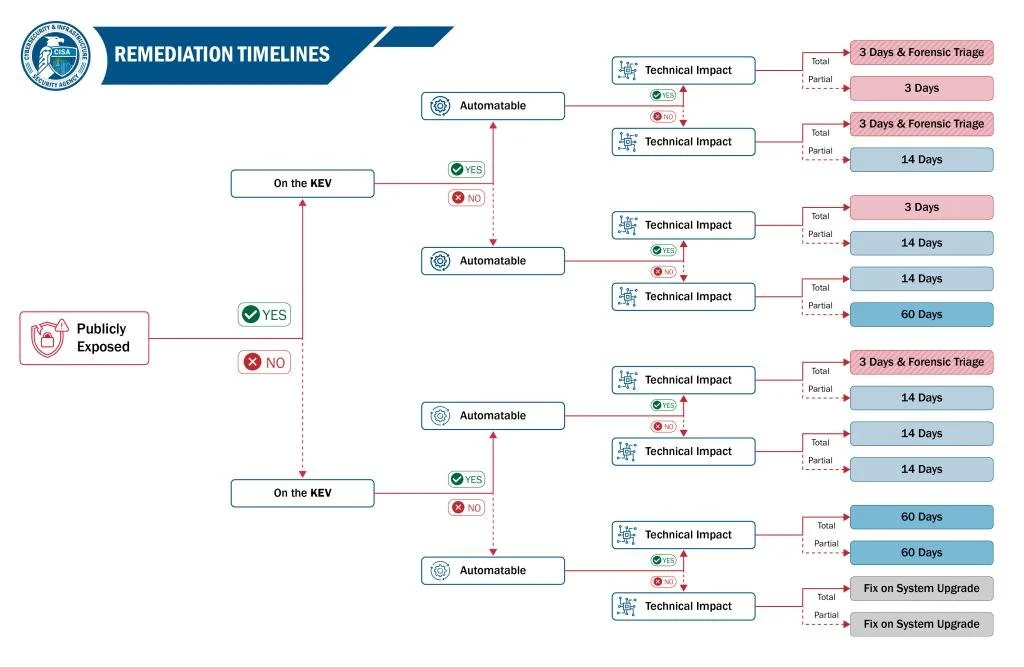
Image Source: CISA.gov
The Bottom Line
Hackers are using automation and artificial intelligence to find cracks in the armor faster than ever before. By consolidating old rules and introducing this dynamic, risk-focused approach, CISA is ensuring the government stops wasting time fixing minor issues and starts aggressively fortifying the gates against real, active threats.