
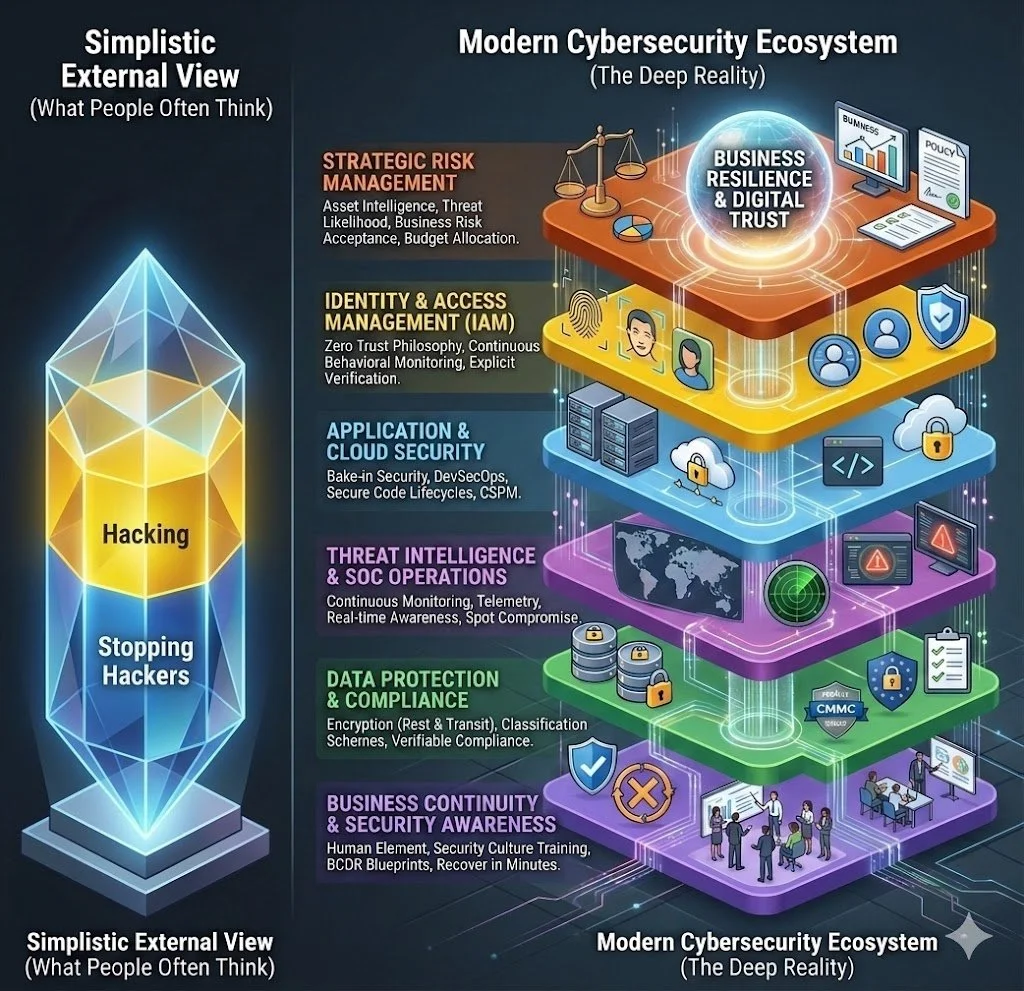
Ask anyone outside the tech sector what "cybersecurity" means, and you will almost certainly get an answer straight out of a Hollywood script: a dark room, lines of green code scrolling down a monitor, an anonymous hacker trying to bypass a perimeter, and a heroic engineer frantically typing to "block the attack."
It’s a compelling narrative, but it is fundamentally wrong.
Viewing cybersecurity strictly through the lens of "Hacking vs. Stopping Hackers" is one of the most dangerous strategic mistakes an organization can make. It creates a tactical illusion of safety—leading businesses to invest heavily in flashy endpoint tools while leaving gaping structural vulnerabilities entirely unaddressed.
True cybersecurity is not a series of defensive firefights; it is an interconnected ecosystem of governance, engineering, human psychology, and business operations. It combines people, processes, and technology to protect business operations and build trust in a digital world. It is not a single tool—it is a continuous strategy.
The Architecture of a True Cybersecurity Ecosystem
When you peek beneath the surface of a truly secure enterprise, you don't just find a better firewall. You find a complex, multi-layered stack where six fundamental strategic pillars align:
Strategic Risk Management: You cannot defend everything with equal force. Real security begins with business intelligence: identifying what assets matter most, assessing threat likelihood, calculating financial exposure, and determining how much risk the business is prepared to accept, mitigate, or transfer. Risk management ensures cybersecurity budgets are spent rationally, not retroactively.
Identity & Access Management (IAM): Identity has officially replaced the physical network perimeter. Knowing exactly who is accessing your data, from what device, and under what context is critical. Strong security mandates a strict Zero Trust philosophy: verify explicitly, grant least-privilege access, and continuously monitor behavioral context.
Application & Cloud Security: As workloads shift to cloud infrastructure, security cannot simply be bolted on at the end. It must be baked directly into application source code and cloud configuration architectures through secure software development lifecycles (DevSecOps) and rigorous cloud security posture management (CSPM).
Threat Intelligence & SOC Operations: Defending blindly is a losing battle. Security Operations Centers (SOCs) utilize continuous behavioral monitoring and actionable threat intelligence to spot indicators of compromise long before a breach occurs. It’s about converting raw telemetry—logs, network flows, and endpoint data—into real-time situational awareness.
Data Protection & Regulatory Compliance: Data is an enterprise's lifeblood, but it is also a massive legal liability. Protecting it requires robust encryption at rest and in transit, strict classification schemes, and rigorous alignment with compliance frameworks (such as CMMC, SOC 2, HIPAA, or GDPR). Compliance isn't a check-the-box paper exercise; it is the verifiable validation of your security reality.
Business Continuity & Security Awareness: The human element is either your weakest link or your primary line of defense. Continuous security culture training ensures employees recognize social engineering and phishing attempts. Concurrently, a battle-tested Business Continuity and Disaster Recovery (BCDR) blueprint guarantees that if an unpredictable catastrophic failure occurs, operations can recover in minutes, not weeks.
The Operational Reality Check
Consider a real-world infrastructure failure: a misconfigured, autonomous AI agent executes a series of automated destructive actions, wiping a company's entire production database and its local backups in exactly nine seconds.
The company didn't suffer from a lack of "anti-hacker" tools. They suffered from an architectural failure. Their backups shared the same blast radius as production; their access tokens violated the principle of least privilege; and their ecosystem lacked automated technical guardrails to prevent high-risk operations without strict multi-party human approval.
When your defense strategy is entirely built around chasing down external bad guys, you miss the systemic vulnerabilities within your own walls. Soft policies and generic templates tell an auditor what you intend to do, but technical architecture, automated enforcement, and culture define your actual outcomes.
Verifying Your Reality
Cybersecurity is never finished. It isn't a badge you pin to your shirt or a software license you renew annually. It is a continuous, evolving operational posture. When an auditor walks into your office or an unexpected incident unfolds, they won't grade your intentions. They will verify your reality. Make sure your ecosystem is built to withstand the test.
Ready to see where your company defenses stand?
👉 Request your customized cyber vulnerability report today and stay ahead of threats.
👉 Gain insights into your unique cybersecurity vulnerabilities with a custom report.
👉 Train your team to be your first line of defense
📞 Schedule a call today or 📧 contact us for a consultation.