
If you ask an executive outside of the technology department what keeps a Chief Information Security Officer (CISO) awake at night, they will likely guess a few predictable answers:
The latest zero-day vulnerability making headlines.
The pressure of a strict, newly introduced compliance audit.
Finding the budget for a shiny, next-generation security tool.
But if you sit down and talk to actual cybersecurity professionals on the ground today, you’ll quickly realize those aren’t the true sources of anxiety.
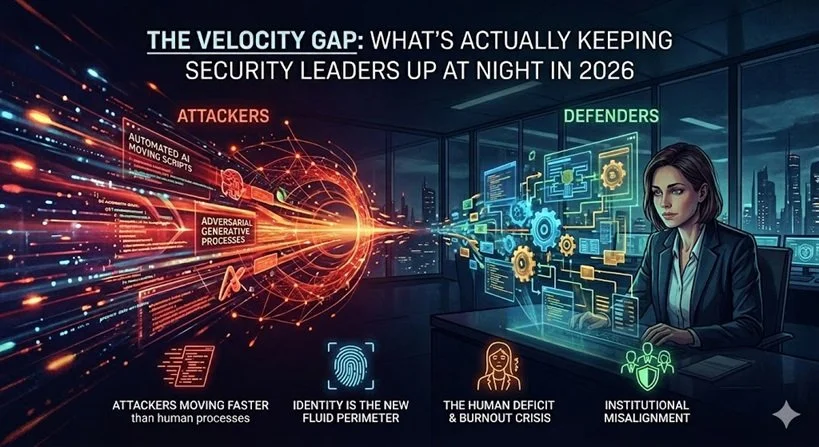
The biggest threat to modern businesses isn't a specific piece of malware. It’s a systemic vulnerability that no single software tool can patch: the widening velocity gap between attackers and defenders.
The Reality of 2026: The Hard Facts
The modern threat landscape has shifted from localized, human-driven attacks to highly automated, decentralized campaigns. The data paints a stark picture of what security teams are up against:
The Damage Is Staggering: Global cybercrime damages are projected to cross a breathtaking $10.5 trillion, transforming malicious hacking into one of the largest economies in the world.
The Playing Field Has Changed: Generative AI is empowering both sides. While defenders use AI to detect anomalies and automate responses, attackers are scaling their operations exponentially—cloning voices, bypassing authentication filters, and altering code signatures in real-time.
Time Is Not on Our Side: According to industry reports, the average time required to identify and contain a single data breach is hovering around 277 days. When attackers break through in minutes, a nine-month remediation loop is a catastrophic lag.
The Cost of Failure is High: The average cost of a enterprise data breach has climbed past $4.88 million, factoring in regulatory penalties, direct remediation, and long-term reputational damage.
The Real Four Pillars of Anxiety
When we look closely at why cybersecurity feels like an uphill battle right now, it boils down to four distinct structural challenges:
1. Attackers Are Moving Faster Than Human Processes
The primary asymmetric advantage of modern threat actors is speed. AI can generate thousands of uniquely tailored phishing emails in seconds, run rapid reconnaissance on vulnerable cloud misconfigurations, and execute attacks before a human engineering team can even schedule an emergency alignment call. We aren’t just fighting clever individuals anymore; we are fighting automated code.
2. Identity Is the New Fluid Perimeter
For decades, cybersecurity was built on a castle-and-moat mentality: secure the internal network, and you secure the data. But today, the network perimeter is practically non-existent. Attackers don't break in; they log in. Through stolen credentials, sophisticated social engineering, and Multi-Factor Authentication (MFA) fatigue campaigns, human identity has become the single most targeted, vulnerable point of failure.
3. The Human Deficit and Burnout Crisis
Security operations centers (SOCs) are facing a dual crisis: a massive industry-wide talent shortage of over 3.4 million professionals, combined with an intense burnout epidemic among existing staff. When smaller teams are buried under an unending avalanche of daily alerts, operational fatigue sets in. A tired, overwhelmed team inevitably misses subtle, sophisticated indicators of compromise.
4. The Institutional Misalignment
Perhaps the most persistent hurdle isn’t technological, but cultural. Far too many corporate leadership boards still view cybersecurity strictly through the lens of a cost center—a necessary insurance expense—rather than an essential business enabler. When security teams are constantly asked to "do more with less" while handling expanding third-party supply chain risks, systemic gaps are bound to form.
Moving Beyond the Fire Drill
Surviving the threat environment of 2026 requires moving away from reactive, fire-drill mentalities. We cannot protect modern organizations by simply buying more tools or demanding that exhausted engineers work longer hours.
It requires a fundamental rewiring of how leadership supports security: building resilience directly into the corporate infrastructure, automating low-level security responses to protect human capital from alert fatigue, and establishing airtight identity verification frameworks.
Question for the Community
The technology challenges we face are incredibly complex, but the people, process, and governance challenges are proving to be even harder.
If you could wave a magic wand and permanently eliminate ONE core cybersecurity problem for your organization tomorrow, what would it be?
Would you erase phishing entirely?
Would you solve the human talent and burnout crisis?
Or would you bridge the gap between technical security and board-level understanding?
Let’s start a conversation in the comments below.
Ready to see where your company defenses stand?
👉 Request your customized cyber vulnerability report today and stay ahead of threats.
👉 Gain insights into your unique cybersecurity vulnerabilities with a custom report.
👉 Train your team to be your first line of defense
📞 Schedule a call today or 📧 contact us for a consultation.