
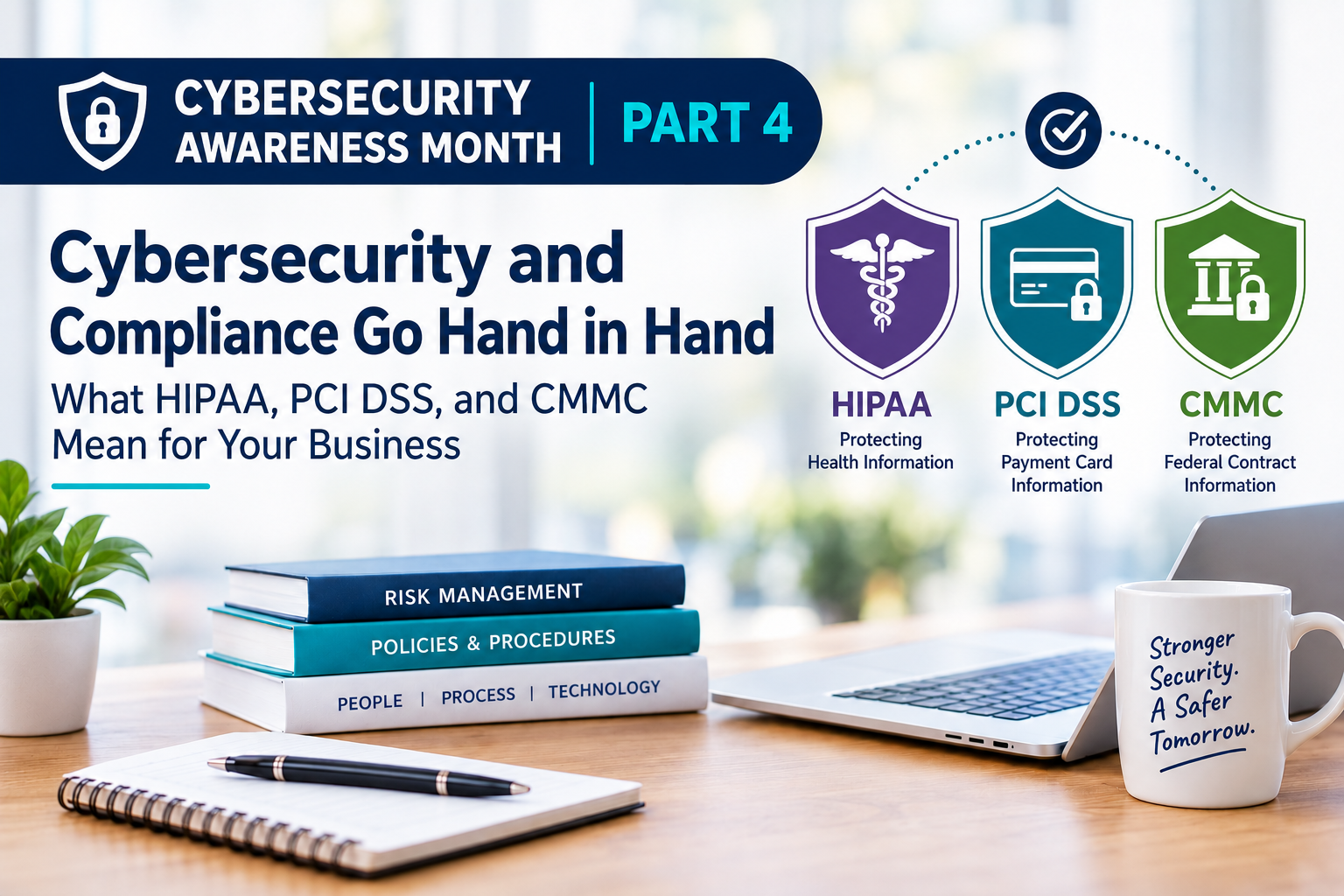
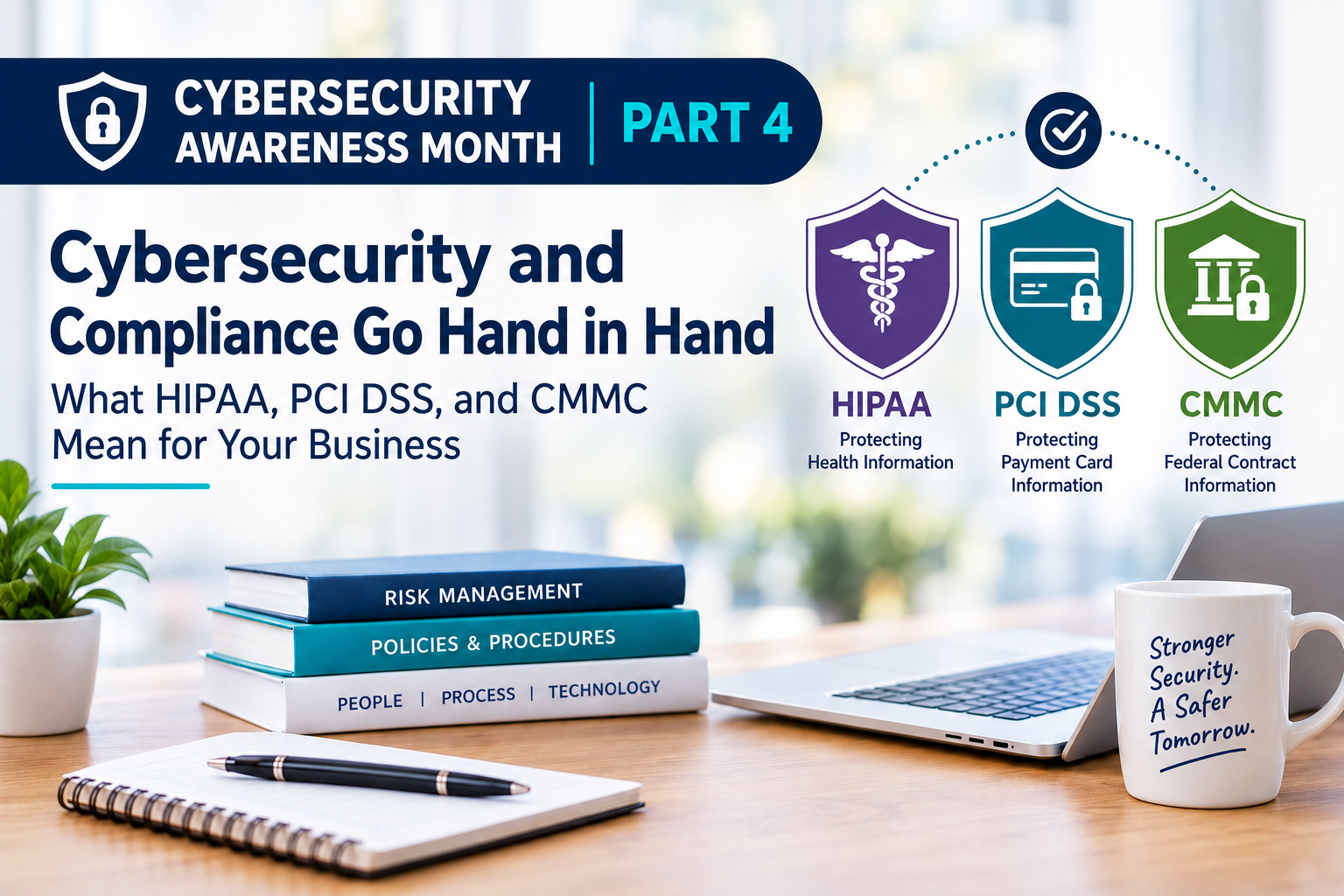
URS Cybersecurity Awareness Month: Part 4
Cybersecurity and Compliance Go Hand in Hand
Cybersecurity is not only about protecting systems from hackers.
For many organizations, it is also about meeting regulatory, contractual, and industry-specific requirements.
Businesses may be required to demonstrate that they have implemented appropriate safeguards to protect sensitive information.
These requirements can vary depending on the organization's industry, the type of information it handles, and the contracts it holds.
Healthcare organizations may be subject to HIPAA.
Businesses that handle payment card information may have PCI DSS responsibilities.
Federal contractors handling certain government information may be subject to CMMC requirements.
Understanding which requirements apply is an important step toward developing an effective cybersecurity and compliance program.
1. HIPAA: Protecting Electronic Health Information
The Health Insurance Portability and Accountability Act (HIPAA) Security Rule establishes standards for protecting electronic protected health information (ePHI).
The Security Rule requires covered entities and business associates to implement appropriate administrative, physical, and technical safeguards to protect the confidentiality, integrity, and availability of ePHI.
What Should Healthcare Organizations Consider?
Risk Analysis
Identify potential risks and vulnerabilities affecting electronic protected health information.
Access Controls
Limit access to sensitive information based on job responsibilities.
Security Awareness Training
Educate employees about phishing, data handling, and security responsibilities.
Policies and Procedures
Document how the organization protects information and responds to incidents.
Incident Response
Establish procedures for identifying, reporting, and responding to security incidents.
Documentation
Maintain evidence of applicable safeguards, risk assessments, training, and security activities.
HHS emphasizes that risk analysis is foundational to HIPAA Security Rule compliance and should be an ongoing process.
2. PCI DSS: Protecting Payment Card Information
The Payment Card Industry Data Security Standard (PCI DSS) provides a baseline of technical and operational requirements designed to protect payment account data.
PCI DSS applies to entities that store, process, or transmit cardholder data or sensitive authentication data, as well as certain entities that can affect the security of the cardholder data environment.
What Should Businesses Consider?
Understanding where payment card information is stored and processed.
Limiting access to cardholder data.
Maintaining appropriate network security controls.
Protecting systems against malware and vulnerabilities.
Monitoring security events.
Maintaining applicable policies and procedures.
Providing employee security awareness training.
Reviewing third-party service provider responsibilities.
Businesses should avoid unnecessarily storing payment card information in email, spreadsheets, shared folders, or other systems that may not be appropriately protected.
Why Documentation Matters
Organizations may need to demonstrate that applicable controls are in place and operating as intended.
Security policies, training records, vulnerability assessment results, access reviews, and incident response documentation can help support compliance activities.
The applicable validation requirements depend on the organization's payment environment and obligations.
3. CMMC: Cybersecurity Requirements for Federal Contractors
The Cybersecurity Maturity Model Certification (CMMC) program is designed to help protect sensitive information within the Defense Industrial Base.
CMMC requirements depend on the type of information handled and the applicable contract requirements.
CMMC Level 1 addresses basic safeguarding requirements aligned with FAR 52.204-21.
CMMC Level 2 incorporates 110 security requirements aligned with NIST SP 800-171 Revision 2.
CMMC Level 3 includes additional requirements aligned with NIST SP 800-172.
What Should Contractors Understand?
Organizations should determine:
Whether they handle Federal Contract Information (FCI).
Whether they handle Controlled Unclassified Information (CUI).
Which CMMC level applies to their contracts.
Which systems are within the relevant assessment scope.
What security controls must be implemented.
What documentation is needed to support assessments.
Which responsibilities belong to the contractor and its service providers.
CMMC is not simply a checklist to complete before an assessment.
It requires organizations to understand their information, systems, responsibilities, and applicable security requirements.
4. Compliance Is More Than Having Policies
One common misconception is that having cybersecurity policies automatically means an organization is compliant.
Policies are important, but they must be supported by appropriate safeguards and actual business practices.
For example:
A company may have a written access control policy, but if former employees still have access to business systems, the policy may not be operating effectively.
A company may have a security awareness training policy, but if employees have not completed training, the organization may lack evidence that the process is being followed.
A company may have a vulnerability management policy, but if identified vulnerabilities are never addressed, the organization may continue to face unnecessary risk.
Compliance requires more than documentation. It requires appropriate controls, implementation, accountability, and evidence.
5. The Importance of Compliance Documentation
Documentation helps organizations demonstrate how they manage cybersecurity risks and meet applicable requirements.
Examples may include:
Risk assessments.
Security policies and procedures.
Employee training records.
Vulnerability assessment reports.
Incident response plans.
Access reviews.
Vendor risk assessments.
Corrective action tracking.
Security monitoring records.
Documentation should reflect the organization's actual security practices.
It should also be reviewed and updated when business operations, systems, or requirements change.
How URS Helps Businesses Navigate Cybersecurity Compliance
Ultimate Risk Services helps organizations understand their cybersecurity risks and develop a structured approach to compliance.
URS can support organizations through:
Risk Identification
External and internal vulnerability assessments and mini penetration testing.
Risk Prioritization
Recommendations for addressing identified security weaknesses.
Policies and Procedures
Customized cybersecurity documentation aligned with business operations and applicable requirements.
Security Awareness Training
Employee education and training documentation.
Compliance Support
Assistance understanding relevant frameworks, maintaining documentation, and preparing for compliance activities.
Ongoing Exposure Monitoring
Optional monitoring services to help organizations maintain visibility into their cybersecurity exposure.
URS does not perform technical remediation. The organization's internal IT team or MSP implements the recommended technical changes.
Our role is to help businesses understand their risks, strengthen their compliance processes, and maintain a clearer path toward cybersecurity readiness.
Final Thoughts
Cybersecurity compliance is not just about passing an assessment.
It is about protecting sensitive information, managing business risks, and establishing practices that support long-term security.
Whether your organization is subject to HIPAA, PCI DSS, CMMC, or another framework, understanding your responsibilities is an important first step.
Identify your risks. Understand your requirements. Implement appropriate safeguards. Maintain documentation. Review your practices regularly.
Compliance should support cybersecurity—not become a paperwork exercise.
Stay tuned for Part 5: From Cybersecurity Awareness to Action — Building a Stronger and More Resilient Business.
Ready to see where your company defenses stand?
👉 Request your customized cyber vulnerability report today and stay ahead of threats.
👉 Gain insights into your unique cybersecurity vulnerabilities with a custom report.
👉 Train your team to be your first line of defense
📞 Schedule a call today or 📧 contact us for a consultation.