
The Human Factor in Cybersecurity: How Small Businesses Can Reduce Insider Threats and Compliance Risks
Why employee awareness, documented policies, and effective internal controls are essential to protecting business data.
Cybersecurity incidents do not always begin with sophisticated hackers breaking through advanced security systems. Sometimes, they start with an employee clicking a fraudulent email link, sharing sensitive information with the wrong person, reusing a compromised password, or downloading unauthorized software.
For small businesses, these seemingly minor actions can lead to significant consequences, including data breaches, operational disruptions, financial losses, and regulatory compliance issues.
Employees are not necessarily the enemy. In many cases, they are the first line of defense against cyber threats. The challenge is ensuring they understand their responsibilities, recognize potential risks, and follow established security procedures.
From a cybersecurity compliance perspective, protecting an organization requires more than installing antivirus software or deploying firewalls. It requires a documented, repeatable approach to managing human-related security risks.
According to the National Institute of Standards and Technology (NIST), an effective cybersecurity learning program should encourage secure behavior, evolve as risks change, and help establish a strong security culture.
NIST
+1
Why Employee Behavior Is a Cybersecurity Compliance Issue
Consider a few common workplace scenarios:
An employee clicks a phishing link and unknowingly provides login credentials to an attacker.
A staff member sends confidential customer information to the wrong recipient.
An employee installs an unapproved browser extension that requests access to sensitive information.
A former employee retains access to business systems after leaving the organization.
A team member shares a password or bypasses an established security procedure to save time.
Each situation creates a potential security risk. Depending on the information involved, the systems affected, and the applicable requirements, it may also create a compliance concern.
For example, organizations handling payment card information, protected health information, or Controlled Unclassified Information (CUI) may have specific security obligations under PCI DSS, HIPAA, or CMMC-related requirements.
The compliance question is not simply whether employees make mistakes. It is whether the organization has implemented appropriate safeguards, provided necessary training, established clear policies, and maintained evidence that its controls are operating as intended.
Compliance takeaway: A written policy alone is not enough. Organizations need to demonstrate that security expectations are communicated, employees are trained, and controls are consistently followed.
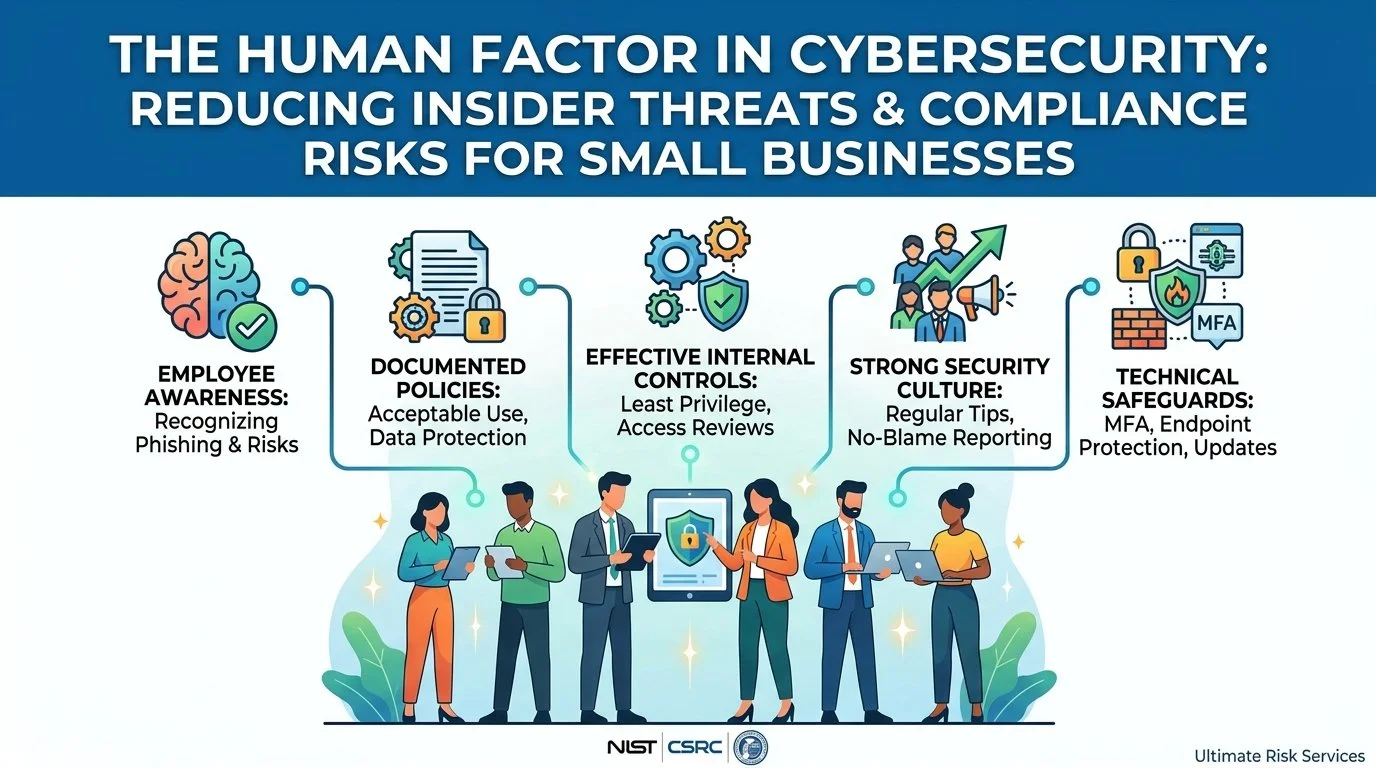
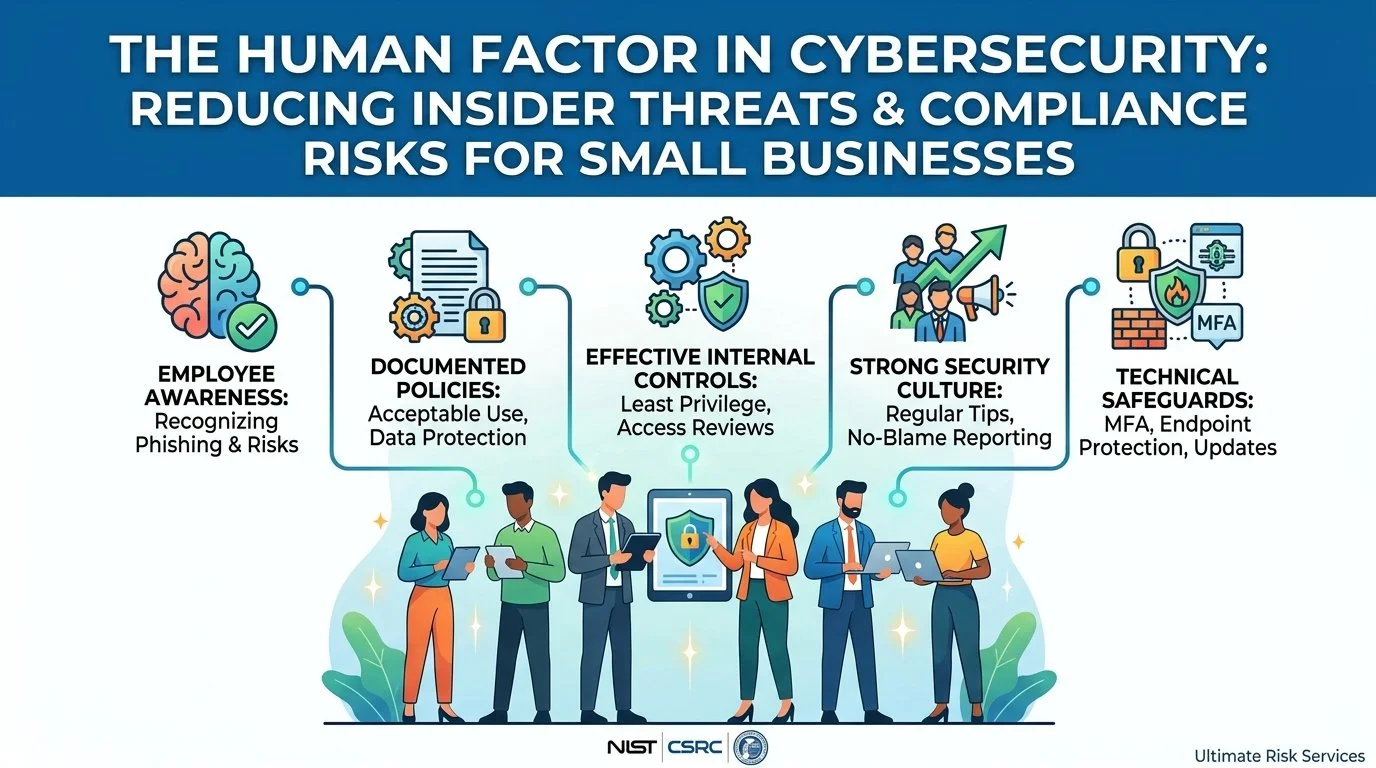
5 Ways to Reduce Employee-Related Cybersecurity Risks
1. Establish a Documented Cybersecurity Awareness Training Program
One-time training during employee onboarding is not enough to address changing cyber threats.
Employees need ongoing guidance on recognizing phishing emails, identifying suspicious links, protecting passwords, using multifactor authentication (MFA), handling sensitive information, and reporting potential security incidents.
Training should reflect the organization's actual risks. For example, finance teams may need additional guidance on fraudulent payment requests, while employees handling customer health information need to understand appropriate data-handling procedures.
From a compliance standpoint, organizations should:
Provide cybersecurity training during onboarding and at defined intervals afterward.
Update training when relevant threats, technologies, or business processes change.
Include instruction on recognizing and reporting social engineering and potential insider threats.
Maintain records of completed training, participation, and follow-up activities.
Evaluate whether training is improving employee awareness and behavior.
NIST SP 800-50 Rev. 1 provides guidance for building and continually improving cybersecurity and privacy learning programs. For organizations subject to CMMC requirements, NIST SP 800-171 also addresses security awareness, training, and insider-threat awareness.
CSRC
+1
Compliance benefit: Documented training helps demonstrate that the organization has established and implemented an awareness program aligned with its applicable security requirements.
2. Make Cybersecurity Awareness Part of Everyday Operations
Cybersecurity should not be discussed only during annual training or after an incident occurs.
Small businesses can reinforce secure practices through short, regular communications that fit naturally into existing workflows.
Consider sharing a brief weekly cybersecurity tip, discussing a recent phishing technique during team meetings, or reminding employees how to verify unexpected requests for payments or confidential information.
Useful topics include:
Recognizing phishing emails and fraudulent login pages.
Verifying requests to change vendor banking information.
Reporting unexpected MFA approval requests.
Protecting customer and employee information.
Using approved tools when handling sensitive business data.
Identifying suspicious activity and reporting it promptly.
Training should also evolve when employees encounter new risks, including AI-generated phishing messages, voice impersonation, and fraudulent requests that appear to come from company leadership.
The goal is to build a workplace culture where secure behavior becomes routine rather than an occasional reminder.
Compliance benefit: Regular awareness activities help reinforce documented security procedures and support a more consistent approach to risk management.
3. Develop and Enforce Clear Cybersecurity Policies
Employees cannot consistently follow security expectations that have never been clearly communicated.
Organizations should establish written policies that explain what employees are permitted to do, what they must avoid, and how they should respond when something appears suspicious.
Depending on the organization's size, operations, and compliance obligations, important policies may include:
Acceptable Use Policy (AUP): Defines appropriate use of company systems, internet access, email, and approved applications.
Access Control Policy: Establishes who may access specific systems and information based on business responsibilities.
Data Protection Policy: Explains how sensitive information must be stored, transmitted, shared, and disposed of.
Incident Response Policy: Defines how employees should report suspected security incidents and who is responsible for responding.
Bring Your Own Device (BYOD) Policy: Sets requirements for personal devices used to access business systems.
Software Installation Policy: Restricts unauthorized applications, browser extensions, and other unapproved software.
Policies should be appropriate to the organization's risk profile and applicable requirements. They should also be communicated to employees, reviewed periodically, and updated when business needs or risks change.
A policy that exists only in a folder but is never communicated or enforced provides limited practical protection.
Compliance benefit: Written and implemented policies help establish accountability, clarify responsibilities, and provide documentation for audits and assessments.
4. Establish Safe Reporting Procedures and a No-Blame Reporting Culture
Employees sometimes recognize a mistake but hesitate to report it because they fear disciplinary action or embarrassment.
That delay can make a security incident more difficult to contain.
For example, an employee who clicks a suspicious link and immediately reports it gives the organization an opportunity to investigate, reset compromised credentials, review system activity, and take other appropriate steps.
If the employee waits several hours or days, an attacker may have more time to misuse the compromised account.
Organizations should make reporting simple and accessible. Employees should know:
Whom to contact when they receive a suspicious email.
How to report an accidental disclosure of sensitive information.
What to do if they approve an unexpected MFA request.
How to report a lost device or suspected account compromise.
Which channel to use when an incident occurs outside normal business hours.
Businesses should establish a documented escalation process so reports reach the appropriate personnel quickly.
A supportive reporting culture does not eliminate accountability for deliberate misconduct. Instead, it encourages employees to report mistakes and suspicious activity before the impact becomes more serious.
CISA's insider-threat resources emphasize training, reporting channels, and an organizational approach to identifying and managing insider risks.
CISA
+1
Compliance benefit: Timely reporting supports incident response, helps preserve relevant evidence, and enables the organization to follow its established response and notification procedures.
5. Strengthen Technical Controls Alongside Employee Training
Training is essential, but it cannot eliminate every mistake or prevent every malicious action.
Effective cybersecurity requires a combination of employee awareness, documented processes, and technical safeguards.
Small businesses should consider implementing controls such as:
Multifactor authentication: Adds another layer of protection to accounts, particularly email, remote access, and administrative accounts.
Least-privilege access: Limits employee access to the information and systems required for their job.
Network segmentation: Helps separate guest devices and less-trusted systems from sensitive business resources.
Email security and phishing protection: Helps identify or block suspicious messages and malicious links.
Endpoint protection and software updates: Reduce exposure to known threats and vulnerable applications.
Access reviews: Help identify unnecessary permissions and accounts that should be removed or adjusted.
Logging and monitoring: Help identify suspicious activity and support investigations.
Formal onboarding and offboarding procedures: Ensure access is granted appropriately and revoked promptly when employment or responsibilities change.
These controls should be selected based on the organization's risks, operational needs, and applicable compliance requirements.
For example, businesses handling CUI may need to assess relevant NIST SP 800-171 requirements, while organizations processing payment card data or handling protected health information must evaluate the safeguards applicable to their respective obligations.
Compliance benefit: Technical safeguards reduce reliance on employees making the right decision every time and provide additional layers of protection when human errors occur.
How Does Employee Cybersecurity Training Support Compliance?
Employee awareness is not just an IT concern. It can be an important part of demonstrating that a business has implemented its cybersecurity program.
The specific obligations depend on the applicable framework, contract, and type of data being protected.
Framework
Employee-related compliance considerations
CMMC / NIST SP 800-171
Security awareness, training, and recognition and reporting of potential insider threats, as applicable to the assessment requirements.
HIPAA
Workforce security awareness and training obligations, along with applicable administrative, physical, and technical safeguards.
PCI DSS
Security awareness and training requirements applicable to personnel, alongside other required security controls.
NIST Cybersecurity Framework
Workforce awareness and cybersecurity risk management as part of the organization's broader cybersecurity program.
These frameworks are not interchangeable, and the precise requirements depend on the organization's circumstances. Completing awareness training alone does not establish compliance with any of them.
For organizations subject to formal assessments, the ability to produce relevant evidence is important. Useful records may include training materials, attendance or completion records, approved policies, access reviews, incident reports, and documented corrective actions.
What Small Businesses Should Document
To make an employee cybersecurity program more defensible during an audit, assessment, or customer review, organizations should consider maintaining the following evidence:
An approved cybersecurity awareness and training policy.
Training schedules and records of employee completion.
Relevant cybersecurity policies and employee acknowledgments.
Documented procedures for reporting suspicious activity.
Access authorization and periodic access-review records.
Incident response procedures and records of exercises or actual incidents, as appropriate.
Corrective actions addressing identified gaps or recurring training issues.
The objective is not to generate paperwork for its own sake. Documentation should demonstrate that the organization has defined its expectations, implemented its controls, evaluated their effectiveness, and addressed identified weaknesses.
Final Thoughts: Build a Security Culture, Not Just a Training Checklist
Your employees can be a source of cybersecurity risk, but they can also be one of your organization's strongest defenses.
The difference often comes down to preparation, clear expectations, effective technical controls, and a workplace culture that encourages employees to recognize and report potential threats.
For small businesses, the practical starting point is straightforward: train employees regularly, establish and enforce appropriate policies, limit access to sensitive information, encourage prompt reporting, and retain evidence that your cybersecurity program is working.
Cybersecurity compliance is not just about having policies on paper. It is about putting those policies into practice and being able to demonstrate that your organization is managing risk.
At Ultimate Risk Services, a structured cybersecurity compliance program can help businesses identify gaps, strengthen policies and procedures, organize compliance documentation, and improve visibility into their cybersecurity risks.
The goal is to make compliance practical, measurable, and aligned with your business needs.
Ready to see where your company defenses stand?
👉 Request your customized cyber vulnerability report today and stay ahead of threats.
👉 Gain insights into your unique cybersecurity vulnerabilities with a custom report.
👉 Train your team to be your first line of defense
📞 Schedule a call today or 📧 contact us for a consultation.