
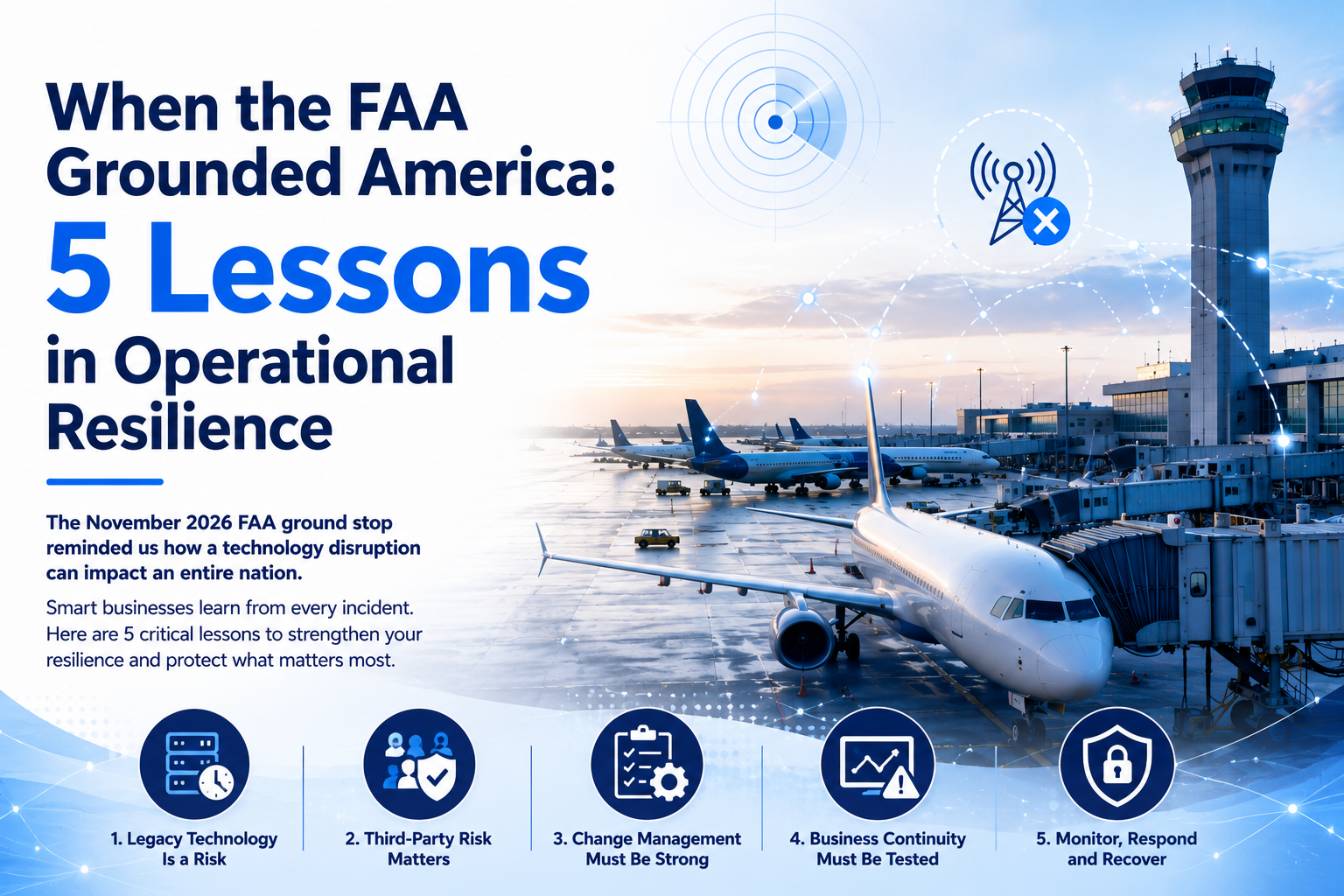
When Critical Systems Fail, Business Continuity Is Put to the Test
On November 13, 2026, travelers across the United States experienced an unusual disruption. The Federal Aviation Administration (FAA) issued a nationwide ground stop after technical problems affected communications and radar systems used by air traffic controllers.
Thousands of flights were delayed, canceled, or diverted. Airports experienced significant disruption, airlines struggled to restore schedules, and travelers were left waiting for updates.
The FAA lifted the nationwide ground stop at approximately 8:15 p.m. Eastern Time, after more than four hours. However, the impact continued as airlines worked to restore normal operations.
According to the FAA, approximately 3,500 aircraft safely landed during the disruption. The agency also reported that approximately 12,462 flights were canceled on Friday, although not all cancellations were directly attributable to the ground stop.
But what actually happened?
And more importantly, what can businesses learn from an incident involving one of the country's most critical transportation systems?
At Ultimate Risk Services (URS), we believe this event highlights an important reality: Cybersecurity is not just about preventing cyberattacks. It is also about managing technology risks, maintaining operational resilience, and preparing for unexpected disruptions.
What Happened During the November 2026 FAA Ground Stop?
Initial FAA and Department of Transportation updates identified a telecommunications problem that affected the stability of communications and radar systems supporting air traffic control.
The FAA's subsequent investigation update described instability involving legacy telecommunications equipment. Data flooding the FAA telecommunications network created inconsistencies that affected system communications and radar feeds.
According to the FAA, the network experienced approximately 1,000 connection attempts every four to five seconds.
The initial investigation identified two potential locations associated with the excessive data activity: a radar site in Amarillo, Texas, and a radio communications site in El Dorado, Arkansas.
The issue occurred while the FAA's network service provider, L3Harris, was performing work that included deploying a new router at the El Dorado location.
The FAA and its service provider isolated the affected locations, disabled certain router functionality, and took additional precautionary measures before allowing operations to resume.
Was it a cyberattack?
Based on the FAA's published findings, there was no indication that the incident was caused by a cyberattack or an outside malicious actor.
This distinction matters. Not every major technology disruption is a cybersecurity breach. Equipment instability, configuration problems, maintenance activities, and third-party technology failures can create serious operational risks even without a malicious attacker.
The incident demonstrates why organizations must prepare for both cyber threats and non-cyber technology failures.
5 Critical Lessons Every Business Should Learn
1. Legacy Technology Can Become a Major Business Risk
Many organizations continue to depend on aging infrastructure, outdated applications, unsupported operating systems, and legacy network equipment.
These systems may have supported business operations for years, but age and familiarity do not guarantee reliability or security.
The FAA incident illustrates how instability involving legacy infrastructure can affect interconnected systems and disrupt operations on a much larger scale.
What businesses should do:
Maintain an inventory of hardware, software, network devices, and critical systems.
Identify unsupported or end-of-life technology.
Evaluate technology risks based on business impact.
Establish a prioritized modernization and replacement plan.
Test new infrastructure before introducing it into production environments.
Technology modernization should be treated as a risk management priority, not simply an IT improvement project.
2. Third-Party Vendors Can Introduce Significant Operational Risk
The FAA incident also highlights the importance of third-party risk management.
Organizations increasingly depend on external providers for cloud hosting, telecommunications, managed IT services, cybersecurity monitoring, software development, and network infrastructure.
A vendor's maintenance activity, configuration change, or equipment failure can affect the organization relying on its services.
Even when a company has strong internal security controls, it may still experience disruptions caused by a service provider.
What businesses should do:
Maintain an updated inventory of critical vendors and service providers.
Conduct risk assessments before onboarding third parties.
Evaluate vendor security controls and operational reliability.
Require documented change management and maintenance procedures.
Establish incident notification and escalation requirements.
Review vendor access and privileges regularly.
Remember: Outsourcing a technology service does not mean outsourcing responsibility for managing its risk.
3. Change Management Must Include Risk Assessment and Testing
Technology changes are necessary. Organizations must upgrade equipment, replace outdated systems, install security patches, and introduce new configurations.
However, even routine changes can create unexpected problems when dependencies are not fully understood.
The FAA incident reinforces the importance of carefully managing changes to critical infrastructure.
Before implementing changes, organizations should understand what systems depend on the affected technology and what could happen if something goes wrong.
What businesses should do:
Require formal approval for significant technology changes.
Perform risk and impact assessments before implementation.
Test changes in controlled environments whenever possible.
Maintain documented rollback and recovery procedures.
Schedule maintenance with operational impact in mind.
Monitor systems closely after changes are deployed.
A successful technology change is not simply one that gets installed. It is one that works without creating unacceptable risks to business operations.
4. Business Continuity and Disaster Recovery Must Be Tested
The FAA's response demonstrates why organizations need established procedures for operating during technology disruptions.
When critical systems become unstable, businesses need to know how to respond, communicate, recover, and maintain essential services.
Having a Business Continuity Plan (BCP) or Disaster Recovery Plan (DRP) documented is not enough. Employees must understand their responsibilities, and recovery procedures must be tested.
What businesses should do:
Identify critical business processes and supporting technology.
Establish Recovery Time Objectives (RTOs) and Recovery Point Objectives (RPOs).
Maintain reliable backups and recovery capabilities.
Identify alternative communication channels.
Develop procedures for operating during system outages.
Conduct tabletop exercises and disaster recovery tests.
Review and update plans following significant incidents.
Business continuity is about ensuring that an organization can continue delivering essential services even when its technology does not perform as expected.
5. Operational Resilience Requires Continuous Monitoring and Accountability
One of the biggest lessons from the FAA incident is that interconnected systems require continuous monitoring and clear accountability.
Organizations cannot assume that systems are functioning properly simply because they were working yesterday.
They need visibility into their infrastructure, clear escalation procedures, and defined responsibilities for identifying and addressing technology risks.
What businesses should do:
Implement continuous monitoring of critical infrastructure.
Establish procedures for detecting unusual network activity.
Define incident response responsibilities.
Maintain clear communication between IT, security, management, and vendors.
Track identified risks through remediation.
Conduct periodic assessments to evaluate whether controls remain effective.
Operational resilience is not a one-time project. It requires ongoing oversight, testing, and improvement.
How the FAA Incident Connects to the NIST Cybersecurity Framework 2.0
The lessons from this incident align with the six functions of the NIST Cybersecurity Framework (CSF) 2.0.
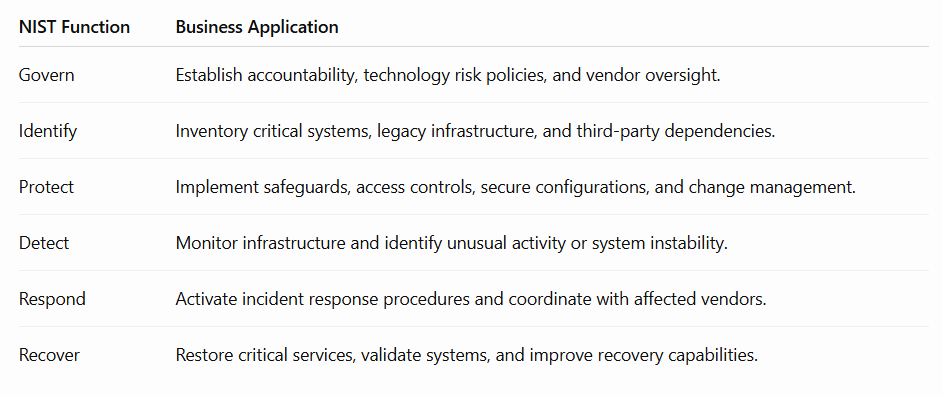
The framework provides organizations with a structured approach to managing cybersecurity risks while strengthening their overall operational resilience.
Why This Matters to Small and Mid-Sized Businesses
Large organizations are not the only ones exposed to technology disruptions.
Small and mid-sized businesses often depend on a limited number of IT providers, cloud platforms, internet service providers, and business applications.
If one of these services becomes unavailable, the impact can affect:
Customer communications and service delivery.
Financial transactions and payment processing.
Employee productivity and daily operations.
Access to critical business information.
Regulatory and contractual obligations.
Customer confidence and business reputation.
A disruption does not need to involve ransomware or stolen data to become a serious business problem.
Sometimes, one failed system or an unexpected vendor change is enough to interrupt operations.
The URS Recommendation: Assess. Prepare. Monitor. Recover.
The November 2026 FAA ground stop is a reminder that technology reliability and business resilience must go hand in hand.
Organizations should not wait for a major outage to discover that their infrastructure has weaknesses, their vendors have inadequate safeguards, or their recovery plans have never been tested.
At Ultimate Risk Services (URS), we encourage businesses to take a proactive approach to cybersecurity risk management and operational resilience.
Start with these four actions:
Assess: Identify technology vulnerabilities, third-party dependencies, and operational risks.
Prepare: Establish incident response, business continuity, and disaster recovery plans.
Monitor: Continuously evaluate technology performance, security controls, and vendor risks.
Recover: Test recovery procedures and ensure critical business functions can resume following a disruption.
Remember: You don't have to experience a cyberattack to suffer a major technology disruption. Resilience starts before something goes wrong.
Is Your Business Prepared for an Unexpected Technology Disruption?
Ultimate Risk Services helps businesses strengthen cybersecurity risk management, governance, and compliance through practical assessments and security recommendations.
Whether your organization needs help identifying technology risks, evaluating security controls, preparing for compliance requirements, or improving operational resilience, taking action today can help prevent tomorrow's disruption.
Ready to see where your company defenses stand?
👉 Request your customized cyber vulnerability report today and stay ahead of threats.
👉 Gain insights into your unique cybersecurity vulnerabilities with a custom report.
👉 Train your team to be your first line of defense
📞 Schedule a call today or 📧 contact us for a consultation.